
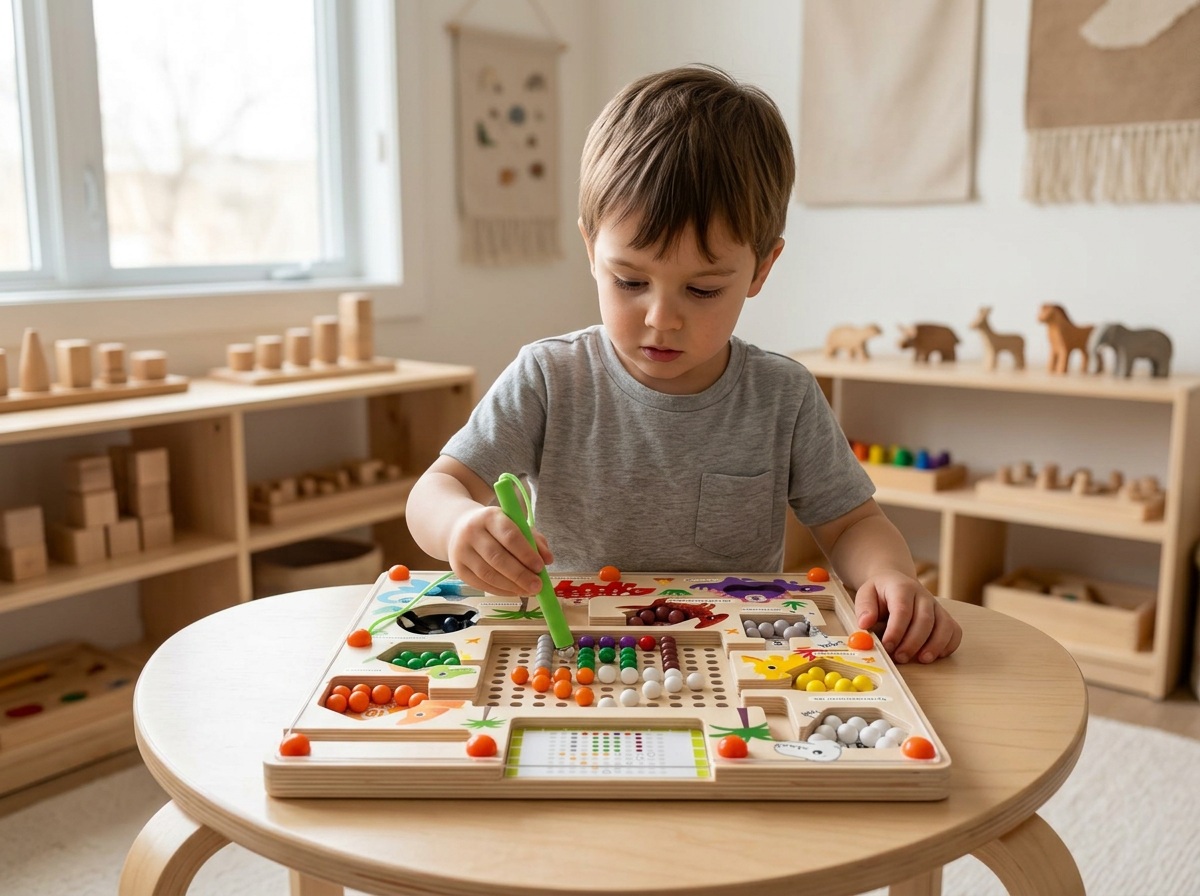
Choosing educational toys for preschoolers is no longer simply about finding products that keep children occupied. Parents, educators, retailers, and preschool buyers are increasingly looking for learning tools that encourage meaningful interaction while supporting early childhood development. Among today’s most popular educational products, Maze Toys continue to stand out because they combine hands-on exploration with age-appropriate challenges that help children learn through play.
Research in early childhood education consistently shows that preschool children develop more effectively when they actively manipulate objects, experiment with solutions, and receive immediate feedback from their actions. Rather than relying on passive observation, activities that involve movement and decision-making strengthen multiple developmental skills simultaneously. This is one of the key reasons why Maze Toys are widely used in preschool classrooms, Montessori-inspired environments, occupational therapy activities, and home learning spaces.
The growing popularity of screen-free learning has also contributed to the demand for educational maze toys. According to recommendations from child development specialists, preschool children benefit from regular opportunities to participate in hands-on play that encourages curiosity, concentration, and independent exploration. Educational toys that combine these elements are increasingly favored by schools and families seeking balanced learning experiences.
For distributors and educational brands, the market has expanded beyond traditional wooden bead mazes. Today’s product range includes wooden maze toys, magnetic maze toys, themed activity mazes, and Montessori-inspired designs that support different learning objectives while meeting the needs of classrooms, retailers, and private-label collections.
This guide examines how Maze Toys contribute to preschool development, compares different product types, explores the features professional buyers should evaluate, and explains why they continue to be a reliable category within the educational toy industry.
Why Maze Toys Improve Preschool Learning
Preschool learning is most effective when children participate actively instead of simply watching or listening. Maze Toys naturally encourage this type of engagement by presenting children with achievable challenges that require observation, planning, and repeated experimentation. Every successful movement through a maze reinforces the connection between thinking and action, allowing children to discover solutions independently rather than memorizing instructions.
Research published in early childhood education has found that manipulative learning activities can significantly improve fine motor coordination, visual perception, and sustained attention during the preschool years. Developmental specialists also note that children are more likely to remain engaged when educational tasks provide immediate visual feedback—a characteristic built into nearly every type of maze activity.
Unlike single-purpose toys, Maze Toys encourage several foundational abilities to develop at the same time. As children move beads or magnetic balls through different pathways, they naturally practice hand-eye coordination, strengthen finger muscles, improve spatial awareness, and develop simple problem-solving strategies. These combined learning experiences explain why educational maze toys continue to be recommended for both classroom learning materials and home-based early education.
One classroom observation frequently reported by preschool teachers is that children often choose to repeat maze activities even after reaching the correct solution. Each attempt becomes an opportunity to try a different route, improve speed, or correct previous mistakes. This willingness to revisit the same activity reflects intrinsic motivation, an important factor in long-term learning and independent exploration.
Research suggests that preschool children typically maintain focused attention for approximately 8–15 minutes during structured learning activities. Maze Toys fit naturally within this attention span because each challenge can usually be completed within a short, rewarding session.
Another reason Maze Toys remain highly valued is their flexibility. A simple wooden maze can introduce color recognition to younger preschoolers, while a more complex magnetic maze can help older children refine pencil grip and planning skills before they begin formal handwriting lessons. This adaptability allows educators to use the same category of toy across multiple developmental stages without changing the underlying learning approach.
Types of Maze Toys for Preschool Classrooms and Home Learning
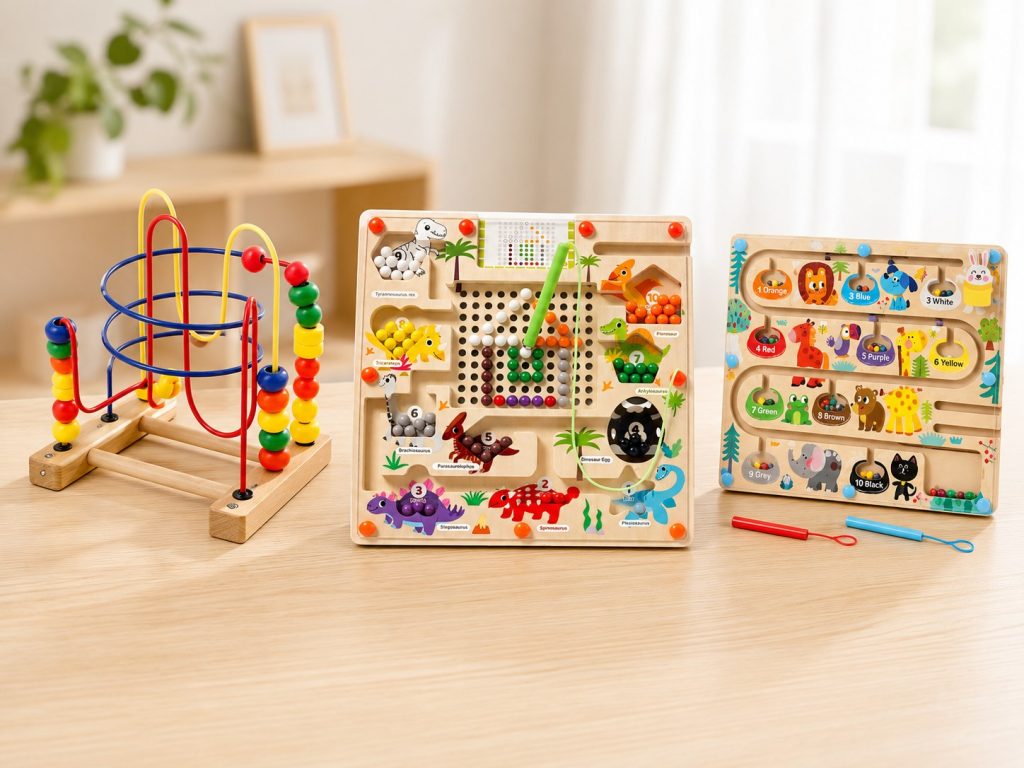
Although all Maze Toys share the same core concept, different designs support different learning outcomes. Understanding these differences helps parents, educational distributors, and preschool buyers select products that match children’s developmental needs while ensuring long-term educational value.
Wooden Maze Toys
Among all preschool educational toys, wooden maze toys remain one of the most established choices. Their simple construction, durable materials, and intuitive design make them particularly suitable for daily classroom use.
Most wooden bead mazes feature colorful beads that travel along fixed steel tracks mounted on a solid wooden base. Younger children quickly understand how their hand movements influence the beads, allowing them to build confidence while strengthening finger control and bilateral coordination.
Professional manufacturers typically design classroom-grade wooden maze toys with practical specifications rather than decorative features. Products intended for preschool environments commonly include wooden bases between 15–20 mm thick, bead diameters of approximately 18–25 mm, and powder-coated steel wire that withstands repeated daily handling. These measurable specifications are often more valuable than broad marketing descriptions because they provide buyers with objective information about product durability.
In busy preschool classrooms where educational toys may be used by dozens of children each week, reinforced construction helps maintain long-term performance while reducing maintenance and replacement costs.
Magnetic Maze Toys
Magnetic maze toys introduce an additional level of precision by replacing direct hand movement with a magnetic stylus. Children guide enclosed balls through carefully designed pathways, requiring slower, more controlled movements than traditional bead mazes.
Because the balls remain enclosed beneath a transparent cover, children must rely entirely on visual tracking and coordinated wrist movement. This makes magnetic maze toys particularly useful for developing pencil control before formal writing instruction begins.
Many occupational therapists and preschool educators incorporate magnetic mazes into fine motor activities because they encourage children to stabilize their hands while making accurate directional movements. Instead of simply reaching a destination, children gradually learn to adjust pressure, improve movement accuracy, and maintain concentration throughout the activity.
Montessori-Inspired Maze Toys
Many Montessori-inspired maze toys emphasize self-directed learning through carefully designed challenges rather than step-by-step instruction. Instead of encouraging speed, these products focus on allowing children to experiment independently until they discover successful solutions.
Common themes include animals, transportation, numbers, letters, weather, and nature. These familiar subjects help maintain children’s interest while creating opportunities for teachers and parents to introduce new vocabulary during play. As children discuss colors, directions, shapes, or counting, Maze Toys become tools for language development as well as cognitive growth.
How Maze Toys Support Fine Motor Skills and Cognitive Development
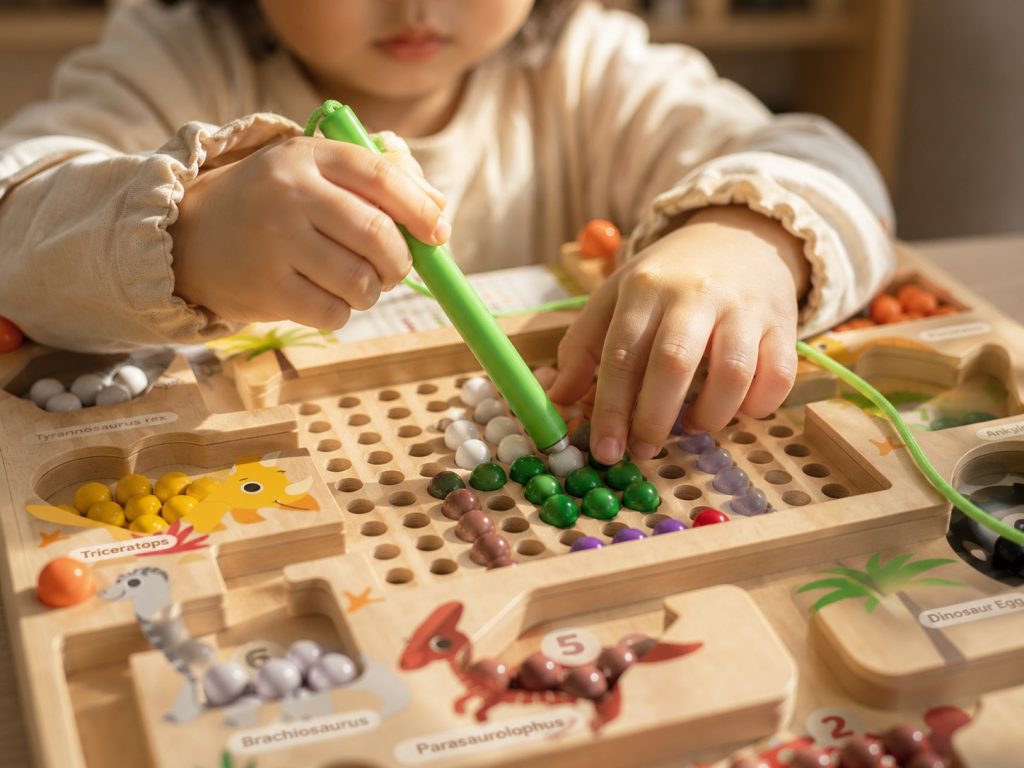
The educational value of Maze Toys extends far beyond entertainment because every movement combines physical coordination with active thinking. Rather than practicing isolated skills, preschool children develop several essential abilities simultaneously through repeated interaction.
Fine motor development is perhaps the most visible benefit. Guiding beads through curved wire tracks or navigating enclosed pathways requires children to coordinate small muscles in their fingers, hands, and wrists with visual information. Over time, these repeated movements strengthen the muscle control needed for writing, drawing, cutting with scissors, fastening buttons, and other everyday classroom activities.
Research indicates that structured manipulative activities can improve fine motor performance by approximately 18–27% over several weeks of guided practice, depending on children’s age and activity frequency. While Maze Toys are only one part of a balanced learning environment, they provide regular opportunities to practice the precise hand movements that preschool children will later use for academic tasks.
Cognitive development progresses alongside these physical improvements. As children encounter turns, dead ends, and multiple pathways, they begin predicting outcomes before moving each piece. They learn to pause, reconsider unsuccessful choices, and test alternative solutions instead of relying on trial and error alone. These experiences gradually strengthen logical thinking, spatial reasoning, and early executive functioning.
Visual tracking is another important developmental area supported by educational maze toys. Following moving objects across a pathway encourages children to coordinate eye movements smoothly, a skill that later contributes to reading readiness and classroom learning. Many preschool teachers observe that children who regularly participate in visual tracking activities become more comfortable following lines of text and maintaining focus during guided lessons.
Language development also occurs naturally during maze play. Instead of giving direct instructions, educators often encourage conversation by asking open-ended questions such as, “Which path looks shorter?” or “Can you find another way to reach the finish?” These discussions help children explain their thinking, compare solutions, and expand vocabulary within a relaxed learning environment.
In many classrooms, Maze Toys are not used as isolated activities but are combined with building blocks, shape sorters, and other preschool educational toys to create balanced learning stations. This combination allows children to rotate between different types of challenges while reinforcing complementary developmental skills throughout the day.
How to Choose the Right Maze Toys for Different Preschool Ages
Selecting suitable Maze Toys involves more than choosing an attractive design. Children’s developmental abilities change rapidly between the ages of three and five, so the most effective educational maze toys are those that match their current stage of learning while leaving room for gradual progression.
The table below provides a practical overview for educators, retailers, and procurement specialists selecting Maze Toys for different preschool age groups.
| Preschool Age | Recommended Maze Toys | Primary Learning Focus |
| 3 years | Wooden bead maze toys with simple pathways | Hand-eye coordination, color recognition, basic fine motor control |
| 4 years | Magnetic maze toys with moderate complexity | Pencil grip, visual tracking, concentration, directional awareness |
| 5 years | Multi-path maze toys with numbers or letters | Logical thinking, planning, early literacy and numeracy concepts |
Age recommendations should always be considered alongside individual developmental readiness. Some younger children may confidently complete more advanced maze challenges, while others benefit from spending additional time with simpler activities before progressing.
Professional buyers also evaluate product specifications that influence long-term classroom performance. Instead of relying on generalized marketing claims, schools and educational distributors increasingly compare measurable characteristics such as recommended age, component dimensions, structural stability, coating compliance with EN71-3 or ASTM F963 requirements, and the durability of wooden construction under frequent daily use.
Experienced preschool suppliers often recommend selecting Maze Toys according to expected classroom frequency rather than purchase price alone. In learning environments where educational manipulatives may be used several times each day, reinforced wooden bases, securely fixed wire tracks, smooth edge finishing, and consistent manufacturing quality generally provide better long-term value than lower-cost alternatives requiring frequent replacement.
For OEM buyers and educational brands developing private-label collections, choosing products with customizable themes, packaging options, and classroom-oriented designs can further improve market competitiveness while meeting the evolving expectations of schools and educational retailers.
What Features Should You Evaluate When Purchasing Maze Toys?
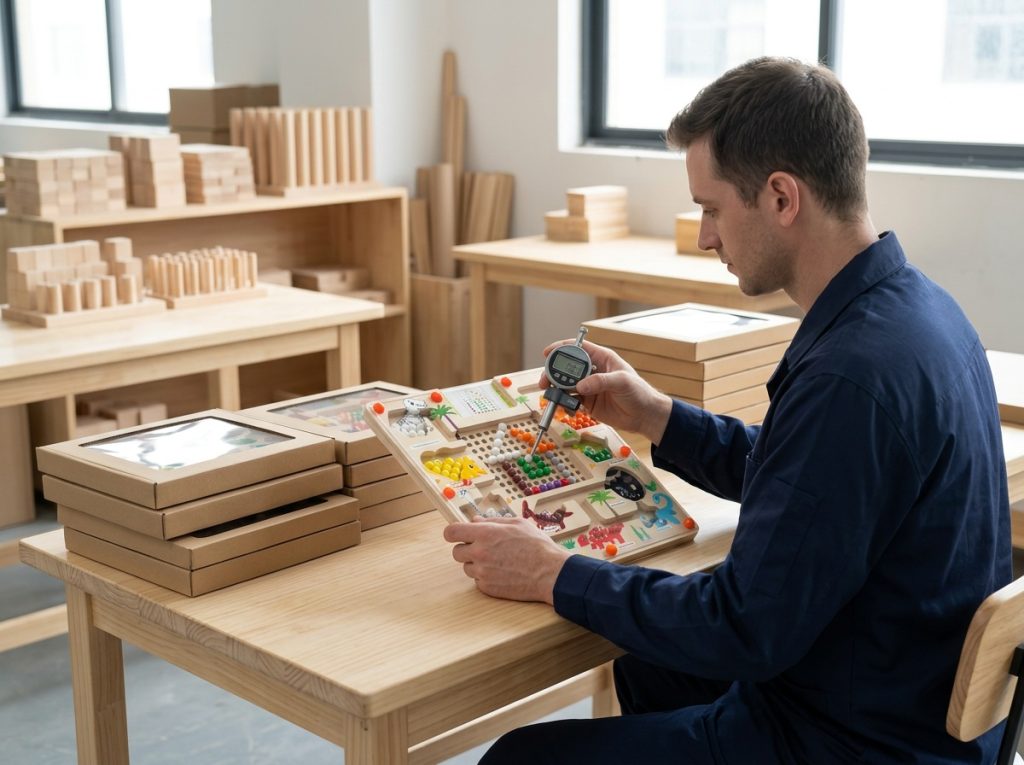
Selecting high-quality Maze Toys involves more than comparing colors or product appearance. Whether the toys are intended for preschool classrooms, retail shelves, or private-label collections, buyers increasingly focus on measurable specifications that influence educational performance, durability, and long-term value.
The table below highlights several objective factors that professional purchasers commonly evaluate before placing an order.
| Feature | Why It Matters |
| Recommended age (36 months+ or 48 months+) | Matches children’s developmental abilities and classroom use |
| Ball diameter above 15 mm | Better suited for preschool manipulation according to the intended age group |
| Solid wood thickness of 15–20 mm | Improves stability during frequent classroom use |
| Smooth edge radius below 2 mm | Provides a more comfortable handling experience |
| Water-based coating tested to EN71-3 or ASTM F963 requirements | Demonstrates compliance with applicable toy safety testing requirements |
| Secure wire tracks or enclosed maze channels | Helps maintain structural integrity during repeated daily use |
Beyond these measurable specifications, experienced educational buyers also pay attention to product consistency. A well-manufactured Maze Toy should maintain smooth movement throughout the maze, with evenly finished edges and securely assembled components that withstand repeated classroom handling.
From a manufacturing perspective, details such as precision drilling, stable wire installation, and consistent surface finishing often determine how well a product performs over several years of use. Although these production details are less visible than appearance, they have a direct impact on customer satisfaction and repeat purchasing.
Another factor receiving greater attention is product flexibility. Many schools prefer educational maze toys that complement existing classroom themes, allowing teachers to integrate numbers, letters, animals, transportation, or seasonal topics into everyday learning activities. This makes the toy useful not only for developing fine motor skills but also for reinforcing broader educational objectives.
Maze Toys Compared with Other Preschool Educational Toys
Every educational toy supports children’s development in a different way, and creating a balanced learning environment usually involves combining several categories of learning materials. Building blocks encourage spatial creativity, shape sorters strengthen recognition skills, and puzzles introduce visual reasoning. Maze Toys, however, occupy a unique position because they combine physical coordination with continuous problem solving.
Instead of focusing on one developmental area, Maze Toys encourage children to think, observe, plan, and move simultaneously. This integrated learning process explains why they remain one of the most frequently recommended manipulative toys for preschool education.
| Toy Category | Fine Motor Skills | Logical Thinking | Independent Learning | Classroom Durability |
| Maze Toys | Excellent | Excellent | High | High |
| Building Blocks | Moderate | High | High | High |
| Shape Sorters | High | Moderate | Moderate | High |
| Jigsaw Puzzles | High | High | Moderate | Moderate |
| Stacking Toys | Moderate | Low | Moderate | High |
Research on early childhood education suggests that children benefit most when learning experiences combine movement, exploration, and communication. For this reason, many preschool classrooms rotate children between activity stations that include Maze Toys, puzzles, construction toys, and sensory materials throughout the day.
Teachers also observe an interesting pattern during these rotations. While some educational toys are set aside after one successful attempt, Maze Toys often encourage repeated engagement. Children frequently challenge themselves to complete the maze using a different route, move more carefully, or finish with greater accuracy. This voluntary repetition provides valuable opportunities for practicing persistence and self-correction without requiring additional instruction.
Why Educational Buyers Continue to Invest in Maze Toys
The educational toy market has evolved significantly over the past decade, with increasing demand for products that encourage active participation instead of passive entertainment. Within this changing landscape, Maze Toys continue to demonstrate strong commercial value because they combine proven educational benefits with reliable long-term classroom performance.
For preschool operators, durability is often just as important as educational value. Classroom manipulatives may be used by multiple groups of children every day, making structural quality an important purchasing consideration. Reinforced wooden bases, securely installed wire tracks, smooth finishing, and consistent production standards all contribute to longer product life and lower replacement costs.
Educational distributors also value the flexibility of Maze Toys. Rather than serving a single lesson objective, one product can support activities related to colors, counting, alphabet recognition, directional language, visual tracking, and fine motor development. This versatility allows retailers to market the same product across multiple educational themes while helping teachers make better use of classroom resources.
From a manufacturing perspective, customization has become increasingly important. Professional OEM and ODM suppliers now offer a wide range of options that allow educational brands to develop differentiated product collections without changing the core learning principles that make Maze Toys effective.
Common customization options include:
- Private-label branding and logo printing
- Custom shapes and educational themes
- FSC-certified wood options for specific market requirements
- Tailored packaging for retail or e-commerce channels
- Instruction manuals in multiple languages
- Support for EN71, ASTM F963, CPSIA, or regional compliance requirements
Rather than selecting products based solely on price, many international buyers now evaluate suppliers according to production consistency, quality management, communication efficiency, and long-term manufacturing capability. These factors help ensure stable supply chains while supporting the growing demand for high-quality educational toys in global markets.
Conclusion
As hands-on learning continues to play an increasingly important role in early childhood education, Maze Toys remain one of the most practical and versatile educational resources available for preschool environments. Their ability to combine fine motor development, hand-eye coordination, logical thinking, visual tracking, and independent problem-solving within a single activity makes them valuable for both home learning and professional classroom settings.
Research and classroom experience consistently indicate that children learn most effectively when they can actively explore, experiment, and repeat meaningful challenges at their own pace. Well-designed wooden maze toys, magnetic maze toys, and other educational maze toys provide exactly this type of learning experience while supporting broader goals such as school readiness, concentration, and confidence.
For retailers, distributors, and educational brands, selecting Maze Toys should involve more than comparing product appearance. Evaluating measurable specifications, manufacturing consistency, customization capabilities, and long-term durability helps ensure that each product delivers lasting educational and commercial value.
Whether you are sourcing Maze Toys for preschool programs, educational retailers, or private-label collections, working with an experienced manufacturer that offers stable production capacity, flexible OEM and ODM services, and consistent quality management can help build a stronger product portfolio. As global demand for screen-free educational products continues to grow, professionally designed Maze Toys remain a dependable investment for both learning outcomes and long-term business success.