
Every preschool teacher knows the moment: a child stares blankly at a fraction worksheet, pencil hovering, completely disconnected from what the numbers mean. Abstract symbols like 1/2 or 0.25 mean nothing to a 4-year-old who has never seen a concept physically split apart. The real challenge isn’t whether kids can memorize fractions — it’s whether they can see them.
That’s the gap Vindstier’s Magnetic Fraction Teaching Aids were designed to close.
This guide is written for preschool and kindergarten teachers who are actively looking for preschool math manipulatives that do more than sit in a storage bin. We’ll break down exactly how this tool functions in a real classroom, what makes it structurally different from flash cards or printed worksheets, and why it keeps working even when kids take it home for tutoring sessions.
What Makes These Magnetic Fraction Teaching Aids Different from Standard Math Manipulatives
Most fraction tools on the market ask children to either sort pre-cut pieces or fill in blanks on paper. Vindstier’s Magnetic Fraction Teaching Aids combine both approaches in a single foldable book format — a design decision that changes how a teacher can actually deploy it.
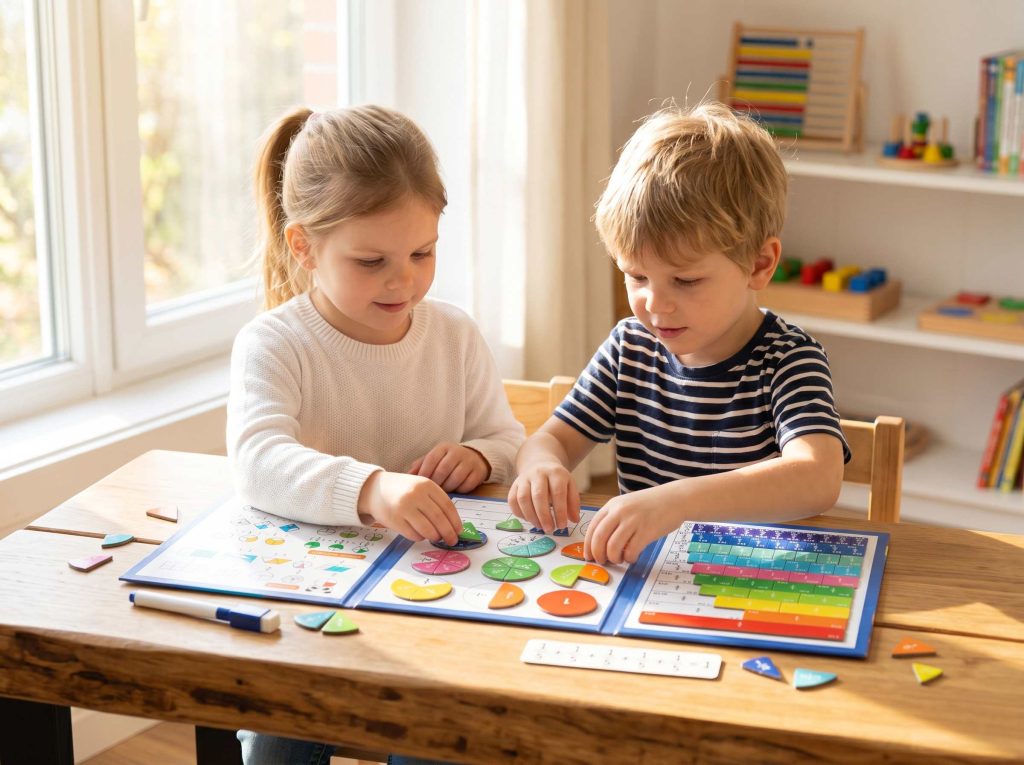
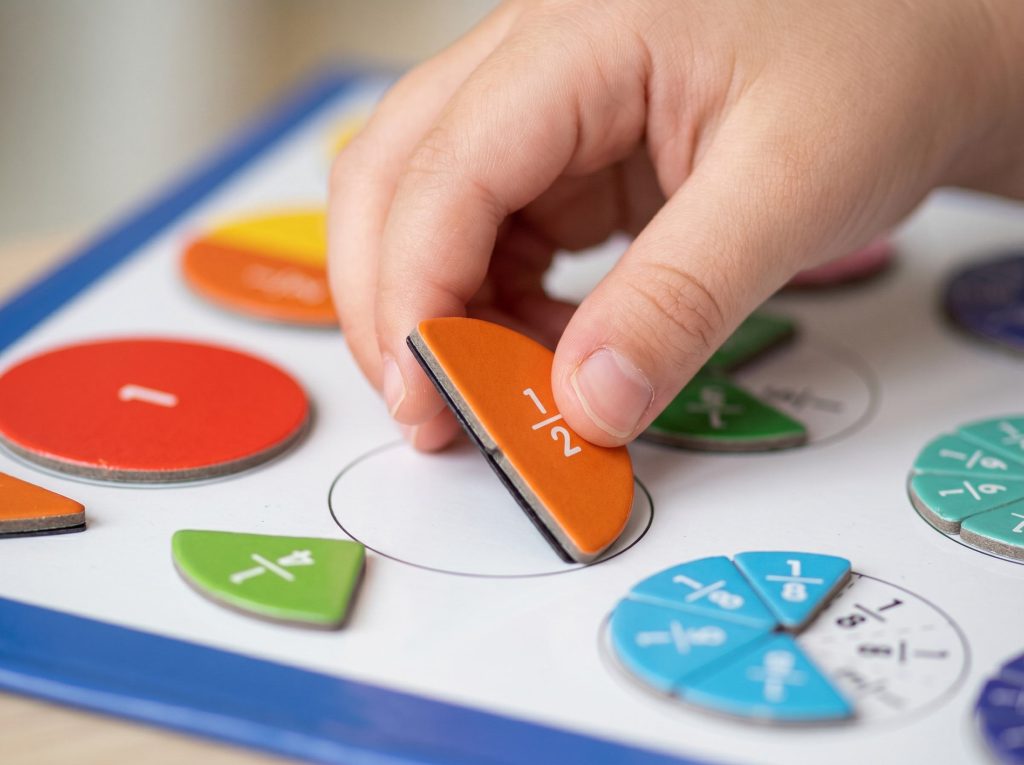
The book pairs magnetic foam tiles with write-and-wipe activity pages. Children physically place a magnetic piece representing 1/4 onto a color-coded pie chart, then use the included marker to write the matching decimal (0.25) directly on the erasable surface. That dual-action moment — placing and writing simultaneously — is what bridges the gap between concrete manipulation and symbolic understanding.
For a teacher managing 15–20 children at once, this matters. You don’t need two separate materials. One tool handles both the physical and written components of a fraction lesson.
The magnetic tiles themselves are backed with a firm magnetic layer and filled with EVA foam at a thickness that prevents tearing even after repeated classroom use. Rounded corners mean you won’t find a teacher worrying about a child getting a paper cut mid-lesson. These aren’t fragile flashcards — they’re built for daily, hands-on contact by small hands that squeeze, drop, and occasionally throw things.
How to Integrate Magnetic Fraction Teaching Aids into Daily Preschool Math Lessons
The most effective use of these Magnetic Fraction Teaching Aids in a classroom isn’t a special “fraction day.” It’s a 10-minute warm-up activity that runs three to four times a week.
Here’s a practical sequence teachers can follow:
Step 1: Visual Introduction with the Pie Chart Pages
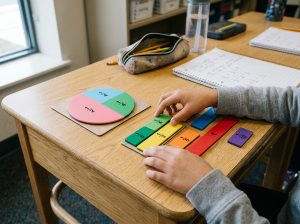
Open the book to the color-coded pie chart section. Each fraction is represented in a distinct color — halves, thirds, quarters, and eighths each have their own visual language. Ask students to select a magnetic tile from the set and match it to the corresponding section on the chart. No verbal explanation needed at first. The color coding does the teaching.
This approach aligns directly with Montessori-style learning (making it one of the more effective Montessori toys 3+ years classrooms have access to) because children self-correct based on visual feedback rather than teacher correction.
Step 2: Bar Graph Matching for Equivalence
Flip to the bar graph pages. Here, children use the same magnetic tiles to match equivalent fractions — discovering that 2/4 looks the same as 1/2 when laid out on a bar. This is where the stem toys for preschoolers angle becomes concrete: children are running a comparison experiment with physical evidence, not memorizing a rule.
Teachers can prompt: “Can you find another tile that fills the same space?” This single question generates 5–10 minutes of self-directed exploration.
Step 3: Write-and-Wipe Reinforcement
After matching, students write the fraction, decimal, or percentage beside each tile using the included erasable marker. The write-and-wipe surface means the activity resets in seconds — no printing new worksheets, no collecting pencils, no waiting for paper to dry.
For classrooms managing mixed ability levels, this is significant. A child who has mastered halves can move to eighths on the same page while a peer works on thirds. One set of Magnetic Fraction Teaching Aids supports differentiated instruction without requiring the teacher to prepare separate materials.
Why the Folder Design Solves a Problem Every Preschool Teacher Recognizes
Ask any early childhood educator about their biggest frustration with math manipulatives, and the answer is almost always the same: pieces go missing. A set of 40 fraction tiles becomes a set of 31 by October.
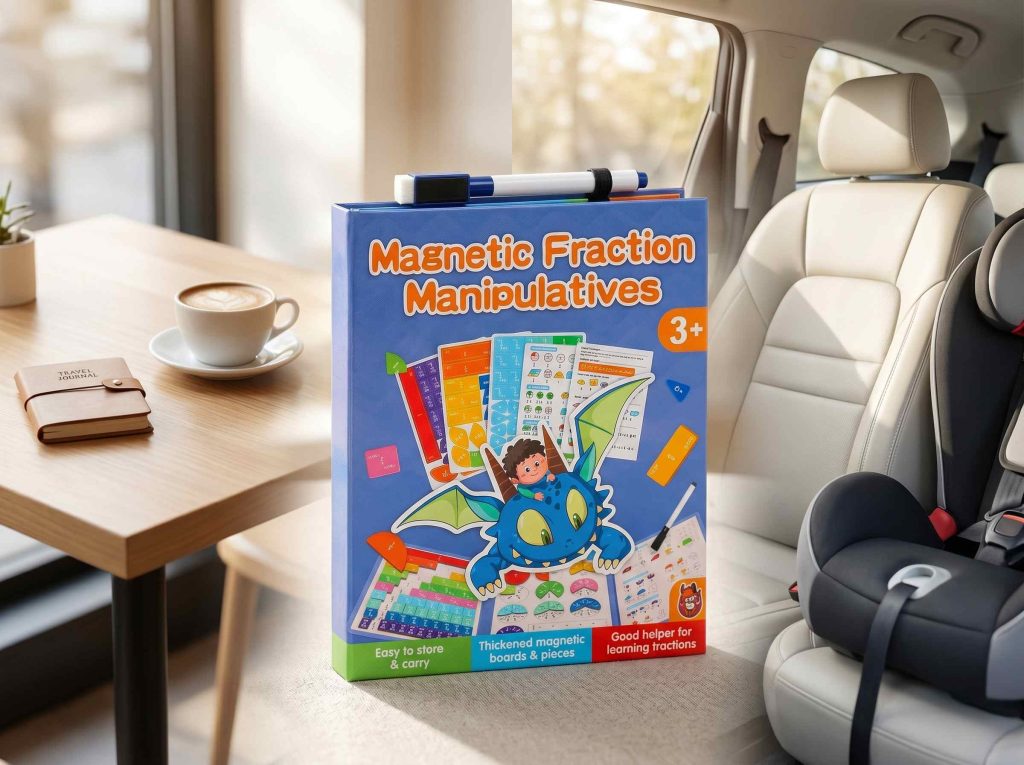
Vindstier’s design addresses this directly. The entire tool folds into a self-contained book. All magnetic tiles and the included marker store inside the folder itself. There are no separate zip bags, no small containers to label, no drawers to organize. When a child finishes a session, everything folds shut.
This makes the Magnetic Fraction Teaching Aids genuinely portable in ways that most teacher math tools are not. A teacher can send it home with a student for tutoring without worrying that half the pieces will disappear. It fits in a backpack. It works on a restaurant table while waiting for food. It functions identically on a car seat during a road trip.
For teachers who work with children outside traditional classroom hours — tutors, resource room specialists, homeschool co-op instructors — this portability is a genuine operational advantage, not a marketing point.
The Classroom Safety Question: What Preschool Teachers Actually Need to Check
When introducing any new material to a preschool classroom, safety review isn’t a formality — it’s a genuine liability concern. Teachers need to be able to answer parent questions specifically, not generally.
Vindstier’s Magnetic Fraction Teaching Aids carry both CE and CPC certifications. In practical terms for a classroom setting:
- The CPC (Children’s Product Certificate) means the product has been independently tested against U.S. federal children’s product safety standards — relevant for any teacher purchasing for an American preschool or childcare program.
- The CE marking means it meets European safety directives — relevant for international schools or programs sourcing materials for EU-based classrooms.
- The EVA foam core and rounded tile edges mean there are no sharp points that could cause injury during the fast-paced, sometimes chaotic handling of a typical preschool math session.
The magnetic backing is strong enough to hold tiles securely to the activity pages without requiring force, but not so strong that small children struggle to lift and reposition pieces. This balance — firm enough to stay, easy enough to move — is something teachers notice immediately during first use.
Using Magnetic Fraction Teaching Aids to Bridge Summer Learning Loss
Educational research consistently shows that children lose up to two months of math learning over summer. The challenge for teachers isn’t just covering new content in September — it’s rebuilding what faded over June, July, and August.
The Vindstier Magnetic Fraction Teaching Aids were specifically designed by education specialists with this problem in mind. The color-coded system means a child returning in September can re-engage with fractions visually before any verbal or written work is expected. The pie chart format is immediately recognizable even after a two-month gap because color memory is more persistent than symbol memory in young children.
For teachers assigning take-home materials at the end of the school year, this makes the tool a practical recommendation — not just for review, but as a genuine tool for preventing regression. Unlike a printed packet that gets crumpled and ignored, the book format keeps materials organized and accessible throughout summer.
It’s worth noting that families purchasing this for home use often describe it as one of the more versatile educational toys for 3 year olds in their household — used not just for structured tutoring but as open ended play toys during free time, where children explore the tiles without instruction.
How Magnetic Fraction Teaching Aids Support Different Learning Stages in the Same Classroom
A typical preschool or kindergarten classroom is not a uniform group. In any given class, you’ll have children who are still learning to count to 10 alongside children who are starting to grasp basic division concepts.
The Vindstier Magnetic Fraction Teaching Aids accommodate this range through their multi-representation format. The same set of tiles can be used at three distinct levels:
At the foundational level, children match tiles to color-coded sections by color alone — they’re learning visual discrimination and the concept of “part of a whole” without any number symbols.
At the intermediate level, children begin connecting tiles to written fractions (1/2, 1/4) using the bar graph pages — building symbol recognition alongside visual understanding.
At the advanced level, children use the write-and-wipe surface to practice equivalence: writing 0.5 next to the 1/2 tile, or 50% next to the half-pie chart — working with three simultaneous representations of the same value.
This layered approach is what makes these among the more adaptable stem toys for preschoolers currently available. A teacher doesn’t need to buy a separate tool for each developmental stage. The same book grows with the child.
Magnetic Fraction Teaching Aids as a Classroom Gift and Budget Resource
End-of-year budgets and classroom wish lists are a reality every teacher navigates. The Vindstier Magnetic Fraction Teaching Aids are packaged in a structured themed gift box, which makes them one of the cleaner options when requesting donations from parents or presenting to a school purchasing committee.
The presentation matters for one practical reason: it signals to decision-makers that this is a purpose-built educational resource, not a novelty toy. The box presentation also makes it a natural fit for back-to-school gift drives or as stocking stuffers for 3+ years programs run by parent-teacher organizations.
For teachers purchasing independently, the all-in-one design (tiles, book, marker, folder) means there are no additional materials to source. The cost of ownership is contained within the single purchase.
Conclusion
Preschool teachers don’t need more worksheets. They need tools that work in the real physical conditions of an early childhood classroom — tools that survive daily handling, support multiple skill levels simultaneously, store without becoming a logistics problem, and give children a way to see abstract concepts rather than just hear about them.
The Vindstier Magnetic Fraction Teaching Aids address each of those needs through specific design decisions: the EVA foam tiles that withstand repeated use, the write-and-wipe surface that resets instantly, the foldable folder that eliminates missing pieces, and the color-coded dual-chart format that supports everything from basic matching to percentage equivalence.
For preschool and kindergarten teachers actively building their math manipulative toolkit, or for families looking to extend classroom learning at home, this is a tool worth examining directly. Vindstier offers wholesale purchasing options for schools and distributors — making it accessible for classrooms equipping multiple sets, not just individual families.
If you’re sourcing educational toys for 3 year olds that carry genuine classroom credentials, start here.