

A teacher places a cylinder in the wrong opening, pauses, and waits. If the material makes the mismatch visible or leaves another cylinder without a place, a child may be able to investigate it. If the only signal is an adult saying “try again,” the set may look Montessori-inspired without giving the learner a useful way to check the work.
That distinction matters when a school compares samples. A catalogue photo can show finish and color, but it cannot show whether the material’s feedback survives ordinary handling, an incomplete set, or a child’s first independent attempt. Montessori control of error is therefore a practical question for a sample review: what can the learner notice, and what can the learner do next without being told the answer?
Identify the feedback before evaluating the finish
Montessori control of error gives the learner a way to detect and investigate a mismatch. The Association Montessori Internationale (AMI) explains that feedback may come from the material’s construction, from a difference the child can perceive, or sometimes from a later adult presentation. A cylinder that cannot fit the remaining opening offers mechanical feedback; a size sequence that looks uneven offers perceptual feedback.
Built-in feedback should not be confused with an automatic “right answer” printed on every surface. The American Montessori Society (AMS) describes control of error as feedback that helps a learner recognize and correct an error during the activity. For buyers, the useful question is whether that feedback is available to the intended learner in the actual task, not whether a supplier has used the phrase in a description.
An evaluator can write one sentence before touching a sample: “In this activity, the child compares ___ and notices a mismatch when ___.” If the second blank can be filled only with “the teacher checks,” the material may still have a place in a guided lesson, but its support for self-correction needs a closer look.
The task also needs to be specific. Sorting by size, matching a word to a picture, and practicing a pouring sequence have different feedback. A buyer who asks merely whether a set is “self-correcting” may receive an answer that applies to a different activity than the one the school plans to teach.
Try one plausible error during a sample review
To test Montessori control of error, start with the supplier’s stated use and the school’s intended use. Lay out all parts, follow the supplied instructions, and complete the activity once as intended. Then introduce one plausible error without forcing pieces or creating an unsafe condition. The purpose is to see what the material reveals, not to prove that every child will respond in the same way.

For a size-grading task, put two neighboring pieces out of order and step back. Can someone see or feel a meaningful break in the sequence? For a matching task with a control card, make one incorrect match and check whether the reference is legible and independent of an adult’s verbal cue. The Montessori Foundation’s explanation of materials gives a three-part-card example in which a child uses a combined image-and-label card to check a match.
The reviewer should then ask a second question: can the learner act on the feedback? A visible mismatch is less useful when pieces jam, the reference card is hard to orient, or correction requires disassembling an unwieldy setup. Montessori control of error works as intended only when the next step is available to the learner, not just clear to an adult who already knows the solution.
This test is an editorial purchasing method, not a formal Montessori certification or a validated assessment. It helps a school compare the function of samples under a defined task. It cannot establish learning outcomes, legal safety compliance, or the experience of every child who may use the material.
Separate an unclear cue from an unfamiliar task
An adult who knows a material may spot a mismatch immediately. A child meeting it for the first time may need a demonstration, more time, or a simpler starting contrast. One unsuccessful attempt does not prove that Montessori control of error is absent; likewise, a trained adult’s quick correction does not prove the cue is accessible to children.
Run the trial in two passes. First, have an educator familiar with the task identify the intended feedback and whether the components actually supply it. Second, after an appropriate presentation, observe a learner’s attempt when the school’s normal consent and supervision practices allow. Record what the learner notices, whether a new attempt is possible, and what support the adult provides. Avoid treating the observation as a score of the child’s ability.
Some problems are caused by the material rather than the teaching task. Two pieces may look identical when their differences are supposed to matter. A control image may use colors or print too faint to distinguish from the working position. A tray may hide the only sign of an incomplete sequence. Those are sample-design questions that a purchasing team can raise with a supplier.
Other problems call for a teaching adjustment. AMI notes that an adult may observe and give another presentation later when a child’s use does not support the material’s purpose. Its guidance on children working with materials also cautions against redirecting every departure from a demonstration: observation, the purpose of the activity, and the risk of damage all matter. A sample review should leave room for that professional judgment.
Use a three-pass checklist for the sample
The checklist below turns Montessori control of error into observable sample questions. It is an editorial decision aid, not an official Montessori standard. Mark each line “clear,” “needs clarification,” or “unsuitable for this task,” and keep the observation beside the mark. That short note is more useful than a single overall rating when two educators or buyers review the same sample.

| Pass | What to check | Record a concrete observation |
|---|---|---|
| 1. Teaching task | State the intended comparison or sequence; identify the adult presentation and the learner’s independent action. | “Learner orders pieces by size; adult presents the starting method.” |
| 1. Feedback | Make one plausible error. Note whether feedback is mechanical, perceptual, shown on a control card, or supplied by an adult later. | “One piece remains without a fitting place,” or “no visible difference after a swap.” |
| 2. Correction | Check whether the learner can locate and revise the mismatch without damage or a spoken answer. | “Pieces can be removed and retried,” or “only the adult can reach the control card.” |
| 2. Access | Check contrast, orientation, handling, working-space needs, and whether the intended users can perceive the cue. | “Reference image is legible on the table but not from the floor mat.” |
| 3. Completeness | Compare the physical set with the component list; repeat the task after accounting for storage and any spare parts. | “Missing one insert removes the end-of-task feedback.” |
| 3. Purchase record | Capture exact model, current age label, instructions, contents, care information, and market-specific documents to verify. | “Model code and component count confirmed; document scope still requested.” |
The first pass protects the educational purpose. The second tests whether a correction is possible in the planned classroom setup. The third prevents a promising demonstration from becoming an incomplete or unsupported order. Schools can adapt the wording to the exact material rather than copy the example observations as if they were test results.
Check what happens after the first week of use
Montessori control of error can disappear when a set becomes incomplete. If an activity depends on all its pieces, a lost part may create a false mismatch or make successful completion impossible. Buyers should identify which parts carry the feedback, how the set is counted when returned, and whether missing components can be replaced before ordering classroom quantities.
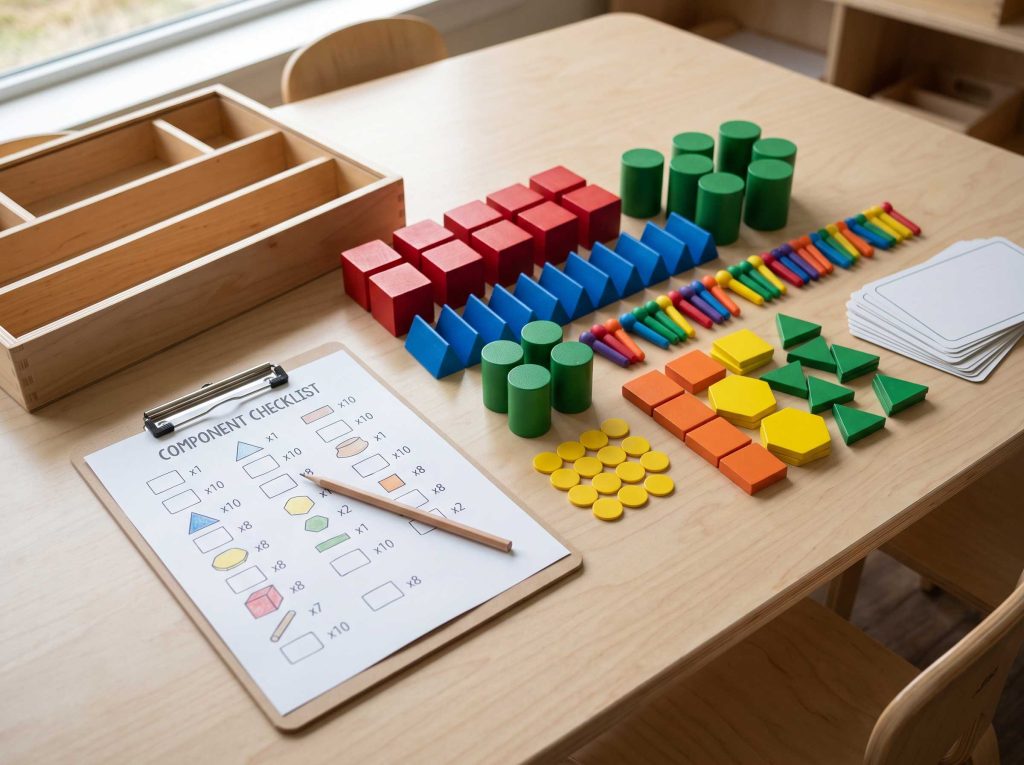
That operational check connects to a broader classroom materials audit and the site’s guide to educational toy spare parts. Those resources address access and replacement planning across a classroom. A control-of-error review adds a narrower question: will the learning cue still work when the material is handled, stored, cleaned, and counted in the way this classroom actually operates?
Durability is not just a claim about a material such as wood or plastic. A loose fit can change mechanical feedback; fading marks can weaken a visual reference; a warped tray can make pieces seem incorrect when they are not. Inspect the actual sample’s functional relationships and ask how the current production model preserves them. Do not infer a service life from one sample or a catalogue photograph.
The school should also check the product’s labeled age range, instructions, parts, and the safety documents relevant to its destination market. An educationally useful feedback mechanism does not establish that an item is appropriate for every age group. If a proposed use involves small or detachable parts, the setting’s safety and supervision requirements take priority over the activity design.
Know when the idea has limits
Not every valuable classroom activity has a single correct arrangement. Open-ended building, imaginative play, and exploratory art can invite judgment and revision without a built-in answer. Montessori control of error would be the wrong purchasing test for a material intended for that kind of open-ended work.
Feedback can also depend on perception and prior experience. A size difference that seems obvious to one learner may be hard for another to see or feel, and a printed control card may not suit every child’s access needs. A school may need a different presentation, a clearer contrast, or another activity; no sample checklist can decide that for every learner in advance.
One common mistake is to label adult correction as a design feature of the material. Adults remain essential for presentation, observation, safety, and later support, yet those roles should be described honestly. Another mistake is to assume that a child who does not correct an error immediately has failed. The trial should reveal what the material offers, while the educator interprets the individual response over time.
Turn the review into a precise supplier question
Before approving an order, a classroom team can send the supplier a concise brief: the intended age group and task, the exact model under review, the component list, the feedback mechanism observed, any unclear cue, and the documentation required for the destination market. Ask how Montessori control of error functions in that model, whether it matches the sample, and whether individual feedback-bearing parts are replaceable. These are questions to resolve, not services to assume a supplier offers.
For schools comparing Montessori-inspired materials, the strongest next step is a testable sample question rather than a broad claim that a product “teaches independence.” The related practical life classroom guide can help educators place a material within a shelf routine; the checklist above helps buyers decide whether this particular sample supports the intended work.
Teams considering a Vindstier item can use the site’s contact page to request the current model’s component list, instructions, age labeling, and applicable documentation, and to ask whether a sample is available. Those facts, combined with a trial of Montessori control of error, support a decision grounded in the classroom task rather than a label on a catalogue page.