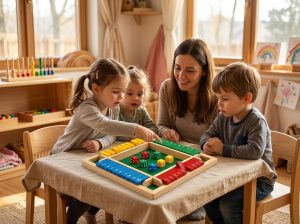

A practical educational toy evaluation checks how materials work in an ordinary classroom. A toy may look convincing on a meeting-room table, yet children may struggle to join its pieces, groups may compete for essential components, or teachers may spend more time managing materials than supporting the activity.
A short classroom trial helps a purchasing team answer a practical question: can these materials support the intended activity with the space, staffing, and budget available?
The buyer and lead teacher have complementary roles. The buyer checks the proposed order, supplier information, and cost. The teacher defines the activity, reviews suitability for the intended learners, and records what happens during use. Together, they turn those observations into a purchasing recommendation.
This guide includes a completed record using a hypothetical construction set. Its contents, prices, and classroom observations are illustrative and do not describe a specific commercial product.
Start educational toy evaluation with a clear classroom task
Start with the activity the purchase should make possible. “More STEM materials” leaves the review open to impressions. “Materials for two groups to build a bridge, change its support arrangement, and discuss the difference” gives staff something concrete to observe.
Head Start’s guidance describes selecting materials that engage children and encourage peer interaction and learning. A trial brief translates that broad purpose into a specific classroom task. Materials to Support Learning, Head Start
Before the session, record:
- Learners: age range, number of children, and relevant access or support needs.
- Activity: what children will attempt and which actions the teacher wants to observe.
- Configuration: number of kits, essential components, and groups using them simultaneously.
- Space: table or floor area, seating, and tray positions.
- Timing: time available for introduction, use, and reset.
- Adult roles: who demonstrates, who observes, and what help is available.
- Main trial question: the uncertainty this session should resolve.
- Decision criteria: what would make the materials workable for this activity.
Keep the main question focused. For a construction set, it might be:
Can children join and revise the structure after a demonstration, using only the verbal prompts available during an ordinary session?
Choose criteria that fit the school’s routine. If staff have five minutes to recover and store the materials, use that allowance in the trial. It is a local requirement, not a universal benchmark for educational toys.
Check obvious capacity requirements before involving children. If the planned bridge uses four long connectors, each group needs access to at least four. A contents check should resolve that arithmetic before the classroom session.
Complete the adult review before children use the materials
Before the classroom stage of an educational toy evaluation, identify the exact sample and review its supplied age guidance, warnings, instructions, contents, and condition. Resolve outstanding safety and suitability questions before children handle the materials.
Age guidance is one part of this review. Staff also need to consider the intended children’s abilities and handling needs. NAEYC’s toy selection guidance emphasizes developmental suitability, sound construction, and keeping toys in good repair. Good Toys for Young Children by Age and Stage, NAEYC
Keep a short record of:
- The model, version, supplier reference, and a photograph of the contents.
- The supplied instructions and relevant product documentation.
- The fit between the intended users, planned activity, and handling requirements.
- Missing, damaged, loose, or unclear components.
- The person responsible for resolving each outstanding question.

If essential pieces are missing, obtain a complete sample before assessing the intended configuration. If parts are damaged, keep them out of use and resolve the issue before proceeding.
Distinguish a delivery problem from a configuration problem. A kit supplied with fewer pieces than its contents list states needs correction. A complete kit that cannot support the planned activity may require a different order.
A classroom trial can inform teaching fit and operational planning. Product safety and compliance questions require the appropriate documentation and review; ordinary play cannot establish those conclusions.
Observe introduction, use, and reset
During an educational toy evaluation, record what happened, the conditions in which it happened, and the support provided. Separate what children did independently from what they achieved with demonstrations, verbal prompts, or physical assistance.
NAEYC’s observation guidance recommends writing down events and looking for patterns before adjusting the environment. That principle is useful here: a specific account gives the purchasing team something it can act on. Observation: The Key to Understanding Your Child, NAEYC
Introduction: record the help children need
Present the materials in the proposed classroom arrangement and demonstrate the task as planned.
Note whether children can identify the pieces, understand the first step, and begin handling the materials. Record additional explanations or physical assistance, including any help beyond the original plan.
An observer’s presence should also be documented. If a second adult only takes notes, distinguish that role from the teacher support children receive.
Use: watch participation and the intended actions
For a bridge-building activity, useful observations include whether children:
- Reach and handle the components.
- Join and separate pieces.
- Build a structure across the intended gap.
- Change a support or connection.
- Describe a difference after making the change.
- Continue working without a shortage of essential parts.

Record who participates without including children’s names in the purchasing record. A completed group structure does not tell the team whether every child could use the materials.
Use concrete notes. “Two children needed a reminder about connector orientation” is more useful than “the set was difficult.”
Reset: check the work after the activity
Recover the pieces, follow the supplied care instructions, and return the set to its intended storage.
Record the staff time, any missing components, and sorting or storage difficulties. A contents photograph can help staff check completeness. Labels or a different tray position may also be worth trying if the materials themselves fit the task.
If a follow-up is needed, change one practical condition at a time where possible. Record the change and remember that children may also become more familiar with the materials between sessions.
A completed classroom trial record
The educational toy evaluation record below connects the activity brief, observations, and decision criteria. In this hypothetical example, both kits are complete: each contains four long connectors, and the planned bridge uses four per group.
| Record field | Illustrative entry |
|---|---|
| Learners and arrangement | Eight children aged 5–7, working simultaneously in two groups of four. |
| Materials | Two complete construction kits, one per group. Each kit contains four long connectors and the other pieces needed for the planned bridge. |
| Activity | Build a free-standing bridge across a 30 cm gap between two stable supports. Change one support arrangement and describe the difference. Pieces may be reused during revision. |
| Space | One 120 × 60 cm table per group, with a reachable tray for each kit. |
| Time allowance | Three minutes for introduction, 12 minutes for building and revision, and five minutes for reset. |
| Adult roles | One teacher demonstrates and gives verbal prompts. A second adult observes without assisting. |
| Pre-use review | Responsible staff completed the suitability and documentation review for this group and activity. Both kits matched their contents lists, with no damage found. Contents photographs were saved. |
| Decision criteria | Both groups can build and revise a bridge; every child can attempt joining pieces with the planned support; no adult assembly is needed after the demonstration; essential pieces remain available; reset fits the five-minute allowance. |
| Introduction | Six children began joining pieces after the demonstration. Two needed a verbal reminder about connector orientation. No additional physical assistance was provided. |
| Use | All eight children attempted joining pieces. Both groups built a bridge and revised it once by reusing components. Each group described one difference after moving a support. No group stopped because essential parts were unavailable. |
| Reset | Staff recovered all pieces and returned both kits to storage in four minutes using the contents photographs. |
| Scope | One session with these eight children, this activity, and this adult support arrangement. |
These observations support a recommendation about the proposed classroom use. They do not establish that the materials improved engineering ability or would work equally well with a larger group.
For another trial, keep the same record fields and replace the example with the actual conditions and observations.
Compare the cost of complete classroom provision
For school buyers, educational toy evaluation also includes checking what the proposed order makes possible. Unit price becomes useful when the team knows how many groups can carry out the planned activity simultaneously with the quoted materials.
Define a complete station as the materials and essential accessories one group needs to carry out the planned activity at the same time as the other groups.
For the example above, one complete kit supplies one station. Two groups therefore require two kits. No additional connector pack is needed for this task.
The following illustration assumes final quoted amounts in US dollars, with no additional mandatory charges.

| Item | Quantity | Unit cost | Total |
|---|---|---|---|
| Complete construction kit | 2 | USD 89 | USD 178 |
| Delivery | 1 | USD 12 | USD 12 |
| Total acquisition cost | USD 190 | ||
| Complete stations supplied | 2 | ||
| Acquisition cost per station | USD 95 |
Use the same cost basis when comparing suppliers. Include necessary accessories, delivery, and any applicable charges in the proposed order.
Keep replacement arrangements, recurring costs, and staff workload alongside the calculation. They matter to the decision, but they should remain visible rather than being hidden inside an unsupported estimate of lifetime cost.
Treat spare stock separately from components required to run the activity. If the school chooses to buy optional replacement pieces, identify that choice and show its cost.
A short trial may reveal an early handling or reset problem. It does not provide a reliable basis for predicting years of service life.
Write a recommendation that follows from the record
Use one of four outcomes:
- Proceed: order the specified configuration for the intended activity.
- Revise and trial again: adjust a practical condition and observe the revised arrangement.
- Hold for information: obtain a necessary supplier answer or complete an outstanding review.
- Decline for this activity: the materials do not meet the requirements of the planned task.
For the illustrative record, the recommendation could read:
Decision: Proceed with the two-kit configuration for the described bridge activity.
Evidence: Both groups built and revised a bridge with demonstration and verbal prompts. All eight children attempted joining pieces. No adult assembly or additional components were needed, and reset took four minutes.
Limits: The record covers one session with eight children. Longer-term durability, other activities, and larger groups have not been assessed.
Next step and owner: The buyer orders the exact quoted model and contents. The lead teacher saves the activity brief, contents photographs, and trial record with the classroom inventory.
If criteria are not met, connect the next step to the observed problem. Difficulty reaching a tray may justify changing its position. Repeated physical assistance may justify reviewing the instructions or considering another model. A complete kit with too few essential pieces may require a different configuration.
Before approval, obtain written confirmation of the exact model, included contents, necessary accessories, final price, delivery terms, and any outstanding documentation. Confirm replacement compatibility rather than assuming pieces from another version will fit.
When enquiring about Vindstier materials, share the learner age range, intended activity, simultaneous group capacity, support available, and delivery destination. Ask the supplier to identify the proposed model and confirm its contents and sample availability.
Save those answers with the trial record. The buyer can then check that the order matches the evaluated configuration, and the teacher has a clear reference for future use and reorders.