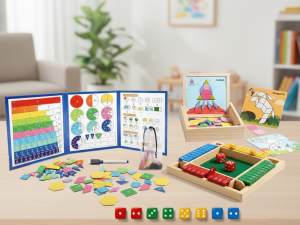

A practical daycare toy list starts with the children, rooms, and routines it needs to support. Buying too much before opening can tie up the budget, crowd storage, and leave little room for replacements. Buying without clear age information or cleaning instructions can create problems before an item reaches the shelf.
For a new program, the aim is to provide a useful opening selection, then refine it through observation. This guide covers age groups, an example preschool purchase list, quantity planning, supplier checks, and a reserve for later purchases.
Start With Room Requirements
Before browsing catalogs, record each room’s intended age range, planned enrollment, licensed capacity, available play areas, and storage space. Check local licensing requirements for equipment and materials before finalizing the order.
An infant room, a toddler room, and a preschool room need different selections. A toy suitable for a four-year-old may be inappropriate for a child who mouths objects, even when both children share the same space.
NAEYC’s age-and-stage toy guidance provides a starting point for matching materials to children’s development. Use it alongside the manufacturer’s age grading and your program’s requirements.
| Room or group | Examples to consider, subject to the stated age range | Key purchasing checks |
|---|---|---|
| Infants | Washable grasping toys, securely constructed soft toys, board books, infant-safe mirrors | Suitability for mouthing, secure construction, cleaning instructions, safe installation where applicable |
| Toddlers | Large blocks, chunky puzzles, stacking materials, push-and-pull toys, simple pretend props | Piece size, stability, accessible storage, space for movement |
| Preschoolers, generally 3–5 years | Construction sets, sorting materials, puzzles, pretend-play props, simple games, threading activities | Specific age grading, task complexity, number of users, completeness and storage |
These examples help organize a purchase list; they do not replace a complete classroom equipment plan. Books, art materials, music resources, accessible furnishings, and outdoor equipment also need consideration.
Confirm Age Suitability Before Purchase
For the United States, CPSC guidance on small parts explains the restrictions on covered products intended for children under three. Small parts can include the whole item, a separate component, or a piece that detaches during specified use-and-abuse testing.
A visual check of loose pieces does not replace the relevant product assessment.
If age grading is unclear, leave the item off the purchase list until the supplier provides enough information to confirm its suitability. Moving it to a preschool shelf does not resolve missing information.
In mixed-age care, combine separate storage with controlled access, supervision, and checks for pieces left behind after activities. Older children’s materials must remain inaccessible to younger children when they are unsuitable for them.
Cover the Main Types of Play
Organize the daycare toy list around what children will be able to do with the materials.
Five useful purchasing groups are:
- Construction: blocks and connecting materials for building and spatial exploration.
- Puzzles, sorting, and manipulatives: materials for matching, classification, counting, and hand coordination.
- Pretend play: figures, vehicles, household props, and dress-up materials.
- Sensory and creative exploration: age-appropriate materials for tactile play, mark-making, and experimenting.
- Movement: balls, balance materials, and suitable indoor or outdoor equipment.
These categories overlap. A set of blocks can support pretend play, while sorting materials may also support counting. Look for useful combinations without expecting every product to serve every purpose.
Check that children can participate in different ways, including seated play, simple grasping, and activities with varying levels of difficulty.
An Example Preschool Daycare Toy List
The following example assumes one room serving 12 children aged 3–5, with several small activities available at the same time.
Quantities and piece counts are illustrative planning choices, not licensing minimums, research-based ratios, or a complete equipment list. Equivalent products may be packaged differently. Adjust the selection for your children, space, curriculum, existing materials, and budget.
| Material | Example opening quantity | Intended use | Check before ordering |
|---|---|---|---|
| Main construction blocks | One approximately 100-piece set | A shared building area for a small group | Confirm block dimensions, usable building space, set contents, and storage capacity |
| Secondary construction materials | Two approximately 20-piece large-piece sets | Separate tabletop activities or additional building options | Confirm age grading and whether the two sets are compatible |
| Sorting and counting materials | Two sets, each with a confirmed contents list | Individual or paired activities | Check component sizes, trays, and replacement-piece availability |
| Puzzles | Four puzzles at two difficulty levels | Individual play with a choice of challenge | Choose clear contents references and storage that keeps each puzzle together |
| Pretend-play props | One coordinated theme with washable open-ended props | Shared role play | Check cleaning methods, fit, fasteners, and suitability of accessories |
| Fine-motor materials | Two activity sets, such as posting or threading materials | Individual or adult-supported small-group play | Check age suitability, component security, and any cord-related instructions |
| Simple cooperative or turn-taking games | Two games | Short small-group activities | Confirm player numbers, rule complexity, and component inventory |
| Balls and movement materials | A separate selection based on the movement area | Planned active play | Confirm space, supervision, intended use, and equipment-specific requirements |

Before approving the order, map these materials onto the room. A large block set has little value if the building area cannot accommodate it. Several tabletop sets may still leave children waiting if there are too few usable activity spaces.
For each set, record its expected contents and assigned shelf or bin. A photograph can help staff identify missing pieces during daily resets.
Set Quantities by Concurrent Use
Licensed capacity helps establish the scale of the room, but it does not determine a fixed number of toys per child.
Ask three questions for each activity:
- How many children can use it comfortably at once?
- How many similar activities will be available at the same time?
- Will cleaning, drying, or repairs temporarily remove it from use?
A construction area that supports several children needs enough compatible pieces for meaningful building. A single-user puzzle may need alternatives nearby. Neither situation calls for a universal duplicate ratio.
After opening, observe repeated waiting, engagement, damage, and the way materials are presented. Competition over an item may indicate insufficient access, but it can also reflect novelty, room layout, or the need for adult support. Review the cause before buying more.
Use Rotation to Manage the Shelf
A study by Dauch and colleagues, published in 2018, compared individual free-play sessions with four and sixteen toys among 36 toddlers. In the four-toy condition, children showed longer engagement with individual toys and a greater variety of play with them.
The study offers a reason to consider how many toys are displayed at once. It does not establish a purchasing ratio, prove that duplicates are better than variety, or determine how many materials a group-care room needs.
A practical approach is to display a manageable selection, store additional materials for rotation, and observe how the arrangement works for the group.
Plan Cleaning and Storage Before Ordering
Choose materials that staff can maintain using the program’s actual procedures.
CDC guidance for early care and education settings distinguishes cleaning, sanitizing, and disinfecting. It identifies mouth-contact items, including toys, as requiring attention to sanitizing and advises using methods appropriate for the material.
Ask suppliers for care instructions before purchase. Confirm compatibility with your procedures, including any rinsing, drying, laundering, or restrictions on immersion.
Wooden components, electronic toys, fabrics, and nonporous plastic items may need different treatment. “Wipe clean” alone may not provide enough information for your setting.
For mouthed toys, establish a collection and treatment routine before they return to shared use, following applicable guidance and local requirements. Keep items awaiting cleaning separate from ready-to-use materials.
Storage should support the same workflow: accessible play materials, secure rotation stock, and a separate place for incomplete, damaged, or unclean items.
Reserve Part of the Budget for Later Decisions
Keep some purchasing flexibility after opening.
As an illustrative budget choice, a program might reserve 10% of its toy allocation for additional materials and replacements. This is a planning option, not a sector standard. The appropriate amount depends on delivery costs, supplier minimums, existing stock, and how easily items can be reordered.
For example, a $2,000 toy allocation with a 10% reserve leaves $1,800 for the opening purchase and $200 for later decisions. Check that essential equipment and required materials are covered before setting money aside.
Use early observations to decide whether the reserve should fund additional copies, different difficulty levels, replacement parts, or an overlooked activity.
A preschool classroom toy inventory can connect each item’s condition and use to the next purchasing decision.
Review Samples Before a Larger Commitment
For unfamiliar products or larger orders, samples can help staff assess size, construction, care requirements, and storage.
Start with an adult review of the product, labels, instructions, and relevant documentation. Confirm suitability and complete the program’s checks before allowing children to use it.
Then, where appropriate, observe supervised use during normal routines. Record:
- Whether children can access and use the material as intended.
- How many children can participate comfortably.
- Whether components remain secure and complete.
- How the item responds to the approved cleaning routine.
- Whether staff can reset and store it easily.

A short trial can reveal immediate problems, but it cannot establish long-term durability or replace required safety testing. Continue checking condition after purchase, and remove damaged items from use.
Request Clear Product and Commercial Information
Alongside samples or quotations, ask for:
| Information | What it helps confirm |
|---|---|
| Product identification and age grading | Which item is being assessed and who it is intended for |
| Relevant test reports and compliance documents | Whether the evidence covers the proposed product and destination market |
| Dimensions, materials, and set contents | Whether the item fits the planned activity and storage |
| Cleaning and care instructions | Whether staff can maintain it appropriately |
| Replacement-part and reorder terms | How missing pieces or worn items can be addressed |
| Sample charges, minimum order quantities, and delivery estimates | Whether the purchase fits the budget and opening schedule |
For the United States, a Children’s Product Certificate (CPC) identifies the covered product and applicable safety rules. For imported products, the U.S. importer is responsible for issuing the CPC; suppliers may support that process with relevant testing and product information.
For the European Union, request the applicable CE marking and conformity documentation, including the Declaration of Conformity and relevant supporting information. A general supplier certificate should not be assumed to cover every item in an order.
Keep product records, supplier details, invoices, and care instructions together so staff can retrieve them when needed.
Choose Suppliers Around the Order’s Needs
One supplier may simplify communication, delivery coordination, and reorders. Several suppliers may offer a better fit across different categories. Compare the actual products, documentation, minimum quantities, and after-sales support.
Specialist movement equipment or furniture may justify a separate supplier. General classroom play materials can be grouped where the assortment and terms suit the program.
For a single daycare room, ready-made products and accessible reorders may matter more than customization. OEM or private-label development becomes more relevant when a buyer is creating an own-brand range or coordinating purchases across several locations.
Vindstier focuses on educational toys for children aged 3+ and offers OEM/ODM customization. Buyers considering preschool play materials can discuss product selection, custom colors, and branded packaging, with suitability, documentation, order quantities, and sample timing confirmed for the specific project.
Check Deliveries Before Materials Reach the Room
Work backward from opening day, allowing time for delivery, inspection, cleaning, and setup. For custom or imported orders, include development, approval, production, and transport in the schedule.
On arrival, compare the delivery with the purchase order and approved specifications. Check quantities, labels, set contents, visible damage, instructions, and the agreed documents. Hold incomplete or questionable items aside while the supplier resolves the issue.
For secondhand purchases and donations, verify identity, age suitability, condition, completeness, and recall status. In the United States, check the CPSC recall database. Decline items when the information needed to assess them cannot be established.
Turn the List Into a Reorder Plan

A useful daycare toy list continues to change after the first delivery. Record what children use, what staff can maintain, which pieces go missing, and where additional choice or access would help.
Begin with age-appropriate materials, a clear room plan, and manageable opening quantities. Keep enough flexibility to improve the selection as the program develops.
For preschool rooms serving children aged 3+, Vindstier can help buyers explore educational toy options, sampling, and OEM/ODM customization. A brief outlining the target age group, room counts, preferred products, and estimated quantities provides a useful starting point for discussing the project.