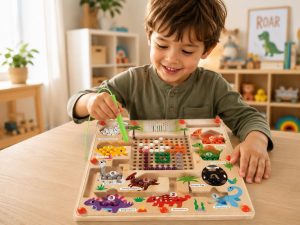

A preschooler places one cup beside each picture of a guest. When the teacher asks, “How many cups are there?” the child looks at the arrangement, points to each cup, and pauses before answering.
The child may understand the matching task without yet knowing how to express the total in English. That distinction matters when planning math activities for children who are learning in more than one language.
Bilingual preschool math games can give children opportunities to explore numbers through movement, familiar objects, and conversation. Rather than requiring a spoken English answer at every step, teachers can observe how children match, count, compare, and change collections while introducing mathematical language.
The three activities below focus on one-to-one matching, equal quantities, and adding one. Each includes simple materials, a clear mathematical goal, adaptable language support, and observations teachers can use to plan the next lesson.
Why Clear Math Goals Matter in Bilingual Preschool Learning
Children bring different experiences with language and mathematics into preschool classrooms. Some may recognize number words in their home language before learning the corresponding English vocabulary. Others may be comfortable counting aloud but still need practice matching objects accurately.
Head Start’s guidance on gathering language information from families notes that children learning two languages may acquire concepts, including counting, in one language before another.
For teachers, this means that mathematical understanding and English-language expression should not always be evaluated as the same skill.
A preschool counting activity might involve three distinct goals:
- Mathematical understanding: Match one object to each picture, count a collection, or recognize equal quantities.
- Language development: Hear and gradually use words such as one, each, same, more, and how many.
- Participation: Show an answer by arranging objects, pointing, gesturing, counting aloud, or speaking in a familiar language.
These goals can support one another without requiring every child to demonstrate them in the same way.
NAEYC’s Make Math Meaningful for Diverse Learners emphasizes familiar materials and real-life activities as useful starting points for children from different language and cultural backgrounds.
A practical approach is to introduce one mathematical action, demonstrate it visually, and then connect a short phrase to what the child does.
Prepare Materials and Language Supports Before Playing
Hands-on math games do not require elaborate equipment. Guest pictures, counting blocks, sorting pieces, or other age-appropriate classroom objects can provide enough structure for meaningful number activities.
Before introducing a game, teachers should consider four questions.
- What should children do? Identify one main mathematical action, such as matching objects or building an equal collection.
- What should children see? Arrange materials so children can distinguish individual objects and compare quantities without unnecessary visual distractions.
- What language will adults introduce? Choose a few short phrases connected directly to the mathematical action. When using home-language expressions, confirm them with families or knowledgeable speakers rather than relying on unverified translations.
- How can children respond? Allow appropriate ways to show thinking through placement, pointing, gestures, familiar-language responses, and spoken English.
Use materials that meet the relevant age guidance and classroom safety requirements. Check components for damage, consider choking hazards, and follow the setting’s supervision and hygiene practices.
Start with small collections appropriate to each child’s experience. Two or three objects may be enough for one child, while another may be ready to compare collections of five or more.
The goal is to make the mathematical relationship visible before adding unnecessary language demands.
Game 1: Snack Table Match — Practice One-to-One Correspondence
Math goal: Match one object to each person and begin connecting matching with counting.
Suggested age: 3–5 years, with collection sizes adjusted to the child’s abilities.
Materials:
- Three to five picture cards showing guests
- An equal number of age-appropriate pretend cups or other counters
- A mat or clear tabletop space
How to Play
Begin by placing two guest pictures on the mat.
Pick up one cup and place it beside the first guest. Repeat with the second cup and guest.
Say, “One cup for each guest,” pointing to each completed pair.
Next, prepare a new arrangement with three guest pictures and invite the child to set the table independently.
Watch whether the child places one cup beside each guest, returns to a picture already served, or notices an unmatched guest.
Once the arrangement is complete, ask:
“How many cups are there?”
The child may count aloud, point while counting, hold up fingers, or answer using a familiar number word.
A teacher can acknowledge the completed arrangement before modeling an English sentence:
“Three guests. Three cups. Each guest has one cup.”

Language Support
Use short, repeated phrases:
- “One for each.”
- “Who needs a cup?”
- “How many cups?”
- “Everyone has one.”
Match the words with pointing and placement. When the child responds in a familiar language, acknowledge the mathematical contribution and model the corresponding English expression without requiring immediate repetition.
What to Observe
A child who successfully places one cup beside each guest has demonstrated something about one-to-one matching.
That does not automatically establish that the child can count the entire collection or identify its total. Those related skills may need separate opportunities for observation.
Try next: Add another guest or change the arrangement of the pictures. Invite the child to prepare the table again without copying the teacher’s original layout.
This variation helps teachers see whether children can apply the matching relationship in a new situation.
Game 2: Make an Equal Set — Compare Two Quantities
Math goal: Create two collections containing the same number of objects.
Suggested age: 3–5 years, adjusted for children’s counting experience.
Materials:
- Two trays or clearly defined work areas
- Age-appropriate counting blocks, large sorting pieces, or pretend fruit
- Optional picture cards representing the collections
Unlike the first game, which focuses on giving one object to each recipient, this activity asks children to compare two groups and reproduce a quantity.
How to Play
Place three blocks on one tray.
Leave the second tray empty and offer the child a small collection of additional blocks.
Say:
“Can you make this tray have the same number?”
Allow the child to build a matching collection.
Once both trays contain three blocks, invite the child to check the result. Children might count each group or pair objects from one tray with objects from the other.
The teacher can model:
“Three here. Three here. The same number.”
Next, spread the blocks on one tray farther apart while keeping the quantity unchanged.
Ask:
“Do these still have the same number?”
Invite the child to check rather than immediately giving the answer.

Language Support
Focus on a small vocabulary set:
- “Same number.”
- “Make these match.”
- “How many here?”
- “How can we check?”
Children can demonstrate equal quantities without providing a complete spoken explanation.
If they use a home-language number word, teachers can connect that response to the visible collection and introduce the English equivalent.
What to Observe
Notice whether the child:
- Copies the number of objects rather than simply copying their arrangement.
- Counts each collection or matches objects to check equality.
- Recognizes that moving objects farther apart does not necessarily change the number.
These observations describe different aspects of quantity understanding.
Try next: Use objects of different colors or shapes while keeping the quantity the same. This helps shift attention toward the number of objects rather than their appearance.
For children who need more support, return to two clearly arranged collections and demonstrate how to check them one object at a time.
Game 3: One More Guest — Explore Adding One
Math goal: Recognize how a collection changes when one object is added.
Suggested age: 3–5 years, using quantities appropriate to each child.
Materials:
- Guest picture cards
- Pretend cups or large counting pieces
- A play mat
This game introduces a changing situation rather than a fixed matching or comparison task.
How to Play
Place two guest pictures on the mat and provide one cup for each guest.
Invite the child to look at the completed arrangement.
Then introduce another guest picture and say:
“Another guest arrives. What do we need?”
Give the child time to decide what should change.
The child may add another cup, point to the new guest, or explain the need for one more.
Once the child completes the arrangement, count the cups together if appropriate:
“Two cups. One more cup. Now there are three.”

Repeat with a different starting quantity when the child is ready.
For an additional challenge, ask the child to predict the new total before adding the cup, then check by counting or matching.
Language Support
Introduce words connected to the visible change:
- “One more.”
- “Another guest.”
- “What changed?”
- “How many now?”
Use gestures to show the arrival of the new guest and the addition of one cup.
Children do not need to write an addition equation to participate meaningfully in this early number activity.
What to Observe
Notice whether the child recognizes the need for another cup, adds exactly one, or counts the new collection to determine the total.
These are related but distinguishable responses.
A child may understand that another guest needs a cup while still developing the ability to name the new total.
Try next: Have one guest leave and ask what happens to the number of cups needed. This creates a natural introduction to one less without requiring formal subtraction notation.
A Bilingual Preschool Math Prompt Card for Teachers
Consistent, concise prompts can help teachers introduce mathematical vocabulary while remaining responsive to children’s different communication styles.
The following prompt card can be used during small-group activities or adapted for family learning.
| Math focus | Teacher prompt | Possible child response | Vocabulary to model |
|---|---|---|---|
| One-to-one matching | “One cup for each guest.” | Places or points to one cup per guest. | One, each, match |
| Counting | “How many cups are there?” | Counts aloud, gestures, or uses a familiar number word. | Count, how many, total |
| Equal quantities | “Make the same number.” | Builds another collection and checks it. | Same, equal, match |
| Adding one | “One more guest arrives. What changes?” | Adds another cup or points to the missing cup. | One more, another, now |
| Comparing collections | “Which has more?” | Points, counts, or matches objects to compare. | More, fewer, same |
The prompts do not need to be used in a fixed sequence.
Teachers should adjust language to the child’s current understanding and the purpose of the activity. When children are comfortable with the action, a short follow-up such as “Show me how you know” can invite further mathematical reasoning.
For bilingual classrooms, teachers may also prepare a small vocabulary reference with accurate home-language equivalents for frequently used concepts.
Such references should be developed or reviewed with qualified language support. A direct word-for-word translation may not always be the clearest classroom instruction.
Adapt Preschool Math Games for Different Learners
Children may need different levels of support even when they participate in the same activity.
An inclusive classroom routine should preserve the mathematical goal while allowing appropriate adjustments to materials, language, and participation.
For Children Beginning to Learn English
Demonstrate the activity with real objects before giving longer verbal instructions.
Use one short phrase at a time and repeat it during the relevant action.
Accept meaningful responses through pointing, arranging materials, or a familiar language.
Avoid treating a lack of spoken English as evidence of a lack of mathematical understanding.
For Children Developing Early Counting Skills
Start with two or three clearly separated objects.
Allow children to touch or move one object at a time while counting.
When appropriate, help them connect the final number word to the total collection.
For Children Ready for More Challenge
Increase the quantity gradually.
Change the arrangement of objects, ask children to predict what happens when one is added, or invite them to explain how they checked two equal collections.
The challenge should come from the mathematical relationship, not simply from longer or more complicated English instructions.
For Partner and Small-Group Play
Assign simple, alternating roles.
One child might prepare a collection while another checks it. Then they switch.
Make sure both children have opportunities to move objects and make decisions. An adult should continue to provide necessary instructions and language support rather than expecting one child to translate or manage the entire activity.
Connect Bilingual Math Learning Between Home and School
Math learning also happens during ordinary family routines.
Setting the table, organizing toys, matching socks, and distributing snacks can all provide opportunities to discuss numbers and quantities.
Teachers can invite families to use the language they naturally speak at home while exploring the same mathematical relationships introduced in the classroom.
For example, a classroom activity involving equal collections could become a home activity in which a child places the same number of spoons beside two sets of plates.
The materials do not need to match exactly.
What matters is that children have another opportunity to explore the relationship between quantities.
Teachers can ask families which counting words children already recognize, what numerical activities appear in daily routines, and how children prefer to respond.
Families may share examples of what a child did or said in their preferred language. This information can help teachers select appropriate prompts for the next classroom activity.
A Published Multilingual Math Resource
Education Development Center’s Young Mathematicians program offers Hungry Numbers, a math game in which children match written numerals with cards showing corresponding quantities of dots.
The resource provides directions in English, Spanish, Portuguese, and Haitian Creole.
It can offer a useful extension for children who are ready to connect quantities with written number symbols.
Teachers can select a level appropriate to the child’s experience rather than assuming that every preschooler should begin with numeral recognition.
Choosing Hands-On Math Materials for Preschool Classrooms
The quality of a preschool math activity depends partly on how clearly children can use the materials to explore the intended concept.
For teachers, school administrators, and educational toy buyers, a useful set should do more than carry a broad educational label.
It should support identifiable mathematical actions and be practical to introduce, supervise, clean, store, and reuse.
Prioritize Clear Mathematical Relationships
Look for materials that make quantities easy to see and manipulate.
Movable counters, sorting pieces, picture cards, and number blocks may support different activities depending on how teachers introduce them.
For example, separate counters are useful when children need to give one object to each guest or create matching collections.
Number blocks that represent numerical values can provide opportunities for exploring number recognition and quantity comparisons when used in developmentally appropriate activities.
Educators interested in tactile number representations can explore Vindstier’s guide to Wooden Number Blocks for Homeschool Math Lessons.
A material’s suitability should always be judged against the specific learning goal rather than assuming that one product will address every mathematical skill.
Check More Than the Packaging Language
For bilingual preschool math games, printing instructions in two languages is not sufficient by itself to ensure that the activity is accessible.
A sample review should consider:
- Visual clarity: Do pictures and diagrams demonstrate the correct mathematical action?
- Language accuracy: Have translations been reviewed by people qualified in the relevant language and educational context?
- Multiple response options: Can children participate by moving, matching, counting, or pointing, rather than only answering verbally?
- Age suitability and safety: Are components appropriate for the intended children, and is the relevant product safety documentation available?
- Classroom practicality: Are materials durable enough for the intended use, easy to organize, and accompanied by clear setup and care instructions?
Schools should also consider the number of children expected to share each set and whether missing components could prevent an activity from functioning correctly.
Evaluate Classroom Sets Before Larger Purchases
A small classroom trial can reveal issues that are difficult to identify from product photographs alone.
Teachers can check whether children understand the demonstrated action, whether pieces remain organized during play, and how much adult support is required.
Purchasing teams can review instruction versions, complete-set contents, age labeling, and applicable safety or compliance documentation for the intended market.
A preschool classroom toy inventory can help staff record materials, storage locations, component counts, and replacement needs.
This information supports more consistent classroom use and gives buyers a clearer basis for future orders.
For educational toy brands and distributors developing preschool math collections, the same considerations can inform product selection, packaging design, and multilingual instruction planning.
Observe Mathematical Thinking Without Overinterpreting Language
A game provides an opportunity to observe a child’s response to a particular task. It does not, by itself, establish overall mathematical ability or language proficiency.
Useful observation notes describe what happened, including the support provided by an adult.
For example, a hypothetical classroom note might read:
“After watching the teacher demonstrate one example, the child independently placed one cup beside each of four guest pictures. When asked for the total in English, the child pointed to the cups but did not give a spoken answer.”
This note identifies the matching action without assuming why the child did not answer verbally.
A teacher might then revisit the collection in a familiar language, offer an additional counting opportunity, or gather relevant information from the family.
A simple observation record can separate three areas:
| Observation area | What to record |
|---|---|
| Mathematical action | What the child matched, counted, compared, or changed |
| Communication | Whether the child used gestures, number words, a familiar language, or English |
| Adult support | What was demonstrated, translated, repeated, or prompted |
These notes can inform lesson planning, but they should not replace the program’s established procedures for developmental or language assessment.
Repeated opportunities across different activities provide a more useful picture than a single response.
FAQs
Should Children Count in English or Their Home Language?
Children can use a familiar language while exploring mathematical ideas. Teachers can acknowledge that response and introduce related English vocabulary.
The immediate goal is to understand what the child can demonstrate mathematically while creating opportunities for language development.
What Are the Best Math Concepts to Introduce First?
One-to-one matching, counting small collections, comparing quantities, and recognizing simple changes such as adding one are useful starting points.
The appropriate sequence depends on each child’s previous experiences and current understanding, rather than age alone.
Do Bilingual Math Games Require Special Toys?
No. Many activities can begin with familiar, age-appropriate classroom objects and simple picture cards.
Purpose-designed educational toys can be useful when their components make the mathematical task clear and support repeated exploration.
How Can Teachers Support Children Who Do Not Answer Verbally?
Offer demonstrations and alternative response methods, including arranging objects, pointing, or using a familiar language.
Observe the mathematical action separately from the spoken response and provide further opportunities to communicate.
Conclusion: Keep the Math Clear and the Language Welcoming
Effective bilingual preschool math games begin with a meaningful mathematical action.
A child may match cups to guests, create equal collections, or add another object before being ready to explain the result in English.
When teachers use familiar materials, clear demonstrations, and flexible response options, they can observe mathematical thinking while introducing useful language.
The three games in this guide offer different opportunities to explore quantities without making unfamiliar vocabulary the only route to participation.
Teachers and families can return to the same concepts through new situations, gradually expanding both mathematical challenges and language opportunities.
For schools, educational toy brands, and distributors, selecting suitable materials begins with understanding how children will actually use them.
Vindstier develops hands-on educational toys and supports OEM/ODM customization for brands and buyers. To discuss preschool learning materials, product selection, or custom educational toy projects, contact the Vindstier team.