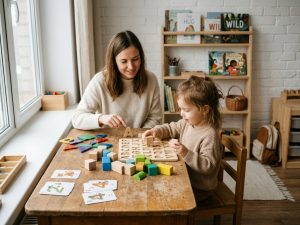

A calm down corner for preschool gives children a place to pause, receive support, and find a manageable way back into classroom activity. A useful setup can begin with a quiet location, comfortable seating, and a few familiar materials. What makes it work is a predictable routine and an adult who knows how to help.
This guide explains how to choose the space, introduce it to children, respond during difficult moments, and keep it accessible and safe.
Agree on the Purpose Before Choosing Materials
The corner is an optional support for children who feel overwhelmed, frustrated, worried, or in need of less stimulation. Children may choose it themselves, and teachers can offer it when they notice early signs that support might help.
Explain its purpose in simple language:
“This is a place to take a break. You can sit with me, look at a book, or ask for help.”
Keep it separate from discipline. Avoid sending children there as a consequence, calling it a place for “bad behavior,” or requiring them to earn their return to play.
Adults still set safety limits. A teacher can acknowledge anger while preventing harm:
“You’re angry that the blocks fell. I won’t let you throw them at people. I’m here to help.”
This approach emphasizes co-regulation: the adult helps the child manage a difficult moment through a steady presence and responsive support. NAEYC describes a comfort-corner example in which adult participation is central. That account provides a practice example, rather than proof that a particular corner or collection of materials will produce the same outcome in every classroom. Read the NAEYC article.
Choose a Location for Your Calm Down Corner for Preschool
Look for a quieter edge of the classroom, away from busy routes, loud equipment, and frequently contested play materials. Leave enough room for a child and adult to sit comfortably together.
Check the location from both perspectives:
- Can educators see and hear the child while supervising the room?
- Can the child see a familiar adult?
- Is the entrance open, with a clear route back to classroom activity?
- Can a child using mobility supports reach the space and materials?
- Are furniture, shelves, and nearby objects stable?
Avoid arrangements that conceal children, obstruct exits, or depend on an adult leaving the rest of the group without adequate supervision.

Before opening the area, decide who will respond when a child needs close support and who will cover the remaining classroom. Follow applicable staffing ratios and program requirements; meeting a numerical ratio alone does not resolve every supervision need.
Head Start’s active-supervision guidance emphasizes staff positioning, clear sightlines, listening, scanning, and accounting for children. Apply those principles to the corner as part of the whole classroom. See the active-supervision guidance.
Start With a Small, Familiar Set of Materials
Choose items children already understand and can use safely. A large collection adds cleaning work and can create competition without improving support.
| Purpose | Possible starting materials | What to check |
|---|---|---|
| Comfortable seating | Stable child-size chair, washable cushion, or small mat | Accessible, intact, and easy to maintain |
| Communication | Familiar emotion pictures, a help symbol, or a feelings book | Understandable without reading |
| Calming options | Simple breathing visual, drawing materials, or a sturdy tactile item | Appropriate for the child and easy to model |
| Quiet engagement | One familiar book or simple puzzle | Complete, age-appropriate, and cleanable |
Inspect items for loose parts, damaged seams, sharp edges, and cords. Keep cleaning products outside children’s reach.

Observe what children actually use. One child may appreciate a tactile object; another may find it distracting. A book, a different seat, or a quiet adult nearby may be enough.
Specialized sensory equipment should follow the child’s agreed support plan and relevant professional guidance.
Teach the Routine During Calm Moments
Introduce the space before children need it during distress. Model a short sequence:
- Notice that a break might help.
- Choose the corner or another available support.
- Ask for help or try a familiar strategy.
- Return to an activity with support when needed.
Let children practice briefly. A teacher might say, “The room feels busy. I’m going to sit here and look at a book for a moment,” then model returning to play.
The National Center for Pyramid Model Innovations provides a visual menu of calming options, including drawing, reading, taking a break, and breathing. Use selected options as ideas to practice together rather than a checklist every child must complete. View the calming-strategies poster.
During an upset, reduce the language:
“Would you like to sit with me here, or walk with me to the quiet seat?”
If the child declines, continue offering support where it can be provided safely. Avoid turning the invitation into a struggle.
Respond to the Child’s Needs in the Moment
The following is an illustrative classroom scenario.
A child’s block tower falls. The child cries and begins lifting blocks to throw. The teacher approaches calmly, protects nearby children, and says:
“Your tower fell. That was frustrating. I won’t let you throw blocks. Would you like me beside you here, or would you like to sit with me?”
The child chooses the quiet seat. The teacher confirms classroom coverage with a colleague before sitting down. The child turns away from a breathing picture, so the teacher puts it aside and remains quietly available.
When the child begins looking toward the play area, the teacher asks:
“Would you like help rebuilding, or would you like to draw first?”
The child chooses drawing. Any discussion about throwing and repairing the disruption happens later, when the child can participate.
The important decisions are whether the support helps, whether everyone remains safe, and what the child needs next. Completing an exercise is not the goal.

When Several Children Need Support
Prepare an alternative before this happens: another visible seat, a quiet activity beside an available educator, or a small portable set of familiar materials.
Do not make a distressed child wait unsupported for a particular cushion. Staff should communicate clearly about who is helping each child and who is supervising the group. If support needs exceed available coverage, use the program’s procedure for requesting assistance.
When Distress Escalates
If a child may hurt themselves or others, follow the program’s safety procedures and any individual plan. Contact designated trained staff or emergency assistance when required by those procedures.
Keep other children safe and maintain supervision. Never lock the child in, block the exit, or use the corner for seclusion.
Adapt the Space for Different Children
Observe preferences and ask families what helps their child feel comfortable. Do not assume that soft lighting, silence, touch, eye contact, or breathing exercises suit everyone.
Possible adjustments include:
- Communication: Offer a familiar word, gesture, picture, or access to the child’s communication device. Accept requests for support without requiring speech.
- Physical access: Provide reachable materials and a suitable seat. Avoid making floor sitting the only option.
- Sensory preferences: Adjust visual clutter, nearby noise, and seating in response to observation. Offer an alternative if an item increases discomfort.
- Language and culture: Use familiar language and images. Ask families about comforting routines and preferences around touch.
- Adult proximity: Explain where the adult will be. Respect a child’s preference for closeness or a little distance while maintaining supervision.
Predictability, choice, and a clear exit are especially relevant when planning with a trauma-informed approach. British Columbia’s child-care guidance highlights these features alongside individual experiences of safety. Educators can apply them without asking children to disclose distressing experiences. See the trauma-informed child-care guidance.
If a child has an Individualized Education Program (IEP) or another individual support plan, coordinate the routine with the family and relevant team. Staff should understand the agreed communication methods, accommodations, and responses.
Make Cleaning and Inspection Part of the Routine
Assign responsibility so that maintenance does not depend on someone noticing a problem.
The workflow below is a planning starting point. Adjust it to local requirements, program policy, material instructions, and patterns of use.
| When | Suggested action |
|---|---|
| Before opening each day | Check sightlines, clear access, furniture stability, and material condition |
| During use and between children | Remove damaged, visibly soiled, or mouthed items for appropriate processing |
| At the scheduled daily reset | Clean frequently touched surfaces and complete the program’s material-care schedule |
| After contamination or illness | Follow the relevant cleaning, sanitizing, or disinfecting procedure before reuse |
| During regular team review | Replace unsuitable items and check whether the layout still meets children’s needs |
Cleaning, sanitizing, and disinfecting serve different purposes. CDC recommends regular cleaning, cleaning before sanitizing or disinfecting, and sanitizing items that contact children’s mouths. Select products suitable for the surface and follow label instructions, including contact time and any rinsing requirements. Launder washable soft materials according to their care instructions and dry them fully. Read CDC’s guidance for early care and education settings.
Use the program’s existing cleaning record where possible. It should identify completed tasks and unresolved issues without creating unnecessary duplicate paperwork.
Support Return and Keep Useful, Private Notes
A break should have a supported route back to classroom life. Readiness may look like accepting help, pointing toward an activity, communicating a preference, or moving more safely. Perfect stillness is not required.
Offer a manageable next step:
“Would you like to join the puzzle table, or shall we look at it together first?”
Avoid requiring an apology, an explanation, or a completed calming exercise before return. Address conflict and repair later, when the child can engage.
When observations are useful, keep them brief and factual:
“During cleanup, the child covered their ears and cried. The teacher offered a quieter seat. The child looked at a book beside the teacher, then joined the drawing table.”
Record the context, support offered, child’s response, and next activity. Avoid labels such as “manipulative,” “bad,” or “attention-seeking,” and do not infer a diagnosis from use of the space.
Keep records in the program’s approved system, with access limited according to its confidentiality procedures. Avoid public charts showing children’s names, emotional states, or frequency of use. Follow existing requirements for incident reporting, family communication, and record retention.
Review the Classroom, Not Just the Corner
After introducing the routine, agree on a review date. Ask:
- Do children understand how to request a break?
- Can staff provide support while supervising everyone?
- Are children able to return to meaningful activity?
- Which materials help, and which create distraction?
- Are some children repeatedly excluded from play?
- Do patterns point to changes needed elsewhere in the room?
Frequent use during cleanup may suggest a noisy or rushed transition. Repeated distress around one play center may call for clearer access to materials or more adult support there. Use observations to improve the environment as well as the corner.
A well-used calming space becomes part of ordinary classroom life: a child can request help, receive a manageable response, and reconnect with an activity. Begin with the simplest workable setup, practice together, and let children’s responses guide the next adjustment.