
Toddler classroom teachers report that color recognition activities often consume 15-20 minutes of circle time yet produce inconsistent results—some children confidently name primary colors while others show confusion between red and orange after weeks of flash card drills. Parents attempting color teaching at home face similar frustration when toddlers who correctly identify “blue” one day point to green objects the next, suggesting memorization without genuine conceptual understanding.
Research from the National Association for the Education of Young Children indicates that abstract color concepts require 200-300 exposures in varied contexts before toddlers achieve stable recognition, yet traditional teaching methods (flash cards, color-of-the-day announcements, isolated naming drills) provide repetitive single-context exposure that fails to build transferable understanding. Understanding how to teach colors to toddlers through play-based methods using readily available toys eliminates the need for specialized curriculum materials while delivering the contextualized, multi-sensory repetition that builds genuine color competency rather than superficial labeling ability.
Why Traditional Color Teaching Methods Fall Short for Toddlers
Color recognition represents a more complex cognitive task than simple vocabulary acquisition, requiring toddlers to isolate a visual property from multiple competing object characteristics. Traditional approaches to teaching colors to toddlers often overlook this developmental complexity.
The Abstraction Challenge: Separating Color From Object Identity
Toddlers initially perceive objects holistically—”ball” represents the entire object including size, texture, function, and color as undifferentiated characteristics. Color recognition requires cognitive abstraction: understanding that “red” describes a visual property shared across different objects (balls, blocks, cars) while remaining distinct from object identity itself.
Flash card drills showing single red objects don’t build this abstraction. A toddler viewing a red apple flash card may associate “red” with apples specifically rather than recognizing red as a transferable property appearing across multiple object categories.
Cognitive research on early language acquisition shows that exposing toddlers to color labels across varied object categories—rather than repeating them on a single object—significantly improves their ability to isolate color from object identity. According to cross-situational statistical learning models, introducing target attributes across diverse contexts helps young children decontextualize abstract concepts and generalize color properties to new objects.
Attention and Motivation: Why Isolated Drills Fail Engagement
Toddlers ages 18-36 months sustain focused attention on adult-directed activities for 3-6 minutes before seeking movement, social interaction, or novel stimulation. Traditional color teaching through circle time drills or flash card sessions requires sustained passive attention that exceeds toddlers’ developmental capacity, creating disengagement that undermines learning regardless of teaching quality.
The cognitive effort required for abstract concept formation demands active engagement—toddlers learn color properties most effectively when motivation comes from achieving functional goals (building a tower, sorting toys, finding matching items) rather than compliance with adult instructions. Play-based approaches embed learning within intrinsically motivating activities, extending engagement duration while providing the repetition and varied contexts genuine understanding requires.
For classroom teachers, play-based methods also address mixed-ability challenges. While circle time color drills target single skill levels, play-based activities accommodate differentiation—advanced children explore color mixing or complex sorting while beginners focus on basic matching, all using the same materials.
Developmental Readiness: When Toddlers Learn Color Recognition
Understanding developmental progression helps teachers and parents set appropriate expectations and recognize readiness signals indicating optimal teaching timing when learning how to teach colors to toddlers.
| Development Stage | Typical Age Range | Key Observable Behaviors | Teaching Focus |
|---|---|---|---|
| Color Matching | 18-24 months | Places identical-colored objects together; sorts toys by color without verbal labels; demonstrates visual discrimination | Provide sorting activities; narrate colors during matching; avoid naming pressure |
| Prompted Naming | 24-30 months | Identifies colors when asked (“show me red”); responds to color requests; understands color vocabulary receptively | Use “find the [color]” games; label colors consistently; celebrate correct identifications |
| Spontaneous Naming | 30-36+ months | Comments on colors unprompted; uses color words in conversation; applies color vocabulary across contexts | Encourage color descriptions; introduce secondary colors; explore color mixing |
Matching Before Naming: The Prerequisite Skill
Color recognition builds on earlier visual discrimination abilities—toddlers typically demonstrate color matching 6-8 months before achieving color naming. Matching requires only visual discrimination without language demands, representing developmentally earlier skill acquisition.
Teachers can assess matching readiness through simple sorting activities. Toddlers who successfully group toys by color (placing all red cars together, all blue cars together) without verbal prompting demonstrate readiness for explicit color teaching. Those still mixing colors during sorting benefit more from general visual discrimination play before progressing to color-focused instruction.
Red and yellow typically achieve recognition earliest, followed by blue and green, with orange and purple emerging later due to their intermediate positions between primary colors. Individual variation in timing remains substantial based on language exposure, visual system maturation, and opportunity for color-focused play.
Five Play-Based Methods: How to Teach Colors to Toddlers Through Everyday Materials
Effective color teaching integrates naturally into existing play routines rather than requiring dedicated instructional time, using toys and materials already present in home and classroom environments.
Method 1: Color Sorting During Clean-Up Routines
Daily clean-up transitions provide natural repetition opportunities for color recognition practice without requiring additional activity planning. Teachers establish color-coded storage systems (red bin for red toys, blue bin for blue toys) and narrate color properties during toy collection: “The red car goes in the red bin. Here’s another red block—red bin.”
This method embeds color exposure within functional routines toddlers complete multiple times daily, creating 15-20 color identification opportunities per clean-up session. The repetition occurs within meaningful context that maintains engagement better than isolated drills.
Beginning learners benefit from bins marked with color samples (red bin has large red circle on front) supporting visual matching before verbal labeling. Advanced children can sort by color without visual cues, strengthening independent recognition. Mixed-age classrooms implement both simultaneously—teachers place color markers on bins for younger toddlers while verbally challenging older children to sort without visual reference.
Method 2: Color Matching Games Using Building Toys
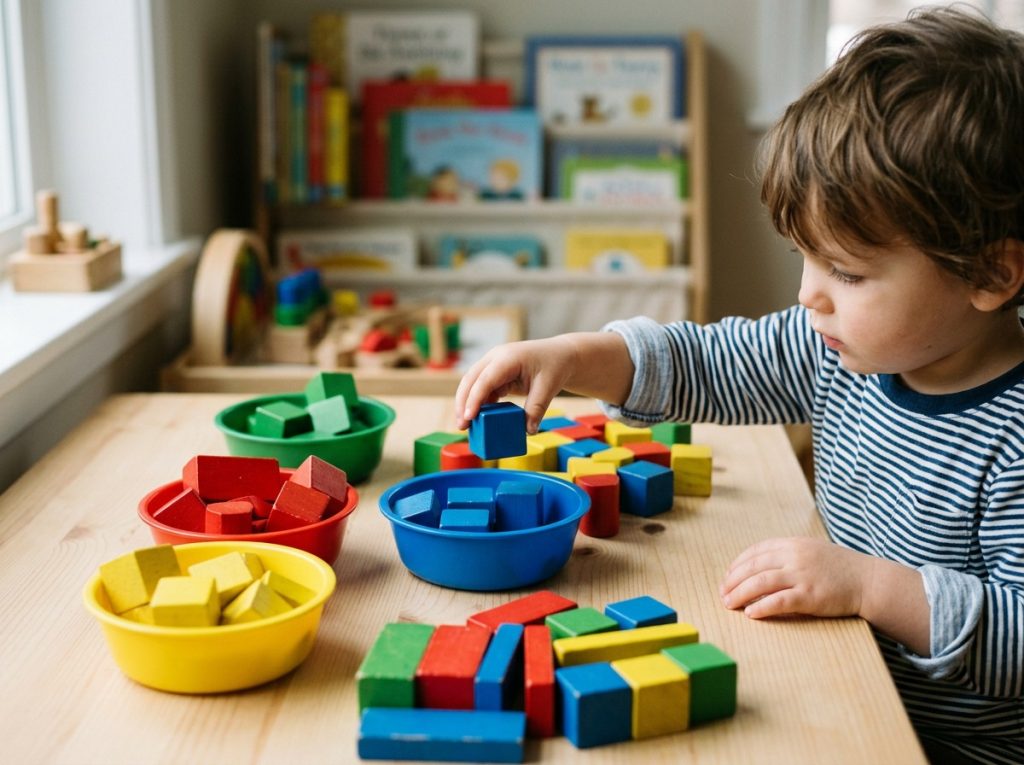
Wooden blocks, magnetic tiles, and stacking toys provide versatile color teaching materials through matching challenges that scale with developmental progression. Teachers begin with simple 2-color matching (finding all red blocks to build a “red tower”) and progress toward multi-color sorting (separating mixed blocks into color groups) as recognition strengthens.
The three-dimensional manipulation involved in building activities provides multisensory engagement (tactile, visual, proprioceptive) that supports memory formation more effectively than purely visual flash cards. Toddlers physically handling colored objects while hearing color names creates stronger neural associations between verbal labels and visual properties.
Activity variations maintain engagement across skill levels. Beginners work with adult-selected color groups (teacher hands child only red and blue blocks, asks child to build separate towers). Intermediate learners sort from mixed collections. Advanced children follow color patterns (red block, blue block, red block, blue block) or count color quantities.
Method 3: Color-Based Treasure Hunts and Finding Games
Movement-based color activities combine toddlers’ physical activity needs with color recognition practice. Teachers announce color-specific search challenges: “Find something red in our classroom” or “Bring me a blue toy.” Toddlers scan environments identifying color matches, then physically retrieve identified objects.
This method transforms color recognition into active problem-solving requiring visual discrimination, environmental scanning, and color-to-word association—more complex cognitive engagement than passive flash card viewing. The movement component extends engagement duration while meeting toddlers’ motor activity needs.
Teachers adjust difficulty through specificity (broad “find something red” versus specific “find a red block”) and quantity (find one item versus find three items). Beginning learners may need adult guidance (“Look at the bookshelf—do you see something red?”) while advanced children complete searches independently.
For space-constrained environments, treasure hunts work within limited areas using existing materials. Teachers rotate color targets across days (Monday red hunt, Tuesday blue hunt) preventing repetition fatigue while ensuring systematic exposure to each color.
Method 4: Dramatic Play With Color-Themed Scenarios
Pretend play scenarios incorporating color themes embed recognition practice within imaginative contexts that naturally engage toddlers. Teachers set up color-focused dramatic play: a “red restaurant” serving red play food on red plates, a “blue store” selling blue items, color-themed birthday parties where children sort gifts by wrapping paper color.
Color recognition within dramatic play serves functional purposes from the toddler’s perspective—correctly identifying red foods ensures accurate restaurant play, proper color sorting demonstrates gift-giving competence. This functional motivation sustains engagement longer than abstract learning tasks.
The social component adds peer teaching opportunities absent from individual activities. Toddlers observe classmates identifying and using color vocabulary during shared play, receiving models from multiple sources (teachers and peers) that reinforce learning.
For institutional settings, color-themed dramatic play requires minimal setup using existing materials (play food, toy dishes, pretend shopping items) grouped by color rather than function. Teachers rotate color themes weekly or biweekly, ensuring repeated exposure while maintaining novelty.
Method 5: Art Activities Emphasizing Color Exploration
Open-ended art experiences using paints, crayons, and colored paper provide multisensory color exposure while supporting creative expression. Teachers narrate color choices during art creation: “You’re painting with red. Now you’re adding blue. Red and blue together make purple!” rather than directing specific color use.
Art activities differ from other methods by emphasizing color perception and experimentation over correct identification—toddlers discover color properties through direct manipulation and observation. Mixing paints demonstrates that colors combine to create new colors, advancing understanding beyond simple identification.
The process-focused nature of toddler art supports color learning without performance pressure. Unlike matching games where children perceive right and wrong answers, art exploration frames all color choices as valid, reducing anxiety for children struggling with color recognition while still providing exposure.

Material Selection: Choosing Toys That Support Color Teaching
Effective implementation of methods for how to teach colors to toddlers requires toys and materials providing clear color differentiation, varied contexts, and durability for repeated handling.
Color Clarity and Differentiation
Toys supporting color recognition use pure, saturated hues (primary and secondary colors) rather than pastels, neutrals, or complex shades that increase discrimination difficulty for beginning learners. Bright red blocks prove easier to distinguish and name than dusty rose blocks. Clear blue differs more obviously from green than teal shades blurring categorical boundaries.
For institutional purchasing, toy collections emphasizing eight basic colors (red, orange, yellow, green, blue, purple, black, white) across multiple toy categories provide broader learning support than collections featuring many toys in limited color ranges. A classroom with red blocks, red cars, red sorting counters, and red play dishes offers better varied-context learning than blocks in fifteen different shades but limited color representation in other toy categories.
Surface finish impacts color perception—glossy plastic toys reflect light creating color variations that confuse toddlers learning color constancy. Matte-finish wooden toys provide more consistent color perception across different lighting conditions and viewing angles.
Durability and Safety for Repeated Handling
Toddlers learning through play-based methods handle, mouth, drop, and manipulate teaching materials hundreds of times across learning progressions. Solid wood construction withstands toddler handling better than hollow plastic equivalents, maintaining color integrity through washing and heavy use.
Water-based, non-toxic finishes preserve color saturation while meeting safety standards for mouthing (inevitable during toddler play). Painted toys using surface coatings rather than solid-colored materials show wear and chipping that create color confusion—a “red” block with chipped paint exposing natural wood underneath no longer provides clear color identification practice.
Measuring Progress: How to Assess Color Recognition Development
Teachers and parents implementing strategies for how to teach colors to toddlers need observable indicators of color learning progression beyond standardized testing inappropriate for toddler age ranges.
Observable Skill Milestones
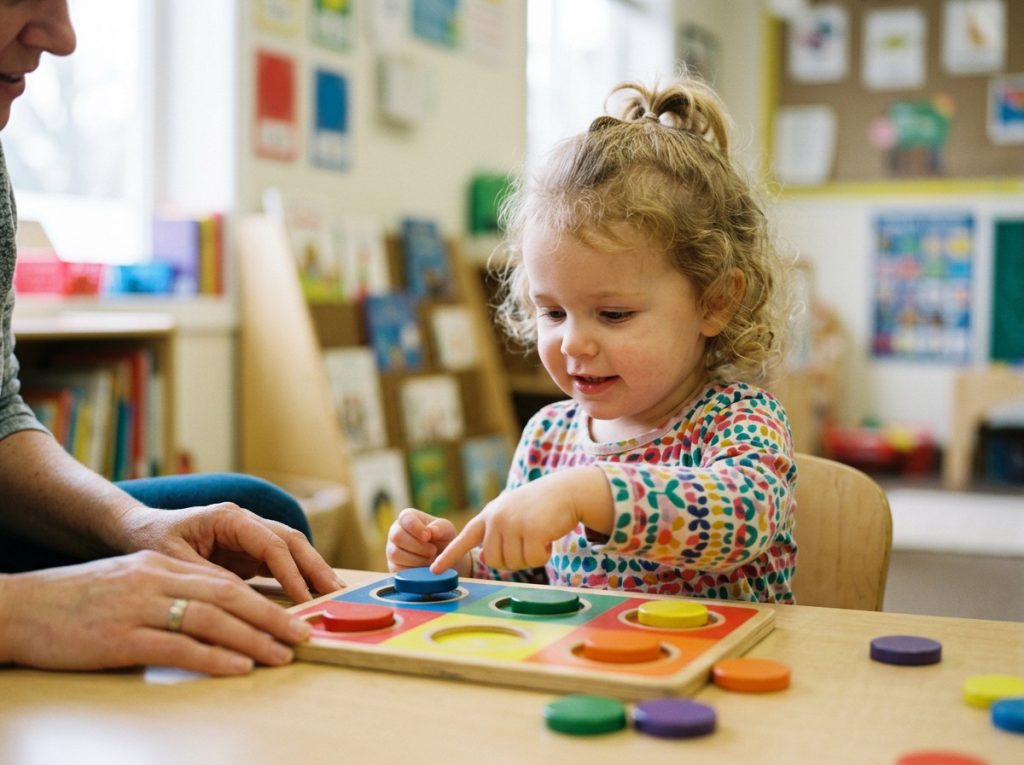
Teachers assess stage progression through informal observation rather than formal testing. Toddlers who consistently sort toys by color during free play demonstrate matching competence regardless of whether they verbally name colors. Those who accurately respond to “find the red car” show receptive color vocabulary even if they don’t yet spontaneously produce color words. Spontaneous comments like “I have blue shoes!” indicate advanced recognition not requiring adult prompting.
For documentation purposes, brief observational notes capture skill progression without requiring dedicated assessment time. Recording instances of color matching, prompted identification, and spontaneous naming creates evidence of learning trajectories useful for family communication and individualized planning.
Most toddlers demonstrate uneven color recognition—accurately naming 1-2 colors while confusing others, or correctly identifying colors in some contexts (toys) but not others (clothing). Temporary color confusion appears even after children demonstrate consistent recognition, typically reflecting cognitive reorganization as children refine color concepts rather than learning loss.
Common Mistakes and Implementation Boundaries
Even well-designed approaches for how to teach colors to toddlers face limitations and misapplications that reduce effectiveness or create unnecessary pressure.
Premature academic pressure. Some programs and parents begin formal color testing before toddlers demonstrate developmental readiness (reliable matching ability), creating performance anxiety around color activities. Forcing verbal color naming before children show spontaneous interest transforms learning into stressful compliance rather than natural concept development.
Over-reliance on single methods. Limiting color teaching to one approach (only color sorting, only naming drills) provides insufficient contextual variety for building transferable understanding. Effective implementation combines multiple methods across daily routines—sorting during clean-up, building games during free play, color hunts during outdoor time.
Inconsistent color vocabulary. Adults sometimes use inconsistent color names (calling the same object “red” and “pink” interchangeably, describing purple items as “blue”) creating confusion about color boundaries and labels. Conscious attention to consistent primary color labeling supports clearer concept formation during early learning stages.
Neglecting color property language. Simply naming colors (“that’s red, that’s blue”) provides less comprehensive understanding than describing color as object property (“you found a red ball—red is the ball’s color”). Property language helps toddlers understand that color represents one characteristic among many object attributes, supporting the abstraction required for transferable recognition.
Conclusion
Learning how to teach colors to toddlers through play-based methods delivers faster, more durable learning than traditional flash card drills by providing the contextualized repetition and varied exposure necessary for abstract concept formation. Color recognition requires 200-300 varied exposures before toddlers achieve stable understanding, making everyday integration essential.
Five accessible methods embed color teaching within existing routines: color-coded storage during clean-up creates daily repetition, building toy matching provides multisensory engagement, movement-based treasure hunts combine physical activity with visual scanning, dramatic play adds functional motivation within social contexts, and open-ended art emphasizes color properties without performance pressure. Implementation requires only existing toys rather than specialized curriculum purchases.
Developmental progression moves from matching (18-24 months) to prompted naming (24-30 months) to spontaneous identification (30+ months), with substantial individual variation. Material selection prioritizing pure saturated hues in durable, matte-finish construction supports clearer color discrimination. Progress assessment relies on informal observation of matching consistency, prompted identification accuracy, and spontaneous color vocabulary use.
Successful implementation avoids premature academic pressure before readiness, combines multiple methods for varied contextual exposure, maintains consistent color vocabulary, and emphasizes color as object property rather than only color names. Teachers and parents achieve better outcomes by integrating color teaching naturally throughout daily activities rather than creating isolated instructional moments that exceed toddler attention spans.