
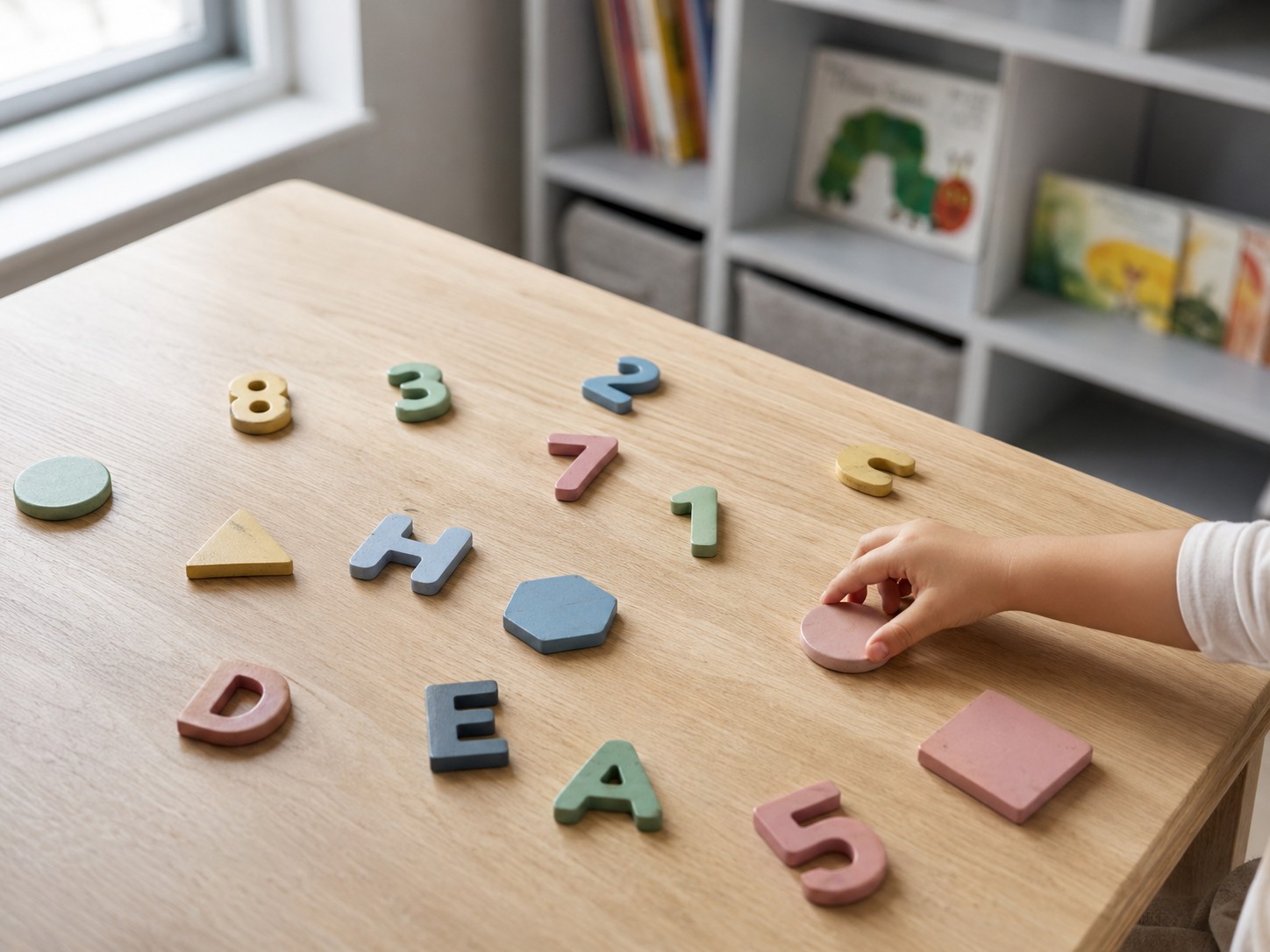
Preschool classrooms face a persistent challenge: young children struggle to stay focused during structured learning activities. Traditional teaching methods often rely on verbal instruction and paper-based exercises, but three- and four-year-olds learn best through tactile exploration and immediate visual feedback. According to the National Association for the Education of Young Children (NAEYC), preschoolers typically maintain focus for only 5-15 minutes on teacher-directed tasks, yet hands-on manipulatives can extend engagement by up to 40% compared to worksheet-based activities.
Magnetic learning toys address this problem by transforming abstract concepts into tangible, manipulable objects. When children physically connect magnetic letters, numbers, or shapes, they engage multiple senses simultaneously—creating stronger neural pathways than passive observation alone. This hands-on, play-based quality is why magnetic learning toys align so well with early childhood development research showing that preschoolers need concrete experiences before understanding symbolic representations.
The rise of magnetic learning toys in preschool settings reflects a broader shift toward play-based learning frameworks that prioritize exploration over memorization. Schools and early learning centers now recognize that durable, versatile educational tools can support multiple curriculum goals while reducing teacher workload. This article examines why magnetic learning toys have become essential in modern preschool classrooms, what problems they solve for educators, and how institutions evaluate these products for long-term use.
The Developmental Fit Between Magnetic Learning Toys and Preschool Learning Needs
Concrete Learning During Critical Brain Development
Children aged 3-5 operate primarily in the preoperational stage of cognitive development (Piaget), where abstract thinking remains limited. They understand the world through direct sensory experience rather than symbolic logic. Magnetic learning toys provide concrete representations of concepts that would otherwise remain intangible—a magnetic fraction circle becomes a physical object children can hold, rotate, and compare, rather than an abstract mathematical notation.
This concreteness matters because preschool brains form synaptic connections at unprecedented rates. When a child physically snaps two magnetic number tiles together to create “10,” the brain encodes that action alongside the visual and tactile feedback. Research from the Institute for Learning & Brain Sciences shows that multi-sensory learning experiences create 30-50% stronger memory retention in early childhood compared to single-modality instruction. Repeated physical manipulation strengthens these neural pathways, building foundational number sense that supports future arithmetic skills. This is the core cognitive benefit that makes magnetic learning toys more effective than static paper materials for early skill building.
Self-Correcting Feedback Through Magnetic Attraction
One underappreciated advantage of magnetic learning materials is their built-in feedback mechanism. For structured activities with clear learning objectives—such as pattern matching, fraction assembly, and word building—pieces either attract and hold firmly or fail to align properly, providing immediate confirmation of correct or incorrect placement. This self-correcting quality allows independent exploration without constant teacher intervention.
Traditional preschool manipulatives like wooden blocks or plastic counters require adult guidance to confirm accuracy. A child building a pattern with non-magnetic materials must wait for teacher validation, interrupting their flow state and creating dependence on external approval. Magnetic learning toys enable autonomous problem-solving, which builds confidence and allows teachers to observe student thinking rather than constantly correcting errors. In mixed-ability classrooms serving 15-20 students, this independence reduces individual teacher interventions by an estimated 35%, freeing educators to facilitate deeper learning conversations. This efficiency gain is a key reason schools are adopting magnetic learning toys at scale.
Practical Applications Across Preschool Curriculum Areas
Across every core preschool subject, magnetic learning toys create flexible, engaging learning experiences that adapt to different lesson plans.

Early Math Foundations Through Magnetic Manipulatives
Preschool math education focuses on four core areas: number recognition, counting skills, basic patterns, and shape identification. Magnetic learning toys with number tiles and geometric shapes address all four simultaneously. A teacher can place magnetic numbers 1-10 on a metal board, then ask children to match quantities of magnetic counters to each numeral—building one-to-one correspondence while reinforcing number symbols.
Pattern recognition activities become particularly engaging with magnetic materials. Children create ABAB or AABB patterns using color-coded magnetic shapes, physically moving pieces until patterns emerge. The immediate tactile feedback when pieces connect helps students recognize when patterns align correctly, developing the logical thinking skills that underpin algebraic reasoning in later grades.
Fraction concepts, typically introduced in elementary school, can be explored informally through magnetic fraction circles. Preschoolers discover through play that two half-circles create one whole, or four quarter-pieces fit together perfectly. These hands-on experiences build intuitive understanding of part-whole relationships years before formal fraction instruction begins, making magnetic learning toys a valuable pre-math investment for early learning programs.
Literacy Development With Magnetic Letter Systems
Letter recognition and phonemic awareness form the foundation of reading readiness, and magnetic learning toys with alphabet sets allow children to physically manipulate letters while learning their shapes and sounds. Unlike worksheets where letters remain static on a page, magnetic letters can be rotated, flipped, and rearranged—helping students understand that letter identity remains constant regardless of orientation or position.
Teachers use magnetic letters for name recognition activities, a key early literacy milestone. Each child’s name appears on a metal strip with corresponding magnetic letters nearby. Children match letters to their names, physically constructing their identity while practicing letter-sound correspondence. As students progress, magnetic letters support CVC word building (consonant-vowel-consonant patterns like “cat” or “dog”). The physical act of assembling letters in sequence reinforces left-to-right directionality and phonetic blending—critical precursors to independent reading. This tangible approach is why magnetic learning toys remain a staple in preschool literacy centers.
Spatial Reasoning and STEM Exploration
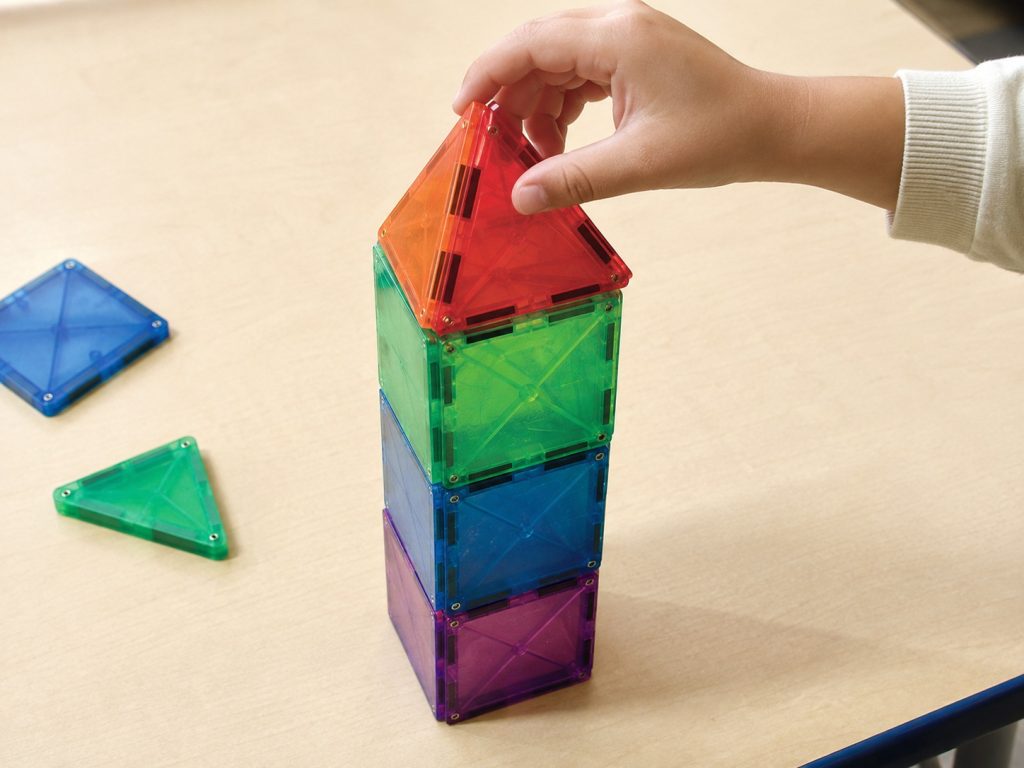
Preschool STEM learning emphasizes exploration, experimentation, and problem-solving rather than formal scientific concepts, and magnetic learning toys with geometric building tiles enable open-ended construction that develops spatial reasoning. Children discover through trial and error that triangles combine to form squares, or that certain shapes create stable structures while others collapse.
This experimentation builds engineering thinking patterns without formal instruction. When a child’s magnetic tower falls, they naturally adjust their approach—testing different base configurations or adding support structures. These self-directed problem-solving cycles mirror the iterative design process used by professional engineers, establishing thinking habits that support future STEM learning. For young learners, magnetic learning toys turn basic structural play into foundational STEM practice.
Why Schools and Institutions Choose Magnetic Learning Toys
Durability and Total Cost of Ownership
Preschool purchasing decisions balance educational value against long-term durability. Standard consumer-grade magnetic learning toys typically withstand approximately 2,000 connection cycles before magnets weaken or detach. In contrast, institutional-quality magnetic learning tools undergo testing for 10,000+ connection cycles, maintaining consistent magnetic strength throughout years of intensive classroom use.
This longevity impacts total cost of ownership significantly. A set of institutional-grade magnetic pattern blocks costing $80 that serves 200 students over eight years costs $0.40 per student—far less than consumable workbooks or fragile plastic toys needing annual replacement. School administrators increasingly evaluate educational materials using this lifecycle cost analysis rather than initial purchase price alone, and magnetic learning toys consistently deliver strong returns on this long-term investment metric.
Multi-Purpose Use Across Learning Centers
Preschool classrooms typically organize into learning centers—designated areas for math, literacy, dramatic play, and art. Magnetic learning toys transition seamlessly between centers, maximizing material utilization. The same magnetic number set used in morning math activities can appear in the dramatic play center as “prices” for a pretend store, or in the art area as stencils for number painting.
This versatility reduces storage demands and simplifies classroom organization. Instead of maintaining separate material sets for each learning area, teachers can rotate a core collection of magnetic manipulatives through different centers. This approach particularly benefits smaller preschools or home-based childcare programs with limited storage space and tight budgets, as a single set of magnetic learning toys can replace multiple single-use materials.
Supporting Diverse Learning Needs With One Tool
Preschool classrooms increasingly include children with varied developmental levels and learning needs. Magnetic learning toys naturally accommodate this diversity through open-ended design. For children with attention difficulties, the tactile satisfaction of magnetic connection provides grounding sensory input that supports focus. The clear boundaries of magnetic boards create defined workspaces that help students with spatial processing challenges understand task parameters. These built-in supports reduce the need for specialized adaptive equipment while ensuring all students access core learning activities, making magnetic learning toys an inclusive choice for universal preschool classrooms.
What to Consider When Evaluating Magnetic Learning Toys
Magnet Strength and Safety Standards
The effectiveness of magnetic learning toys depends on appropriate magnetic force. Magnets must connect firmly enough to prevent frustration when children build structures, but release easily enough for small hands to separate pieces independently. Weak magnets create frustration when pieces fall apart unexpectedly; overly strong magnets require adult assistance to disassemble, defeating the purpose of independent learning.
Safety certifications matter significantly for preschool purchases. Reputable manufacturers ensure magnets remain fully enclosed within plastic or wood casings, eliminating the risk of loose magnets that pose serious ingestion hazards. Schools should verify that products meet ASTM F963 (US), EN 71 (EU), and CPSIA standards, displaying appropriate age-grade certifications. Cheap magnetic learning toys from unverified suppliers may contain exposed or loosely attached magnets that fail safety testing.
Educational Design Beyond Surface Appeal
Not all magnetic learning toys offer equal educational value. Products designed specifically for learning environments differ substantially from general magnetic toys marketed to parents. Educationally designed magnetic manipulatives feature intentional color coding, size progression, and shape relationships that support specific learning objectives.
For example, well-designed magnetic fraction sets use consistent color schemes where all “halves” appear in one color and all “quarters” in another—helping children recognize equivalent pieces across different activities. Generic magnetic learning toys often prioritize visual appeal over pedagogical function, using random color assignments that don’t reinforce mathematical relationships.
Storage and Classroom Management Features
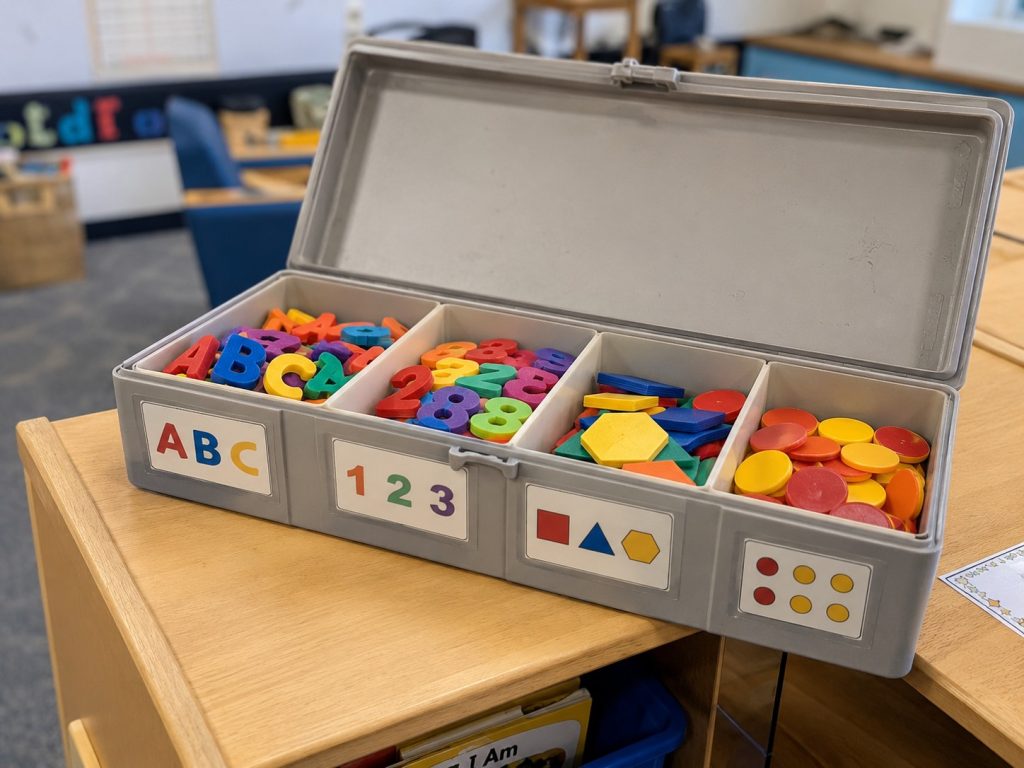
Teachers managing 15-20 preschoolers simultaneously need materials that support quick setup and cleanup. Magnetic learning toys designed for institutional use often include dedicated storage containers with labeled compartments, enabling children to independently return materials to correct locations. This organization teaches responsibility while preserving complete sets—a practical concern when missing pieces render materials unusable. For busy preschool classrooms, well-designed storage extends the usable life of magnetic learning toys significantly.
How Vindstier Magnetic Learning Solutions Support Preschool Education
Research-Based Design Calibrated to Child Development
Vindstier develops magnetic learning toys in collaboration with early childhood educators and developmental specialists, ensuring products match preschool cognitive and physical capabilities. Our magnetic force specifications undergo testing with children aged 3-5 to determine optimal connection strength—firm enough to build three-dimensional structures without collapse, yet requiring only 800-1200 grams of pull force, matched to the average grip strength of 3–5-year-olds, that preschoolers can comfortably manage without adult assistance.
Our magnetic letter and number sets feature tactile surface textures that enhance sensory engagement beyond standard smooth plastic. Children trace embossed letter shapes with their fingers while manipulating pieces, reinforcing letter formation through touch. This multi-sensory approach addresses diverse learning styles within a single product, eliminating the need for separate tactile and visual materials, and sets Vindstier magnetic learning toys apart from basic consumer-grade options.
Institutional-Grade Durability With Educational Integrity
Vindstier magnetic products undergo rigorous durability testing that simulates years of classroom use, passing 10,000+ connection cycles without magnet weakening—five times the durability threshold of typical consumer magnetic toys. Enclosed magnet systems prevent detachment even when pieces are dropped, thrown, or chewed, meeting ASTM F963, EN 71, and CPSIA safety requirements for mixed-age preschool environments.
This durability combines with thoughtful educational design. Our magnetic pattern block sets maintain precise geometric relationships, so triangles genuinely equal half of squares and six triangles create a perfect hexagon. This mathematical accuracy matters because preschoolers develop spatial reasoning through physical manipulation—imprecise shapes teach incorrect relationships that later require unlearning, a detail many budget magnetic learning toys overlook.
Classroom-Ready Implementation Support
Schools purchasing Vindstier magnetic learning systems receive curriculum-aligned implementation guides developed by experienced early childhood educators. These resources provide activity progressions mapped to common preschool frameworks including Creative Curriculum and HighScope, helping teachers maximize educational value from day one. For institutions requiring documentation, our guides include observation prompts that connect open-ended play with specific learning standards.
All sets come with picture-labeled storage trays designed for pre-readers, allowing children to complete cleanup routines independently and reducing material loss over time. Beyond initial purchase, Vindstier offers institutional clients replacement piece services and custom bulk configurations—addressing the practical reality that classroom materials experience loss and require replenishment. This ongoing partnership approach distinguishes educational suppliers from consumer toy retailers, and ensures your magnetic learning toys remain fully functional for years of classroom use.
Real-World Impact: A Regional Preschool Case
A mid-sized preschool network serving 180 students across six classrooms integrated Vindstier magnetic learning sets into their literacy and math centers. After one semester, teachers reported measurable changes: independent work time during center rotations increased from an average of 8 minutes to 12 minutes per student, representing a 50% improvement in sustained engagement. Material management time decreased by approximately 30%, as children successfully completed cleanup routines without adult sorting of mixed manipulatives. Annual consumable and manipulative replacement costs also dropped by an estimated 60% compared to their prior paper and plastic material sets.
The self-correcting nature of magnetic materials proved particularly valuable for their mixed-ability classrooms. Teachers noted that advanced learners spontaneously created complex pattern sequences and multi-step math problems using the same materials that supported struggling students’ basic number recognition—reducing the need for separate differentiated materials and associated storage challenges, proving that high-quality magnetic learning toys deliver measurable value for both students and staff.
Conclusion
Magnetic learning toys have earned their place in preschool classrooms by addressing fundamental challenges in early childhood education. Research confirms magnetic learning toys extend engagement time, support multi-sensory learning that strengthens memory retention, and enable the independent exploration that builds confidence in young learners. For schools and institutions, magnetic learning toys offer exceptional durability that reduces long-term costs, multi-purpose flexibility that simplifies classroom management, and natural accommodation of diverse learning needs.
The most effective magnetic learning toys combine institutional-grade construction with intentional educational design—ensuring materials withstand years of intensive use while supporting specific developmental goals. As preschool education continues evolving toward play-based, child-directed approaches, magnetic learning toys will remain essential tools for teachers who understand that young children learn best by doing.
Vindstier remains committed to developing magnetic learning solutions that serve both educational and institutional needs, creating products that teachers trust and students genuinely engage with throughout their preschool years.
Request a free classroom sample kit and aligned curriculum guide to see how Vindstier magnetic learning toys fit your preschool program.