When teachers set up a structured activity with a defined outcome, most children complete it the same way. The child who finishes first waits. The child who struggles feels stuck. And somewhere in between, the opportunity for genuine thinking quietly disappears.
This is the gap that open-ended toys address — not by adding more instructions, but by removing them entirely.
Open-ended toys have become one of the most discussed categories in early childhood education, and for good reason. Schools, curriculum designers, and educational product buyers are increasingly looking for materials that don’t expire after one use, that work across age groups and learning levels, and that give children room to actually think. The research behind play-based learning supports this direction, and classroom experience confirms it: when children aren’t told what to make, they make something more interesting.
This article examines how open-ended toys work in practice, what makes them developmentally valuable, and why they represent a strong investment for schools and educational institutions building long-term classroom material strategies.
What Makes a Toy Truly Open-Ended?
The distinction matters more than it might seem. A puzzle has one correct answer. A shape sorter accepts only the right piece in the right hole. These are closed-ended materials — useful for specific skills, but limited in scope.
An open-ended toy has no correct outcome. There is no right way to use it, no finished product to compare against, and no moment when the child is “done” unless they decide they are. This structural openness is what drives its educational value.
The table below captures the core difference between closed-ended and open-ended materials across the dimensions that matter most in classroom selection:
| Dimension | Closed-Ended Toys | Open-Ended Toys |
|---|---|---|
| Outcome | One correct answer | Unlimited possibilities |
| Child’s role | Follow instructions | Drive the experience |
| Replayability | Decreases after mastery | Grows with the child |
| Curriculum fit | Targets one skill area | Spans multiple domains |
| Teacher facilitation | Demonstrate and correct | Question and observe |
| Developmental range | Age-specific | Multi-year relevance |
| Cost-per-use over time | Increases | Decreases |
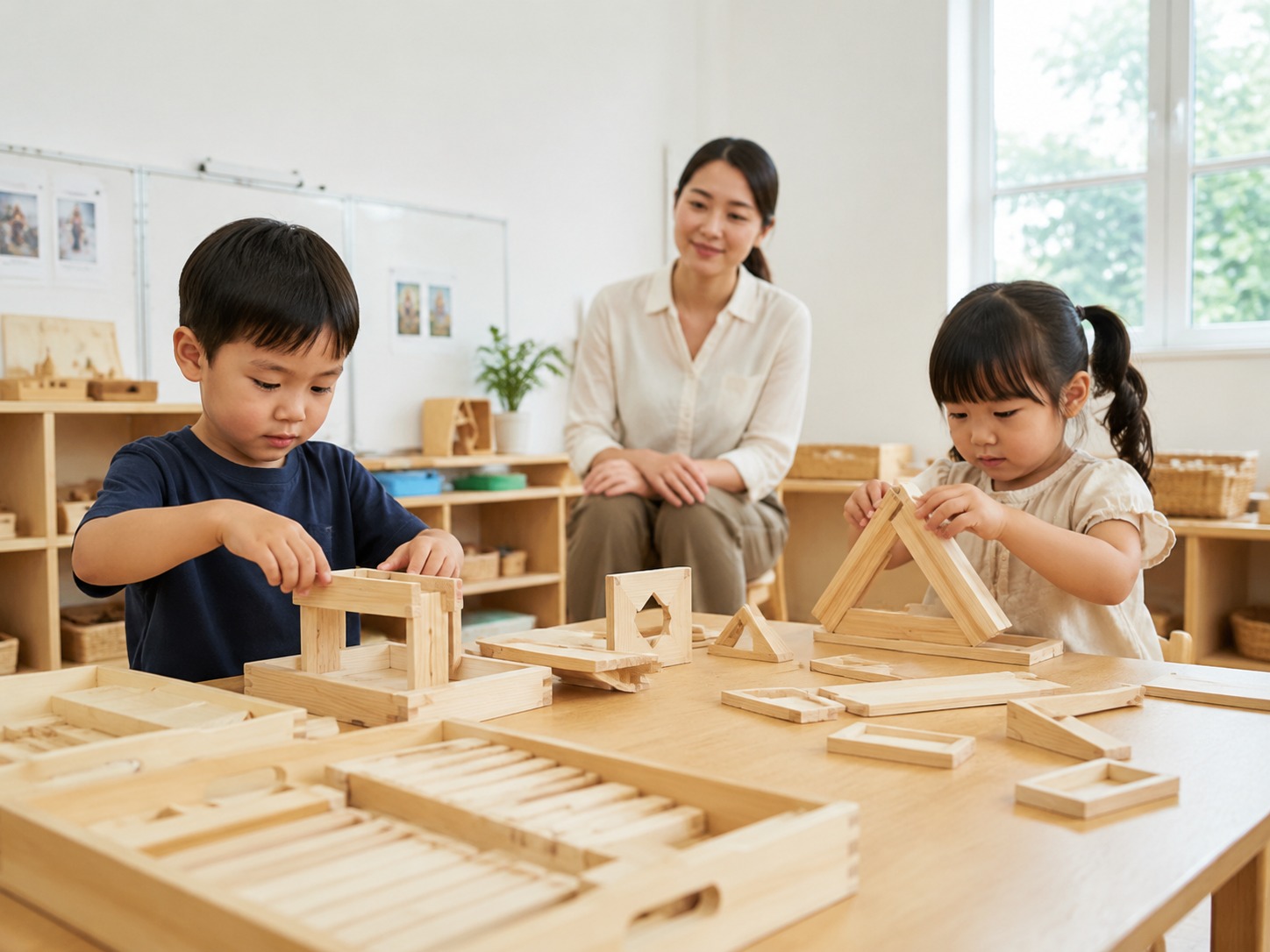
Blocks are the classic open-ended example. A set of wooden unit blocks can become a city, a bridge, a balance challenge, a counting tool, or a sorting exercise depending on the child, the day, and the question the teacher asks. The same material serves a two-year-old stacking for sensory satisfaction and a six-year-old testing structural principles.

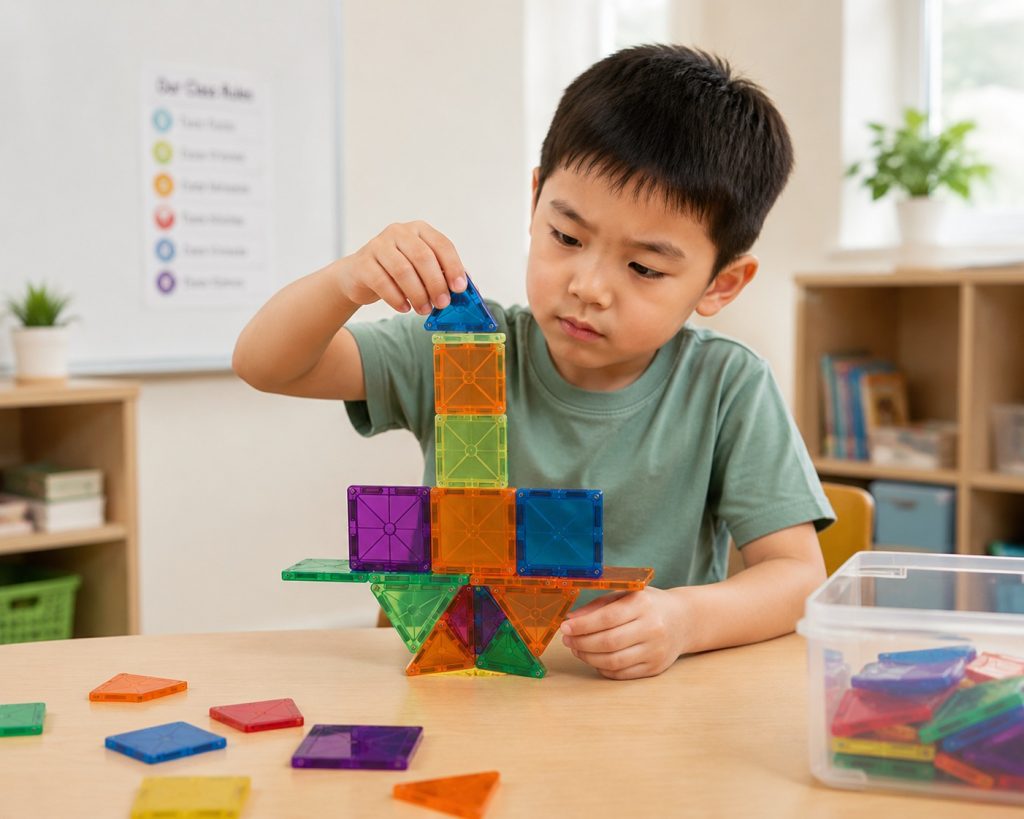
Loose parts — collections of natural materials, connectors, fabric pieces, or wooden shapes — work similarly. So do magnetic building sets, open-format construction materials, and role-play props that don’t lock children into a single narrative.
What these materials share is that the child drives the experience. The toy responds to the child’s decisions rather than directing them.
How Open-Ended Toys Build Creative Thinking
Creativity is not a personality trait. It’s a cognitive process that can be practiced, strengthened, and undermined depending on the environment a child learns in.
When children work with open-ended materials, they repeatedly exercise a specific mental skill: generating possibilities. Before a child places a block, they consider options. Before they add to a construction, they evaluate what they have and what they want. This constant cycle of imagining, attempting, observing, and adjusting is the same process underlying design thinking, scientific reasoning, and creative problem-solving in adult professional contexts.
Research in early childhood development consistently identifies this kind of divergent thinking as a core outcome of play-based learning environments. Maria Montessori’s materials were designed around this principle — that hands-on, self-directed exploration builds cognitive independence more effectively than instruction-based learning. Reggio Emilia’s approach goes further, treating children as active constructors of knowledge who need environments rich with open-ended provocation to express what they’re capable of.
In practical classroom terms, this looks like a child who doesn’t stop at one solution. A child who has spent regular time with open-ended toys develops the habit of asking “what else could this be?” rather than looking for the answer someone else has already decided.
That cognitive flexibility is measurable, and it transfers. Children with strong divergent thinking skills show better performance in language development, mathematical reasoning, and social negotiation — not because open-ended play teaches those subjects directly, but because it builds the underlying mental habits that support learning across domains.
Problem-Solving in Practice: What Happens When There Are No Instructions
The absence of instructions is not a gap — it’s the point.
When a child is handed a toy with a manual, their job is to follow it. When they’re handed open-ended materials, their job is to figure something out. These are fundamentally different cognitive experiences.
Consider a group of five-year-olds given a set of wooden planks, cylinders, and arches with no instructions. Within minutes, most groups will attempt some kind of construction. They’ll encounter a problem — the structure falls, the arch doesn’t reach, the tower tips. At that moment, they have options: give up, ask an adult for help, or try something different.
Teachers who observe open-ended play regularly report that children in well-designed play environments tend toward the third option more readily over time. This is not because they’re braver, but because repeated experience with open-ended materials has taught them that the problem is solvable. They’ve succeeded before without being shown how. That prior experience creates what psychologists describe as self-efficacy — the belief that one’s own effort and thinking can produce results.
“Before we introduced open-ended building materials, I spent most of free play time redirecting children who had ‘finished’ or lost interest. Now the same children work for forty minutes without needing me to intervene. The quality of what they build is secondary — what I’m watching is how they think.”
— Early Childhood Lead Teacher, international preschool program
This shift in classroom dynamic is one of the clearest practical arguments for open-ended toys in school settings. The goal is not to teach children to build a tower. The goal is to build children who try again when the tower falls.
For school directors evaluating curriculum materials, the implications extend beyond individual children. A classroom culture where self-directed problem-solving is normalized reduces teacher workload, supports mixed-ability grouping, and creates observable learning behaviors that are easier to document for accreditation and parent communication.
“We’ve been sourcing open-ended construction sets for our three campuses for two years. The single biggest change we’ve seen isn’t in the children’s products — it’s in how confidently they approach challenges in structured lessons afterward. That transfer effect was not something we anticipated, but it’s now central to how we justify the investment.”
— Director of Curriculum, early childhood school network
For teachers, this changes the instructional role. Rather than demonstrating solutions, a skilled teacher using open-ended materials asks questions: “What do you think would happen if you moved that piece?” “Is there a way to make it stronger?” This Socratic facilitation supports deeper thinking without giving answers — a technique that’s considerably easier to sustain when the material itself doesn’t have a right answer to give away.
Age Progression: How Open-Ended Toys Scale Across Development
One of the most commercially and educationally significant features of quality open-ended toys is their developmental range. A single well-designed material can serve children from toddler age through early primary school — not because the toy changes, but because the child’s use of it evolves.
The progression below illustrates how the same open-ended materials function differently at each developmental stage:
| Age Range | Developmental Focus | How Open-Ended Toys Are Used | Key Skills Supported |
|---|---|---|---|
| 1–3 years | Sensory exploration, cause and effect | Stacking, filling, emptying, mouthing, banging | Fine motor control, spatial awareness, early cause-effect understanding |
| 3–5 years | Symbolic and representational play | Blocks become buildings, fabric becomes costumes, parts become food | Language development, narrative construction, early social negotiation |
| 5–8 years | Intentional design and structural problem-solving | Planning before building, testing, revising, evaluating outcomes | Engineering thinking, mathematical reasoning, persistence, collaborative design |
This developmental continuity is what separates quality open-ended materials from age-bracketed alternatives. A set of magnetic tiles that a three-year-old uses for color sorting is the same set a seven-year-old uses to test geometric stability. The material doesn’t become obsolete — its complexity expands in response to the child’s growing capability.
For school buyers, this range matters significantly. Materials that remain relevant across multiple year levels represent stronger budget value than single-use curriculum resources. A classroom investment in quality open-ended toys serves a cohort of children through three or four years of development, and the materials themselves — when made to appropriate durability standards — outlast the children who use them.
What Classroom Teachers Actually Need From Open-Ended Materials
Teachers working with open-ended toys identify several practical requirements that don’t always appear in product descriptions but consistently shape whether materials get used or stored.
Durability under real classroom conditions. School materials face daily handling by twenty to thirty children. Pieces that chip, fade, or break after a term create frustration and replacement costs. Natural wood, solid connectors, and non-toxic finishes that hold up over years of use are baseline expectations for institutional buyers.
Versatility across curriculum areas. A good open-ended material shouldn’t live exclusively in the creative play corner. Teachers value materials they can bring into mathematics lessons for sorting and counting, into literacy for storytelling props, and into science for observation and classification. Materials that serve only one curriculum area have a narrower case for purchase.
Storage and classroom organization compatibility. Open-ended toys often involve many pieces. Materials that are difficult to sort, store, or audit create ongoing classroom management challenges. Teachers appreciate sets with clear organization logic — consistent sizing, color coding, or storage solutions that support independent child clean-up.
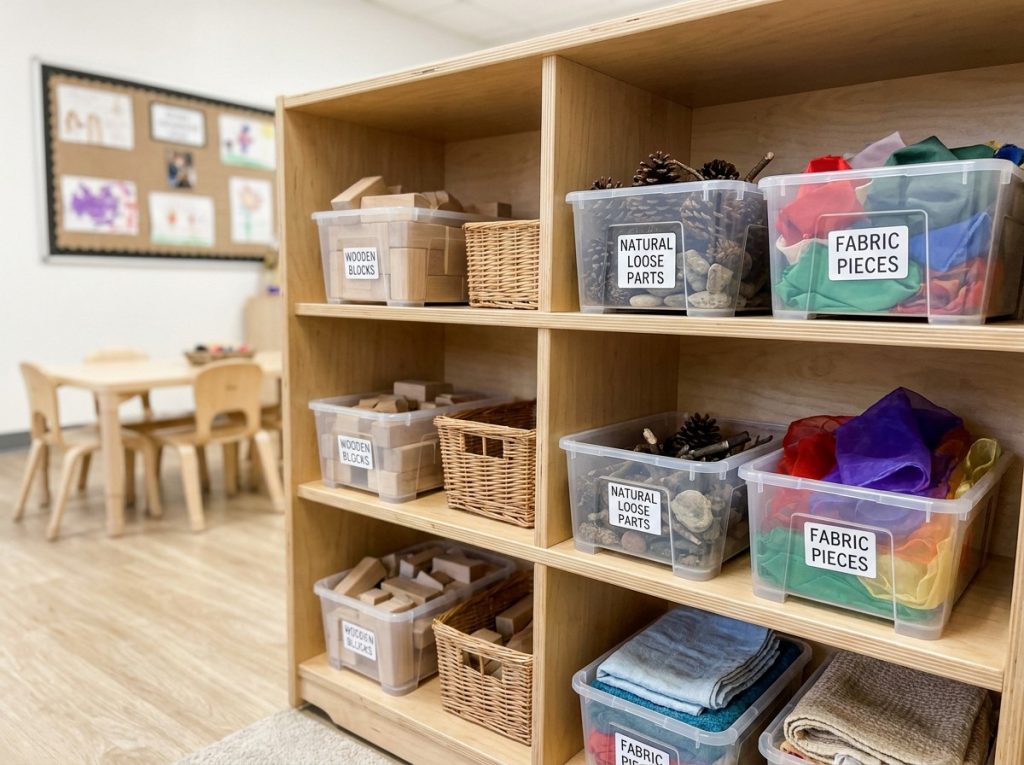
Invitation to play without constant teacher intervention. The best open-ended materials provoke engagement on their own. A child who walks into a classroom and immediately gravitates toward the material — without being directed to it — is the outcome teachers look for. This is partly about visual appeal and partly about the material’s inherent affordances: does it look like it does something interesting?
Vindstier’s open-ended toy collections are developed with these classroom realities in mind. The focus is not on novelty features but on materials that hold up, work across developmental stages, and give both children and teachers genuine room to work. For schools and educational institutions building sustainable classroom material programs, that focus on long-term educational value over trend-driven design is what distinguishes a reliable supplier from a short-term catalog option.
Why Open-Ended Toys Are a Smart Procurement Decision for Schools
Schools and educational institutions purchasing classroom materials face a consistent tension: limited budget against the need for materials that serve diverse learners, last multiple years, and align with contemporary educational frameworks.
Open-ended toys resolve several of these tensions simultaneously.
Because they work across developmental levels, they reduce the need for age-specific replacement cycles. Because they support multiple curriculum areas, they justify budget allocation across departments. Because they require no consumables, their cost-per-use drops significantly over time compared to worksheet-based or single-use craft materials.
There’s also an increasingly important alignment argument. School accreditation frameworks, early childhood quality standards, and parent expectations have shifted toward play-based, child-directed learning models. An institution that can demonstrate a thoughtful, evidence-based approach to classroom materials — including open-ended toys that reflect Montessori, Reggio Emilia, or inquiry-based principles — is better positioned in both regulatory reviews and community trust.
For distributors and toy brands sourcing products for school markets, open-ended toys occupy a stable commercial category. They’re not trend-dependent. They don’t become obsolete when a screen-based toy equivalent appears. Their educational value is grounded in developmental science that hasn’t changed, and the institutional buyers who purchase them are looking for long-term supplier relationships rather than one-time transactions.
The Difference Between Open-Ended Toys and Generic Play Materials
Not every unstructured toy is genuinely open-ended in the educational sense. This distinction matters for buyers comparing options.
Generic play materials may lack the design intention that makes open-ended toys pedagogically useful. A pile of random objects can technically be played with in multiple ways, but materials designed with open-ended educational play in mind typically reflect considered choices: proportions that work mathematically, colors that support sorting and classification, forms that invite stacking, balancing, or connection, and scales that are manageable for small hands but complex enough to challenge.
The difference shows up in classroom outcomes. Teachers working with thoughtfully designed open-ended materials report longer sustained engagement, more complex play scenarios, and more observable problem-solving behavior than teachers using generic alternatives. That difference is not incidental — it reflects the design work behind the product.
For buyers evaluating suppliers, this is a meaningful due diligence question: does the manufacturer understand why the product works educationally, or are they producing materials that look like open-ended toys without the underlying design thinking? A supplier who can speak fluently about developmental stages, play-based learning frameworks, and classroom application has earned a different level of confidence than one who can only describe materials and finishes.
Conclusion
Open-ended toys work because they put the thinking where it belongs: with the child. They create conditions for creativity and problem-solving not by teaching those skills directly, but by providing consistent, meaningful opportunities to practice them. For teachers, they simplify facilitation while deepening learning outcomes. For schools, they represent durable, curriculum-relevant investments that serve children across multiple years of development. For the institutions and brands building educational product programs, they occupy a stable, evidence-backed category with growing institutional demand.
The question for buyers isn’t whether open-ended toys belong in classrooms. The question is which materials are designed with enough educational intention to deliver on that potential — and which suppliers understand the difference.