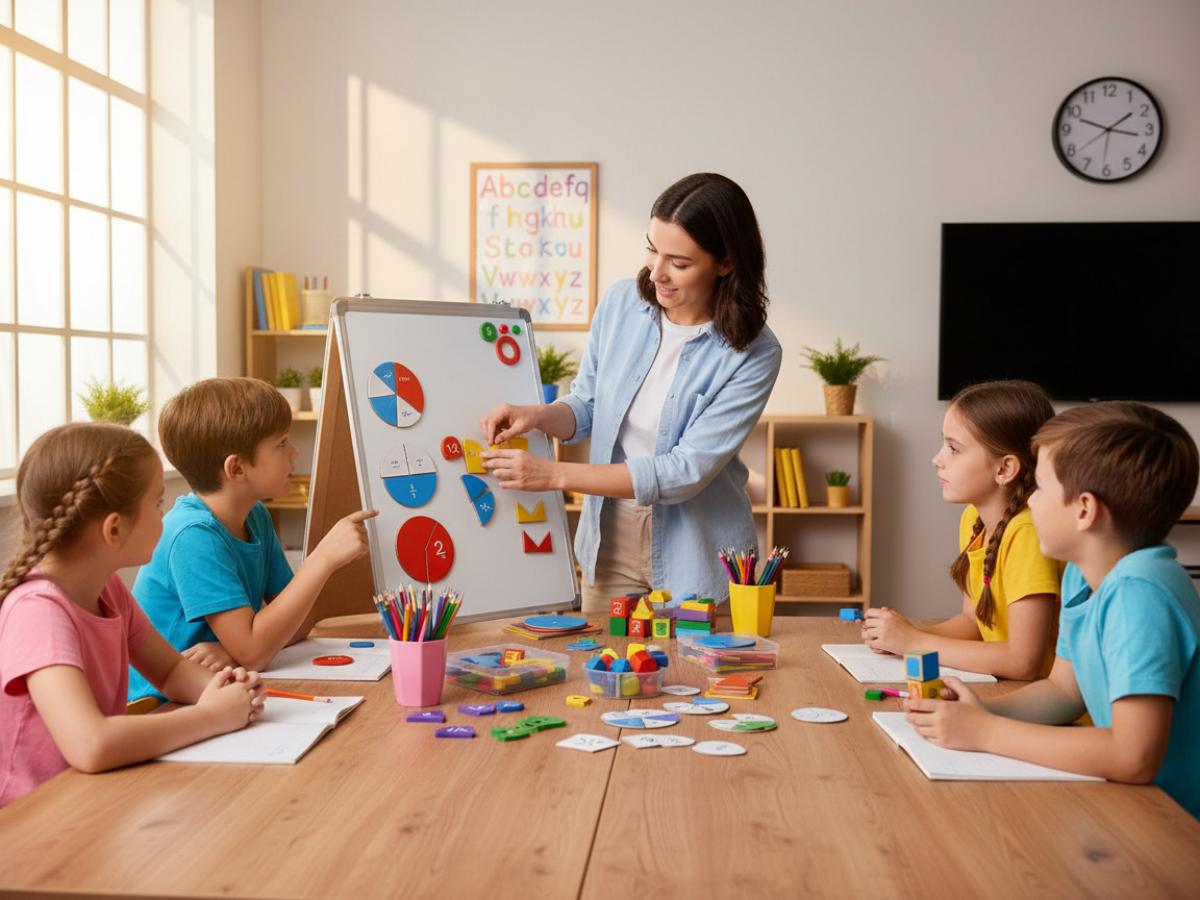
Many teachers face the same challenge when teaching mathematics: students can often complete exercises correctly but struggle to explain the ideas behind the answers.
A child may remember how to solve a calculation but still not understand why a mathematical rule works. This happens because many early mathematics concepts are abstract. Numbers, fractions, and equations represent ideas that young learners cannot always visualize immediately.
This gap between memorization and true understanding is one of the reasons hands-on learning has become increasingly important in mathematics education.
Math manipulatives provide teachers with a practical way to connect abstract concepts with real experiences. By allowing students to interact with physical objects, these learning tools help children explore mathematical relationships before moving toward written symbols and formulas.
From early number recognition to more advanced problem-solving, well-designed manipulatives encourage students to observe, experiment, and develop their own understanding of mathematical ideas.
“Effective mathematics learning begins when students understand the meaning behind numbers, not only the process of calculating.”
Rather than replacing traditional teaching methods, math manipulatives create a bridge between teacher instruction, student exploration, and deeper mathematical thinking.
Why Math Manipulatives Matter in Modern Mathematics Education
Young learners do not naturally begin with abstract mathematical reasoning. They first understand the world through observation, movement, and interaction.
This is why the concrete-to-abstract learning approach plays an important role in early mathematics education. Students typically begin by exploring physical examples, then move toward visual representations, and eventually develop the ability to work with mathematical symbols.
For example, understanding fractions requires more than remembering that one fraction is larger than another. Students need to understand the relationship between parts and a whole. Physical fraction pieces allow them to compare sizes and observe these relationships directly before learning formal calculations.
This approach aligns with mathematics education frameworks such as the Common Core State Standards Initiative, which emphasize developing conceptual understanding alongside procedural fluency.
The purpose of math manipulatives is not simply to make lessons more interesting. Their real educational value comes from helping students build connections between what they see, what they do, and what they understand.
A strong manipulative encourages students to think through questions such as:
- Why does this solution work?
- Can the same concept be represented in another way?
- What changes when the numbers or shapes are different?
These habits support stronger mathematical reasoning and help students become more confident problem-solvers.
How Teachers Use Math Manipulatives at Different Learning Stages
The way teachers use manipulatives changes as students develop. Younger learners often need materials to build basic number understanding, while older students use them to explore more complex relationships and problem-solving strategies.
Building Early Number Sense for Preschool and Kindergarten Students
For younger children, mathematics begins with understanding quantity.
Before children can confidently work with numbers, they need to recognize that numbers represent real amounts. Hands-on materials such as counting tools and number manipulatives allow teachers to create simple activities where children compare groups, identify patterns, and explore basic addition and subtraction.
For example, a teacher may ask students to create different groups of objects and discuss which group contains more or fewer items. The activity appears simple, but it develops essential skills such as comparison, counting accuracy, and logical thinking.
At this stage, manipulatives are not just teaching aids. They provide children with their first meaningful experiences of mathematical relationships.
Teaching Fractions Through a Structured Classroom Activity
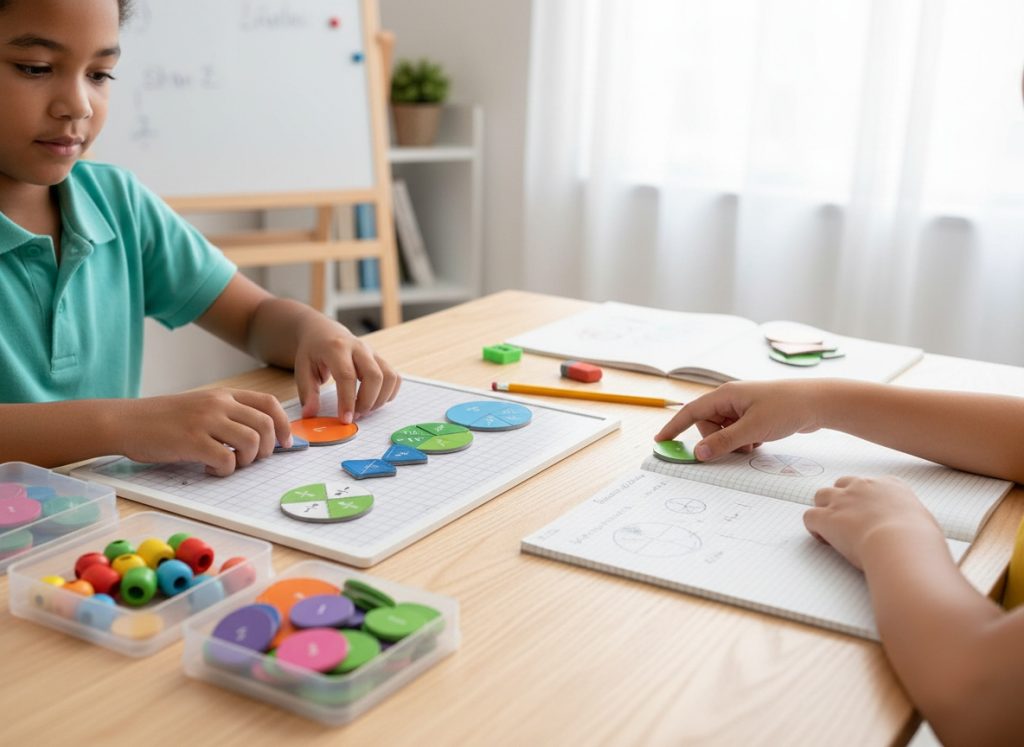
Fractions are one of the areas where many elementary students experience difficulty because they require students to understand relationships rather than simply follow calculation steps.
A well-planned lesson using fraction manipulatives can help students move from confusion to understanding.
The lesson may begin with the teacher introducing a whole object and showing how it can be divided into equal parts. Students then explore different fraction pieces, compare their sizes, and discuss what they observe.
After this exploration stage, teachers can introduce fraction symbols and written calculations. Because students have already seen the relationship physically, the numbers now represent something meaningful rather than abstract information.
The final stage focuses on assessment and explanation. Instead of only checking whether students reach the correct answer, teachers can ask students to demonstrate their thinking by creating examples or explaining their reasoning.
This approach helps teachers identify whether students truly understand fractions or are simply memorizing procedures.
Supporting Older Elementary Students With Mathematical Reasoning
As students progress, manipulatives continue to play an important role.
At higher elementary levels, teachers can use mathematical tools to introduce new concepts, support struggling learners, and provide additional challenges for advanced students.
For example, students may use physical models to explore number relationships, patterns, or problem-solving strategies before expressing their ideas through mathematical notation.
At this stage, manipulatives become thinking tools. They help students test ideas, compare solutions, and develop a deeper understanding of how mathematical concepts connect.
Different Types of Math Manipulatives and Their Classroom Applications
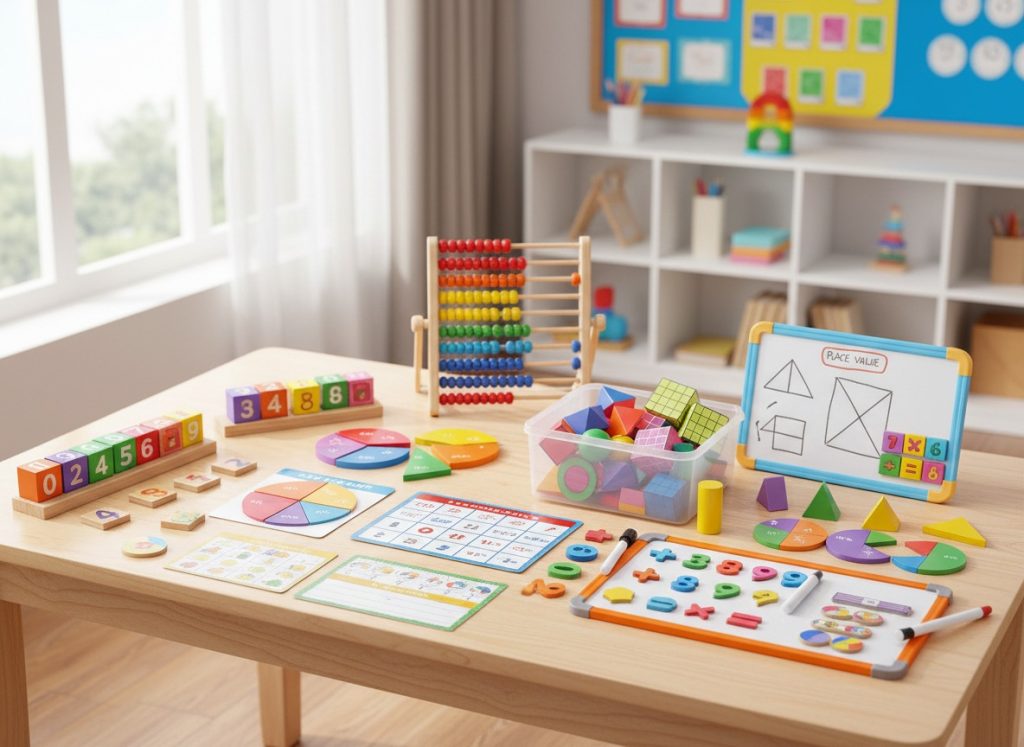
Schools often need to choose from many different types of mathematics learning tools. Understanding how each category supports learning can help educators and purchasing teams make better decisions.
| Type of Math Manipulative | Best Used For | Learning Challenges Addressed | Typical Classroom Use |
|---|---|---|---|
| Number Manipulatives | Preschool and early elementary learning | Number recognition, counting, quantity relationships | Building number sense through hands-on activities |
| Fraction Manipulatives | Elementary mathematics | Understanding parts, wholes, and fraction relationships | Visual fraction lessons, comparisons, and operations |
| Geometry Manipulatives | Elementary geometry learning | Spatial awareness and shape relationships | Exploring patterns, structures, and measurement concepts |
| Magnetic Math Tools | Interactive classroom instruction | Making abstract concepts visible during teaching | Teacher demonstrations and collaborative activities |
However, selecting the right manipulative requires more than choosing a product from a specific category.
Schools should consider whether a tool supports meaningful learning activities, works well in different classroom situations, and provides long-term educational value.
A single-purpose product may only solve one teaching challenge, while a thoughtfully designed resource can support multiple lessons and learning stages.
Common Challenges When Using Math Manipulatives in Classrooms
Although manipulatives provide strong learning benefits, their effectiveness depends on how teachers introduce and manage them.
One common issue is that students may focus more on the materials themselves than the mathematical concepts behind the activity. When manipulatives are used without clear learning objectives, they can easily become simple play activities rather than meaningful learning experiences.
To avoid this problem, teachers should connect every hands-on activity with a specific mathematical goal. Before introducing a manipulative, educators should consider:
- What concept should students understand?
- What questions can guide their thinking?
- How will students demonstrate their understanding?
For example, instead of asking students to simply build a fraction model, teachers can encourage deeper thinking by asking:
“Why does this piece represent one-fourth?”
“How do you know these two parts are equal?”
“Can you create another combination with the same value?”
These questions help students move beyond using materials mechanically and begin developing mathematical reasoning.
Classroom management is another practical challenge, especially when multiple students use manipulatives at the same time. In larger classrooms, teachers need materials that are easy to organize, durable enough for repeated use, and suitable for group activities.
Storage and classroom preparation also influence how frequently teachers use these resources. If materials are difficult to sort, fragile, or require too much preparation time, they are less likely to become part of regular instruction.
Another important consideration is supporting different learning abilities within the same classroom. Some students may need physical models to understand a new concept, while others may be ready to apply the same materials to more advanced problem-solving activities.
Well-designed math manipulatives allow teachers to adjust activities without changing the overall learning goal, making them useful tools for differentiated instruction.
What Schools Should Consider When Choosing Math Manipulatives
For schools and educational organizations, selecting math manipulatives requires more than comparing appearance or price. The most valuable resources are those that support real classroom needs and provide long-term educational value.
Before purchasing, schools should consider:
- Does the product support clear mathematics learning objectives?
- Can teachers use it in different classroom situations?
- Is it durable enough for repeated classroom use?
- Does it encourage interaction and student participation?
Educational purpose should always come first. A product with bright colors or multiple features does not automatically create better learning outcomes. The best resources are designed around how teachers actually introduce concepts, guide discussions, and assess understanding.
Flexibility is another important factor. A manipulative that can support demonstrations, group activities, and individual exploration usually provides greater value than a product designed for only one activity.
This is also where many low-cost educational products have limitations. Some materials may appear attractive but are created mainly for short-term engagement rather than classroom durability and teaching effectiveness.
Professional learning tools should help educators explain difficult concepts more clearly, support different learning levels, and remain useful across multiple lessons.
How Vindstier Designs Math Manipulatives for Real Classroom Needs
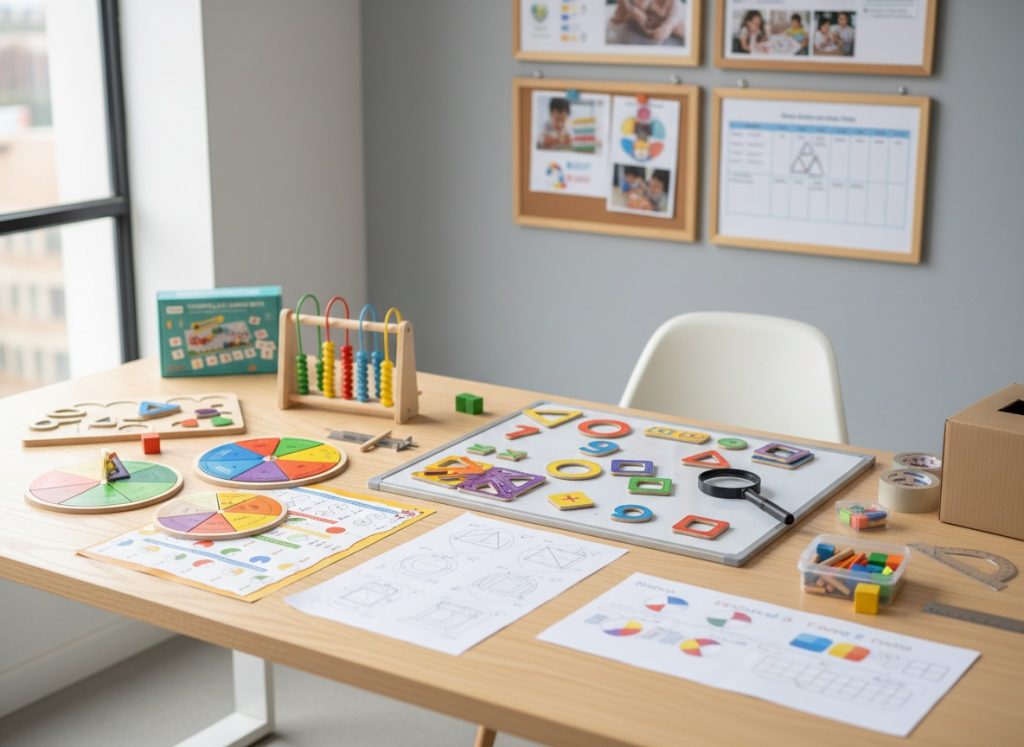
For educational toy manufacturers, developing effective math manipulatives requires understanding both children’s learning processes and teachers’ everyday classroom challenges.
Many educational products focus heavily on appearance, but classroom success depends on more than visual appeal. Teachers need resources that are practical, durable, and closely connected to learning objectives.
Vindstier focuses on creating educational tools that support real teaching environments.
For example, magnetic fraction teaching aids are designed to help teachers demonstrate mathematical relationships clearly on classroom boards while allowing students to participate through hands-on exploration.
Compared with traditional paper-based materials, magnetic learning tools provide greater flexibility during instruction. Teachers can present concepts to the entire class, invite students to interact with the materials, and reuse the same resources across different lessons.
The magnetic design also makes classroom demonstrations more effective because students can observe mathematical relationships clearly from their seats while participating in discussions.
For educational buyers and school partners, the value of a learning tool is not only measured by how engaging it looks. More importantly, it should help teachers create meaningful learning experiences and support students in developing stronger mathematical understanding.
The Future Role of Math Manipulatives in STEM Education
Mathematics provides the foundation for many STEM skills, including logical reasoning, analysis, and problem-solving.
When students work with math manipulatives, they are practicing more than calculations. They learn how to observe patterns, test possibilities, compare different approaches, and develop solutions through exploration.
This connection between hands-on learning and problem-solving is becoming increasingly important as schools place greater emphasis on active learning methods and STEM-focused education.
For educational toy brands, this trend creates new opportunities but also higher expectations. The market is no longer looking for products that simply add entertainment value. Schools need learning tools that solve real teaching challenges and support measurable educational goals.
The future of mathematics learning resources will depend on thoughtful design: products that combine educational purpose, classroom practicality, and engaging student experiences.
Conclusion
Math manipulatives help teachers transform mathematics from an abstract subject into a learning experience students can actively explore and understand.
From building early number sense to supporting more advanced mathematical reasoning, these tools provide educators with practical ways to improve classroom engagement and deepen conceptual understanding.
For schools, teachers, and educational toy suppliers, choosing the right mathematics learning materials means looking beyond simple entertainment value. The most effective products are those that support teaching objectives, encourage independent thinking, and create meaningful interactions between students and mathematical concepts.
Well-designed math manipulatives do not replace effective teaching. They make effective teaching more powerful.