Most homeschool parents hit the same wall around ages 3 to 5: worksheets don’t work, flashcards get thrown across the room, and no amount of verbal explanation makes “5 minus 2” click. The problem isn’t the child — it’s the medium. Abstract symbols on paper ask young brains to skip a developmental step they haven’t reached yet.
Research from the National Association for the Education of Young Children (NAEYC) consistently shows that children under 6 learn mathematical concepts most effectively through physical, hands-on manipulation of objects — not rote instruction. The question for homeschool parents isn’t whether to use manipulatives, but which ones actually deliver structured, progressive learning rather than open-ended play with no measurable outcome.
This is exactly where wooden number blocks — specifically those built around a height-equals-value design system — change the dynamic entirely.
Why the “Height = Value” Design Is a Homeschool Game-Changer
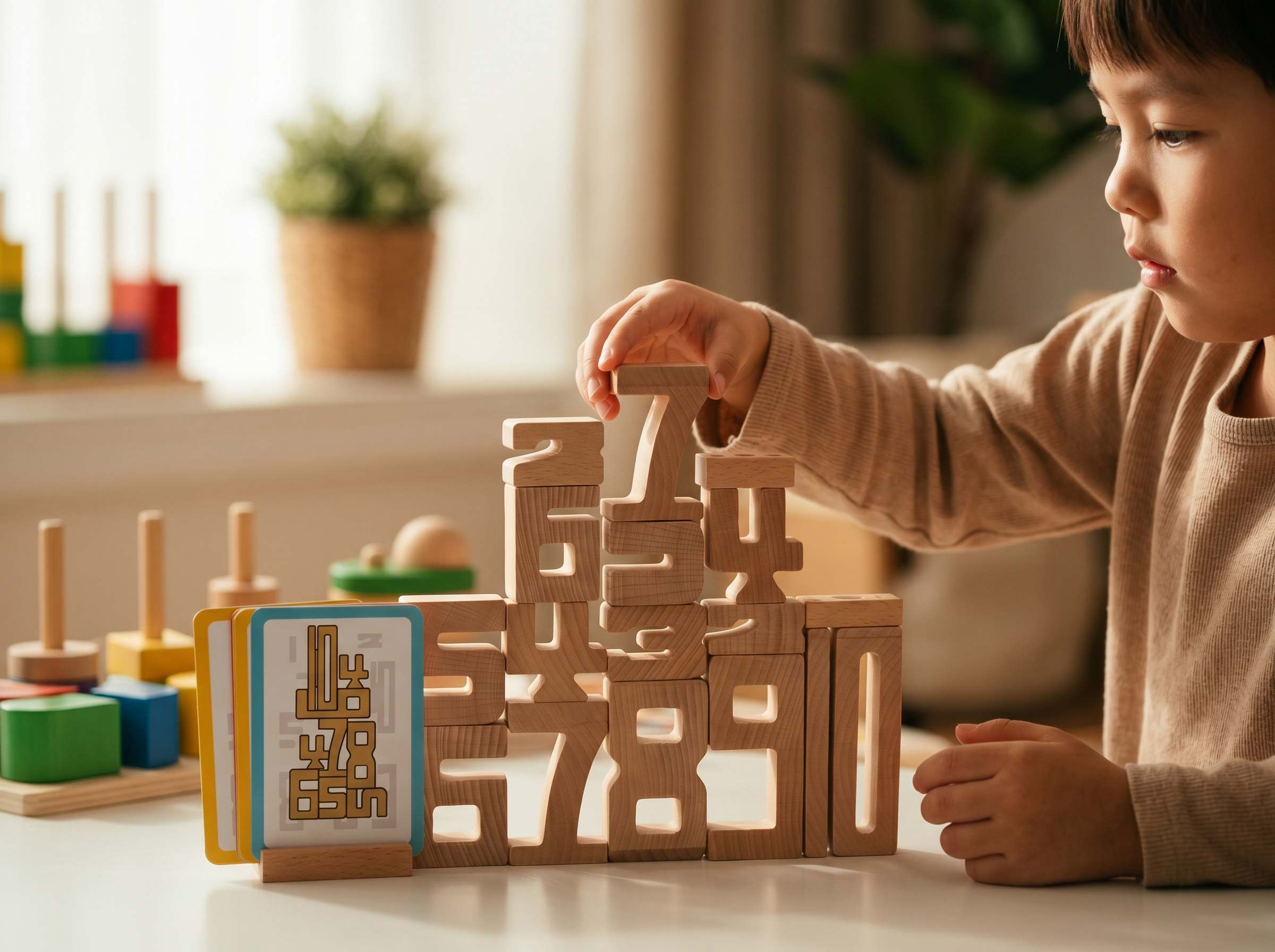
Most counting tools ask children to count units — beads, pegs, dots. The Vindstier Wooden Number Blocks work differently. Each block’s physical height corresponds directly to its numerical value: the block representing 5 is literally taller than the block representing 3. There is no counting required to compare them. A child can see, in real space, that 5 is greater than 3.
This design principle aligns with what developmental psychologists call “analogical reasoning” — the ability to map relationships between physical properties and abstract concepts. A 2019 study published in the journal Developmental Psychology found that children who learned numerical magnitude through height-proportional manipulatives showed 34% faster mastery of addition and subtraction compared to those using uniform unit blocks.
For homeschool parents, this translates to something concrete: you don’t have to explain that 4 + 2 = 6. You place the 4-block and the 2-block side by side, then find the single block that matches their combined height. The answer is physically self-evident.
How to Run a Height-Comparison Math Session at Home
Here’s a simple 15-minute lesson structure that works for children ages 3–6:
- Warm-up (3 min): Ask your child to line up all blocks from shortest to tallest without any numerical prompts. This builds visual magnitude awareness.
- Addition (5 min): Choose two blocks. Ask your child to find a third block that equals their combined height when stacked. No symbols needed at this stage.
- Subtraction (5 min): Start with a tall block. Remove a smaller one from the comparison. Which block fills the “missing height”?
- Recording (2 min): Once children are ready, introduce the number symbols — but only after the physical relationship is already understood.
The sequence matters. Symbol comes last, not first.
30 Logic Challenges That Replace the Need for a Curriculum Spine
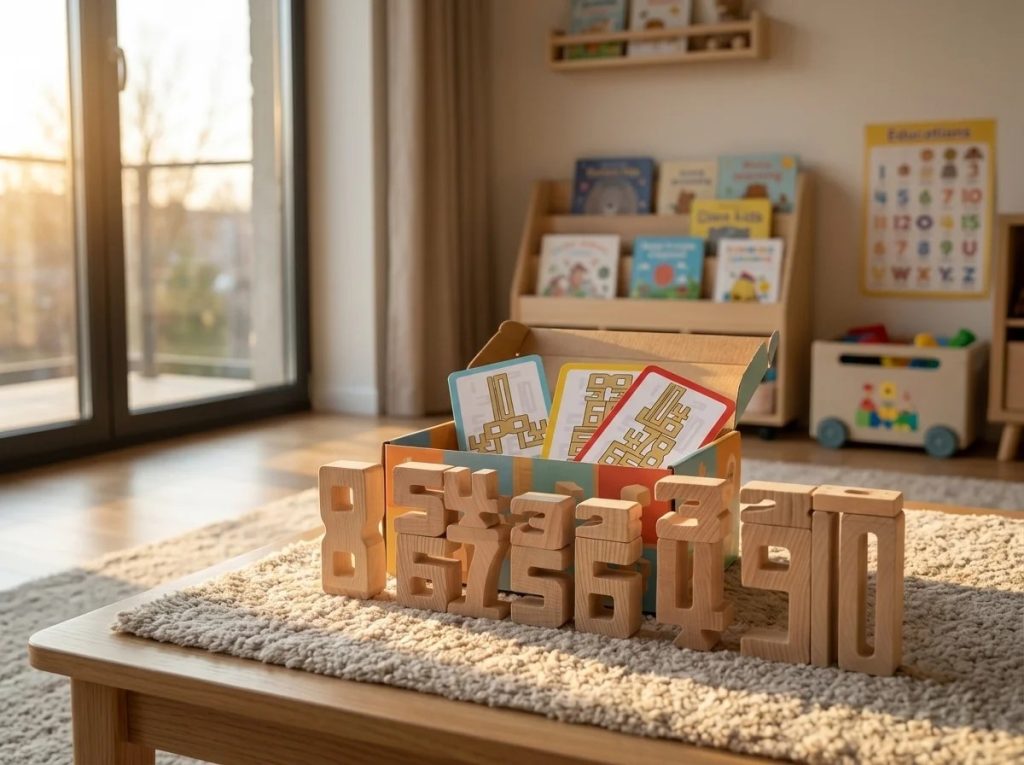
One of the most time-consuming parts of homeschooling math for ages 3–6 is sequencing difficulty. Most parents either move too fast (frustrating the child) or too slow (losing engagement). The included 15 double-sided challenge cards solve this problem by providing 30 pre-sequenced tasks across 5 difficulty levels — essentially a built-in curriculum scaffold.
| Difficulty Level | Skill Focus | Typical Age Range |
| Level 1 | Number recognition, block identification | 3–3.5 years |
| Level 2 | Simple height comparison, greater/less than | 3.5–4 years |
| Level 3 | Single-step addition using height matching | 4–4.5 years |
| Level 4 | Two-step operations, balance challenges | 4.5–5 years |
| Level 5 | Complex balance architecture, multi-block equations | 5–6+ years |
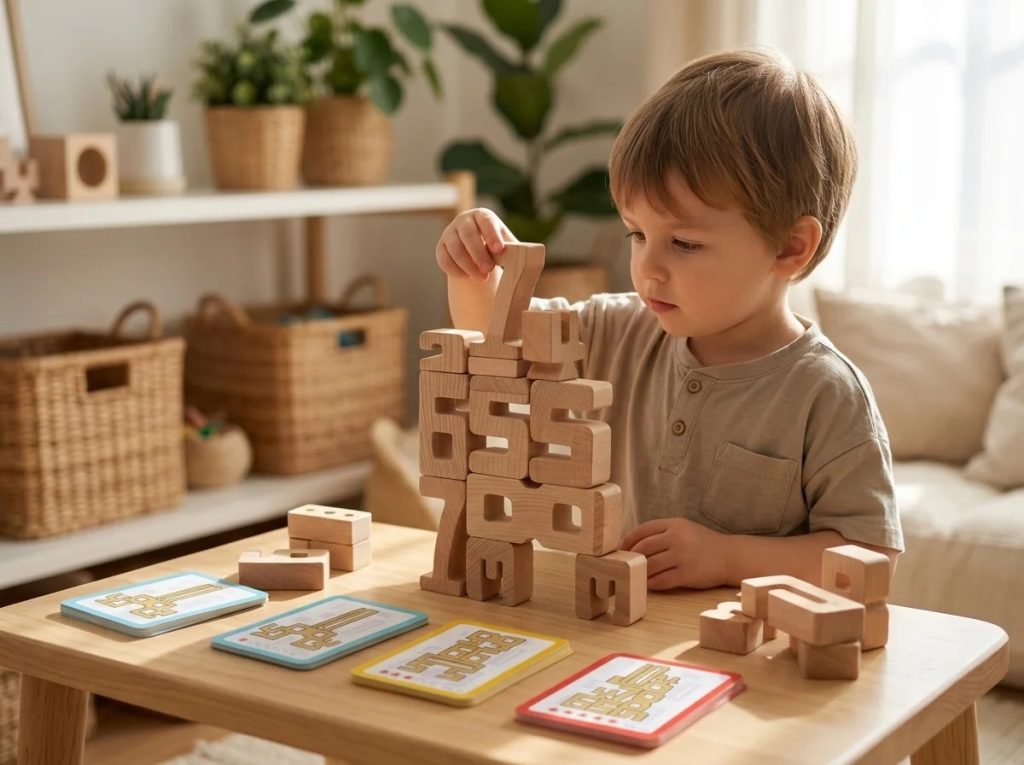
Each card presents a visual puzzle: a target structure that the child must replicate or solve using the blocks. There are no written instructions to read — the challenge is communicated entirely through imagery, which removes the literacy barrier entirely.
What this means in practice: A 3-year-old and a 5-year-old in the same household can use the same set simultaneously, working on different challenge cards at their own level. For multi-age homeschool families, this is a significant logistical advantage.
Using the Challenge Cards as a Progress Tracker
The 5-level structure also doubles as an informal assessment tool. When a child can complete all six Level 3 cards independently and consistently, they’re demonstrating mastery of single-step addition at a concrete level — which directly maps to early elementary math benchmarks. You don’t need a separate assessment workbook for this stage.
The Dot Indicators — A Sensory Layer Most Parents Overlook
The base of each Wooden Number Block features dot indicators corresponding to the block’s value. This isn’t decorative. It adds a second sensory channel — tactile and visual counting — that runs parallel to the height comparison system.
Research in multisensory learning (Shams & Seitz, 2008, published in Trends in Cognitive Sciences) demonstrates that information encoded through two simultaneous sensory pathways is retained significantly longer than single-channel input. When a child sees the height of the “7” block AND counts 7 dots at the base, the numerical concept of 7 is being reinforced through two distinct neural pathways at the same time.
For homeschool lessons, this opens up a specific teaching move:
“Cover the block with your hand so you can’t see how tall it is. Can you count the dots to figure out which number it is?”
This inverts the primary learning channel and forces the child to cross-reference their understanding — a higher-order cognitive operation that worksheets simply cannot replicate.
Safety Specifications That Matter in a Homeschool Environment
Homeschool settings are different from classrooms. These blocks are on the floor, on the couch, near younger siblings, and sometimes in mouths. The material and construction standards of any manipulative used in this context need to hold up to that reality.
The Vindstier Wooden Number Blocks are made from solid natural wood — not MDF, not composite particleboard — with each edge hand-sanded to a smooth, splinter-free finish. The CE and CPC certifications covering this product mean it has been independently tested against both European and U.S. consumer product safety standards for children aged 3 and above, including tests for formaldehyde levels, heavy metal content in surface coatings, and structural durability under repeated stress.
The practical implication: these blocks can be dropped, stacked, knocked over, and chewed on without releasing chemical residue or splintering. For a homeschool parent who is also managing a toddler sibling in the same space, that’s not a minor detail.
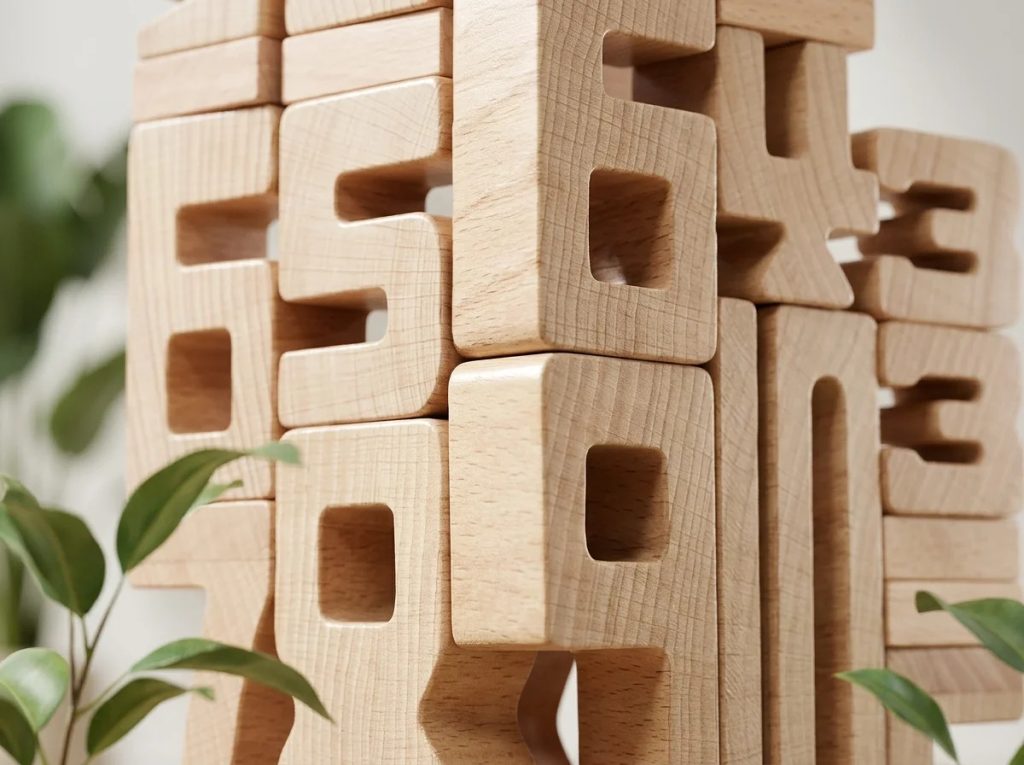
Wooden Number Blocks as a Balance and Coordination Tool
The math function of these blocks is well-documented. Less discussed is what happens when children begin using them as a balance challenge — which the design actively supports.
Because each block’s height and weight are proportional to its value, stacking them in different combinations creates genuine structural physics problems. A child trying to balance a 7-block on top of a 3-block and a 4-block (which are equal in combined height) is simultaneously:
- Solving a math equivalence problem
- Developing hand-eye coordination through the physical act of placing and adjusting
- Building spatial reasoning by predicting which configurations will be stable
A 2021 report from the American Academy of Pediatrics noted that fine motor activities involving balance and precise placement are among the most effective exercises for developing the prefrontal cortex functions responsible for planning, sequencing, and impulse control in children ages 3–6.
This means your math lesson is also, without any additional effort, a motor development session.
A Simple Balance Challenge Lesson Plan
Setup: Clear a flat surface. Place the challenge card showing a target tower configuration face-up.
Task: Replicate the tower exactly — not just the height, but the specific block combination shown. Multiple combinations may reach the same height, but only one matches the card.
Extension: Once the tower is built, ask your child to add one more block to the top without knocking it over. The block choice becomes a physics decision, not just a math one.
This single activity covers number recognition, addition, spatial reasoning, and fine motor coordination within one 10-minute session.
Practical Wooden Number Blocks Lesson Plans by Week
For homeschool parents who want a structured starting point, here is a 4-week introduction framework:
Week 1 — Number Recognition and Magnitude Focus on identifying each block by value and ordering them by height. Use the Level 1 challenge cards. Introduce the dot indicators as a secondary identification method.
Week 2 — Visual Addition Introduce the concept of combining two blocks to find a matching single block. Work through Level 2 and early Level 3 cards. Do not introduce written numerals until the child is consistently matching heights correctly without prompting.
Week 3 — Subtraction as “Missing Height” Present a tall block and a shorter block. Ask which block would fill the height gap. This is the visual model for subtraction. Use the reverse side of Level 3 challenge cards.
Week 4 — Balance Architecture Open play with the Level 4 and 5 challenge cards, focusing on structural stability. Introduce the balance game format: build the tallest stable tower possible using only specific block combinations.
This progression takes a child from number recognition to working addition and subtraction — without a single worksheet.
Conclusion
The challenge in homeschool math for young children has never been a shortage of curriculum options. It’s been the gap between what early learners can abstractly process and what programs expect them to absorb on paper. Wooden number blocks built on the height-equals-value principle close that gap by making mathematical relationships physically real before they become symbolically abstract.
The 30-level challenge card system removes the sequencing burden from the parent. The dot indicators add a second sensory layer that research consistently links to stronger retention. The balance function extends the learning value beyond numeracy into motor and spatial development. And the solid natural wood construction — CE and CPC tested for children 3 and above — means these blocks work in the real conditions of a home learning environment, not just in ideal ones.
For homeschool parents teaching children between 3 and 6, the practical question isn’t whether hands-on math manipulatives are worth the investment. The data on that is settled. The question is whether the specific tool in front of you is designed with enough structure, progression, and sensory intentionality to replace passive instruction entirely. These wooden number blocks are.