Imagine a single toy that replaces three games on your shelf, keeps your child engaged for hours, and quietly builds essential life skills — all while looking beautiful enough to leave out on the coffee table. That toy exists, and it’s called the Vindstier Wooden Falling Ball Game. Designed for curious minds aged 3 and above, this 3-in-1 wooden masterpiece is redefining what it means to play smart. In this guide, we’ll explore why the wooden falling ball game has become a favorite for both parents and educators.
What Is the Vindstier Wooden Falling Ball Game?
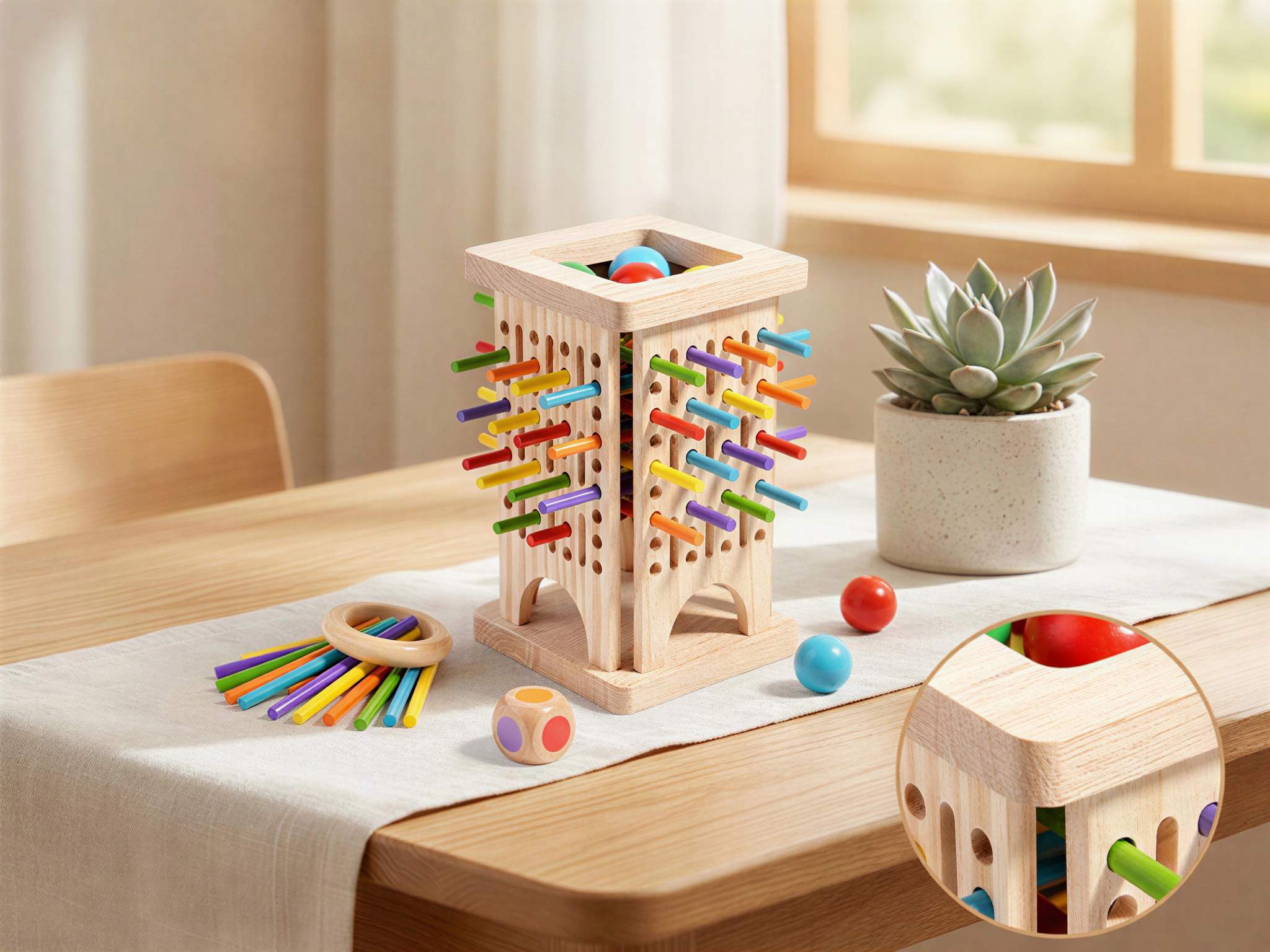
At its core, the Wooden Falling Ball Game is a multi-functional skill toy that combines strategic gameplay, physical challenge, and open-ended creative play into one elegantly crafted set. Made from premium pine and beech wood — finished with non-toxic, water-based paint — every piece is designed to feel as good in little hands as it looks on a shelf.
The set includes a wooden tower (approx. 16.5cm × 9.5cm), a collection of colorful sticks, wooden rings, and balls. What sets it apart from ordinary toys isn’t just the quality of materials — it’s the fact that one box unlocks three completely different play experiences, each one targeting a distinct stage of your child’s development.
This isn’t a toy children outgrow in a week. It’s a toy they grow into.
3 Games in 1: A Closer Look at Each Play Mode
Game 1: Classic Tower Game — Steady Hands Win
Here’s how it works: insert all the colorful sticks through the holes of the wooden tower, then carefully place the ball on top. Players take turns rolling the dice, then remove the stick that matches the color shown — slowly, carefully, without breathing too loudly. The structure wobbles. The tension rises. The player who drops the ball loses.
It sounds simple. It absolutely is not, and that’s the beauty of the wooden falling ball game — it challenges even the adults in the room.
This mode is the heart of the Wooden Falling Ball Game experience. It teaches children:
- Strategic decision-making — not all sticks are equal; some are load-bearing, and smart players learn to identify them
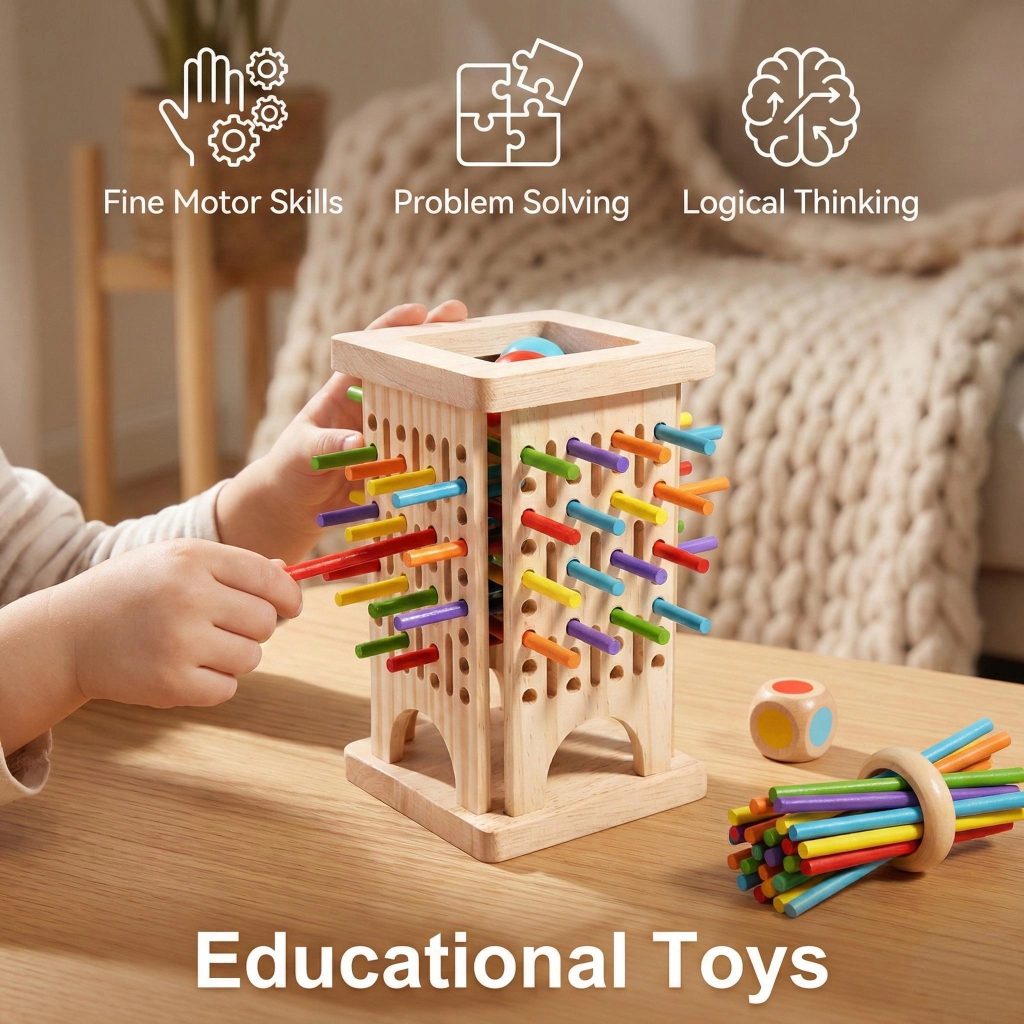
- Fine motor precision — the kind of hand control that later translates to writing, drawing, and instrument playing
- Resilience and sportsmanship — losing gracefully is a skill, and this game gives children safe, joyful practice
It’s the kind of game that pulls parents away from their phones and into the moment. Family game nights just got a serious upgrade.
Game 2: Ring Balance Challenge — Physics Meets Patience
In this mode, the colorful sticks are bundled together and secured with wooden rings into a standing structure. Players take turns pulling sticks out one at a time — without causing the bundle to collapse. Each successful pull requires reading the structure, assessing balance, and executing with calm precision.
What children are actually learning:
- Cause-and-effect reasoning — if I pull this stick, what happens to that one?
- Concentration and patience — two qualities that are increasingly rare and increasingly valuable
- Spatial intelligence — understanding how physical objects support and interact with each other
This mode is a quiet favorite among kindergarten teachers and early childhood educators, who use it as a focused small-group activity to build pre-academic cognitive skills.
Game 3: Creative Construction & Sorting — Open-Ended Play
Remove the rules. Remove the dice. Hand a young child the sticks and balls and simply say: “What can you make?”
The colorful components become tools for:
- Color recognition — sorting red sticks, blue sticks, yellow balls into groups
- Counting and early numeracy — “How many sticks are there? Can you count the blue ones?”
- Imaginative construction — building fences, patterns, abstract structures, or whatever their imagination creates
This mode is especially valuable for toddlers transitioning into structured play, bridging the gap between free play and rule-based games. It’s also a beautiful way for parents and children to play together, side by side, without a winner or loser — just creativity and connection.
Why Wooden Toys? The Case for Natural Play
Before we go further, it’s worth addressing a question many parents ask: why choose wood over plastic?
The answer goes beyond aesthetics. When comparing the wooden falling ball game to standard plastic alternatives, the difference in quality and educational depth is clear.
| Vindstier Wooden Toy | Standard Plastic Toy | |
| Material Safety | Non-toxic wood + water-based paint | Risk of BPA, phthalates, PVC |
| Durability | Lasts years with proper care | Often cracks or breaks within months |
| Sensory Experience | Warm, natural, satisfying texture | Cold, lightweight, artificial feel |
| Environmental Impact | Sustainable, biodegradable | Long-term landfill contributor |
| Educational Value | Multi-mode, open-ended | Typically single-function |
| Longevity of Interest | Grows with the child | Quickly loses novelty |
Wooden toys engage more of the senses. They feel substantial. They reward careful handling. And for a toy like the Wooden Falling Ball Game, the natural weight and texture of the wood actually matters to the gameplay — a plastic version simply wouldn’t have the same satisfying tension.
Educational & Developmental Benefits at a Glance
Pediatric play therapists and early childhood experts consistently highlight the following developmental benefits of multi-mode skill toys like this one:
Hand-Eye Coordination
Every single mode requires children to coordinate visual information with precise physical action. This foundational skill underpins reading, writing, sports, and fine arts.
Executive Function
Planning moves in advance, inhibiting impulsive actions, and adapting strategy when things don’t go as planned — these are executive function skills, and they’re being practiced every time a child reaches for a stick.
Social-Emotional Development
Turn-taking, managing excitement and disappointment, reading other players’ reactions — the social learning embedded in these games is profound and research-backed.
Screen-Free Deep Focus
In a world saturated with passive, fast-moving screen content, giving children a tactile game that demands their full attention is a genuine developmental gift.
Safety You Can Trust: The Vindstier Standard
At Vindstier, we believe that a toy’s first job is to be safe — then to be fun. The Wooden Falling Ball Game is built with that priority at every stage of design and production.
- CE and CPC certified — meeting both European EN71 and American ASTM safety standards, so the toy is fully compliant whether you’re purchasing in Europe, North America, or beyond
- Every surface is 360° smoothly polished with carefully finished rounded corners — because we know that children play with their whole bodies, and a toy should never hurt the hands that hold it.
Perfect For Every Occasion
The Vindstier Wooden Falling Ball Game is genuinely versatile:
- Birthday & Holiday Gifts — a gift that stands out from the sea of plastic toys
- Kindergarten & Preschool Classrooms — ideal for learning centers and small group activities
- Family Game Night — brings everyone to the table, ages 3 to 93
- Wholesale & Retail — CE/CPC certified, ready for global distribution
- Gift Sets & Bundles — beautiful natural packaging makes it a premium gifting option
Conclusion: The Ultimate 3-in-1 Skill Toy
Giving a child a toy should be about giving them an opportunity to grow. The wooden falling ball game by Vindstier isn’t just an afternoon’s entertainment; it’s a tool for building focus, strategy, and fine motor skills. It’s no wonder this wooden falling ball game is topping the must-have lists this year.