
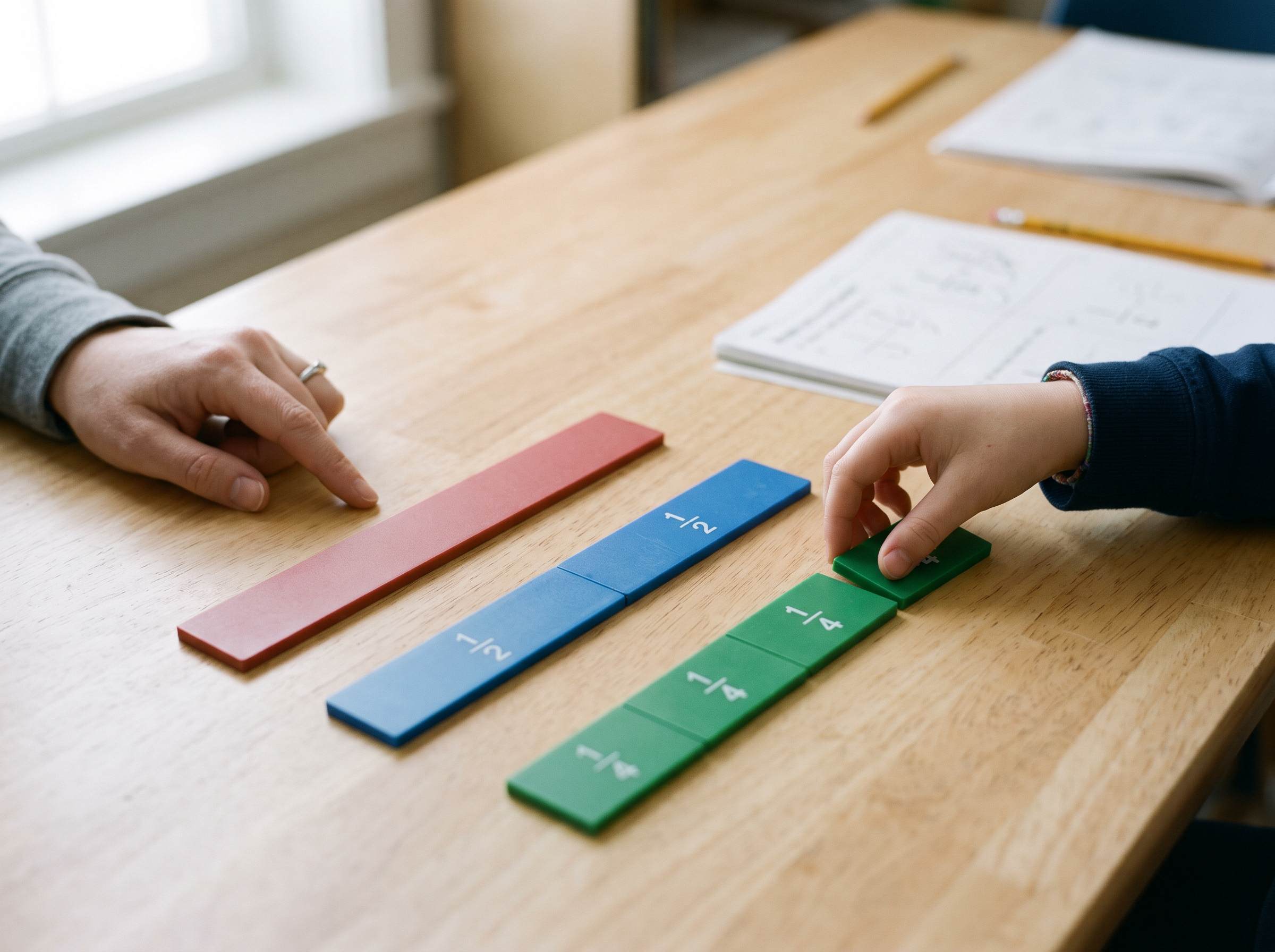
A student places a one-half fraction piece next to a one-quarter piece and confidently chooses the quarter as the larger fraction. The teacher looks more closely and notices something important: the pieces came from different fraction sets, each with a different-sized whole.
The student may be comparing physical lengths correctly while misunderstanding what those lengths represent.
This is one of the most useful teaching moments when working with fraction manipulatives. Before students can compare fractions accurately, they need to understand that the fractions must refer to the same whole.
With the right materials and a clear teaching sequence, educators can turn this common confusion into a hands-on lesson about fraction size, equal parts, and mathematical reasoning.
In this guide, we’ll explore why the same whole matters, how to prepare fraction strips or magnetic fraction manipulatives, and a practical three-step lesson for comparing fractions. We’ll also cover ways to observe student understanding and select suitable materials for classroom use.
Why the Same Whole Matters When Comparing Fractions
Fractions describe relationships between parts and wholes. A fraction such as 1/2 represents one of two equal parts of a whole, while 1/4 represents one of four equal parts.
When both fractions refer to the same whole, 1/2 is greater than 1/4.
However, the physical size of a fraction piece depends on the size of its original whole.
Consider this example:
- Half of a 12-centimeter strip measures 6 centimeters.
- One-quarter of a 32-centimeter strip measures 8 centimeters.
The quarter-piece is physically longer, even though 1/4 is less than 1/2 as a number.
There is no mathematical contradiction. The pieces represent fractions of different-sized wholes.

This distinction explains why students should not compare loose fraction pieces from unrelated sets without identifying their reference units.
The Illustrative Mathematics task Comparing Fractions with a Different Whole addresses this exact misconception. It encourages students to identify why a visual comparison is misleading and explain how using the same whole resolves the problem.
For classroom instruction, the central question is simple:
“Are these fractions describing parts of the same-sized whole?”
That question should come before deciding which fraction is greater.
Prepare Fraction Manipulatives Before the Lesson
Effective hands-on fraction learning begins with materials that represent mathematical relationships accurately.
Fraction strips are particularly useful for introductory length comparisons because students can place pieces at the same starting point and compare their endpoints.
Other representations, including fraction circles, area models, and number lines, can be introduced as students develop a stronger understanding of part-whole relationships.
Four Checks Before Using Fraction Manipulatives
Before distributing the materials, teachers should complete four preparation checks.
1. Rebuild one whole.
Place a whole strip beside two matching half-pieces. The halves should cover exactly the same length as the whole.
Repeat with four quarter-pieces.
2. Confirm equal parts.
Pieces representing the same fraction of an equally sized whole should match in length.
Check whether the parts reconstruct the whole without significant gaps or overlaps.
3. Align the starting points.
Use a common baseline or starting edge when comparing pieces.
Students should compare how far pieces extend from that point rather than relying on where individual pieces happen to be placed.
4. Keep fraction sets identifiable.
Store pieces with their matching whole and maintain a reference photograph or contents guide.
This becomes especially important when a classroom uses multiple sets, demonstration-sized materials, or components from different suppliers.
If a set cannot accurately reconstruct its intended whole, remove it from the comparison activity until the discrepancy is resolved.
For additional instructional approaches, the Colorado Department of Education’s grades 3–5 fraction toolkit includes activities connecting paper folding, fraction representations, and mathematical explanations.
How to Compare Fractions with Manipulatives: A 3-Step Lesson
The following activity is designed for elementary learners who are developing an understanding of equal partitions and unit fractions.
It can be adapted for individual instruction, small groups, or classroom math centers.
Suggested lesson duration: 10–15 minutes, depending on students’ prior knowledge and discussion needs.
Materials:
- One whole fraction strip
- Two matching half-pieces
- Four matching quarter-pieces
- A second set representing a different-sized whole
- A work mat, magnetic board, or other suitable comparison surface
- Paper and pencils for recording observations
Step 1: Build and Identify One Whole
Begin by placing one whole strip in front of the students.
Ask:
“What does this piece represent?”
Explain or reinforce that the strip represents one complete unit.
Next, give students two equal half-pieces and ask them to cover the whole.
Once they have reconstructed the unit, replace the halves with four equal quarter-pieces.
Encourage students to explain what they observe.
Useful questions include:
- How many halves make one whole?
- How many quarters make one whole?
- Why must the parts be equal?
- What stays the same when we divide the whole into more pieces?
The objective is not simply to count pieces.
Students should recognize that the reference whole remains unchanged, even when the number of equal parts changes.
For students who need additional support, teachers can begin with physical matching before introducing fraction symbols.
Step 2: Compare One Half with One Quarter
Keep the whole strip visible.
Place one half-piece and one quarter-piece directly below it, aligning both pieces at the same starting point.

Ask:
“Which fraction piece extends farther, and why?”
Students should observe that the half-piece is longer.
Guide them toward explaining that dividing the same whole into two equal parts creates larger individual parts than dividing it into four equal parts.
The relationship can be summarized as follows:
| Fraction model | Equal parts in one whole | Length if the whole is 12 cm |
|---|---|---|
| One whole | 1 | 12 cm |
| One half | 2 | 6 cm |
| One quarter | 4 | 3 cm |
The measurements are illustrative and apply only to the same 12-centimeter whole.
Students can then connect their physical comparison to the symbols:
1/2 > 1/4
If a student argues that 1/4 must be larger because four is greater than two, return to the complete rows of pieces.
Ask:
“If we divide the same whole into more equal parts, does each individual part become larger or smaller?”
Allow students to rebuild the whole before answering.
This encourages reasoning instead of memorizing a rule about denominators.
Step 3: Change the Whole and Repeat the Comparison
Once students understand the first comparison, introduce a second set of fraction strips.
This new set should represent a longer whole, with half-pieces and quarter-pieces correctly matched to that new unit.
Ask students to repeat the activity.
They should observe that the physical lengths have changed, but the relationship between the fractions has not.
For each whole, one half remains greater than one quarter.
Discuss the difference between the two comparisons:
- The measured lengths depend on the size of the whole.
- The numerical relationship between 1/2 and 1/4 remains unchanged.
- Physical comparisons require identifying the reference whole.
Finish with a reflection question:
“Why should we check the whole before comparing fraction pieces?”
A student who can explain this relationship has demonstrated more than the ability to choose the longer piece.
The student is beginning to connect physical representations with fraction reasoning.
Using Magnetic Fraction Manipulatives in Classroom Lessons
Paper strips are useful for introducing the concept, but reusable magnetic fraction manipulatives can also support repeated comparison activities.
Magnetic materials allow students to position, rearrange, and rebuild fraction relationships without repeatedly cutting or preparing paper pieces.
They can be particularly convenient for guided demonstrations and small-group work when used with an appropriate magnetic surface.
A Practical Example with Vindstier Magnetic Fraction Teaching Aids
Vindstier’s Magnetic Fraction Teaching Aids use color-coded magnetic fraction pieces to help children explore part-whole relationships through physical manipulation.

Teachers can use compatible fraction bars from the set to demonstrate the same-whole comparison.
A practical sequence is:
- Identify the piece representing one whole.
- Arrange the corresponding half-pieces to reconstruct that whole.
- Replace them with quarter-pieces from the same set.
- Compare one half and one quarter using a common starting point.
- Ask students to explain the relationship before recording the comparison with fraction symbols.
The magnetic format can help pieces remain positioned during a demonstration, while the reusable components allow teachers to repeat comparisons or rearrange models.
However, the instructional benefit depends on how the materials are used.
Color-coded pieces should support fraction identification, not replace mathematical reasoning.
After students become familiar with the activity, teachers can cover the color labels or repeat the comparison with single-color paper strips.
This helps reveal whether students understand the part-whole relationship or are simply recalling a familiar color.
An important teaching principle: Magnetic fraction manipulatives are a tool for making relationships visible. They do not automatically establish conceptual understanding without appropriate questions, explanations, and follow-up activities.
To learn more about the available teaching materials, explore Vindstier’s Magnetic Fraction Teaching Aids.
For a broader introduction to visual fraction models, see our guide on how to teach fractions visually using hands-on methods.
How to Check Whether Students Understand Fraction Comparisons
Choosing the correct answer is useful, but it does not always reveal how a student reached that answer.
Teachers should also observe how children manipulate the pieces, describe the whole, and explain the relationship between equal parts.
The following prompt card provides a practical assessment guide.
| Teacher prompt | What to observe | Suggested next step |
|---|---|---|
| “Show me the whole for this piece.” | Does the student identify the reference unit? | Rebuild the whole and keep it visible. |
| “How many of these pieces make one whole?” | Does the student understand equal partitioning? | Arrange complete rows of equal parts. |
| “Why is one half larger than one quarter?” | Does the student explain the size relationship? | Compare two equal-sized wholes divided differently. |
| “What if we use a longer whole?” | Can the student distinguish fraction size from physical measurement? | Repeat the comparison with a second set. |
| “Can you draw what you built?” | Can the student transfer the relationship to a visual model? | Connect the drawing to fraction notation. |
Teachers can record brief observations such as:
- Rebuilt the whole using four equal quarters.
- Compared endpoints after aligning the pieces.
- Identified that the two fraction models originally had different-sized wholes.
- Explained that more equal partitions create smaller unit-fraction parts.
These observations are more informative than simply recording whether a student selected the correct fraction.
They can help teachers decide whether to revisit equal partitioning, introduce another representation, or move toward more complex comparisons.
Connect Fraction Manipulatives to Drawings and Number Lines
Physical fraction pieces should not be the final stage of instruction.
Once students understand the comparison through manipulation, teachers can help them represent the same relationship using drawings and number lines.
Move from Physical Pieces to Drawings
Ask students to draw two bars of equal length.
Divide the first bar into two equal parts and shade one part.
Divide the second bar into four equal parts and shade one part.
Students can label the shaded regions 1/2 and 1/4.
Compare the diagrams and discuss why the shaded half represents a greater portion of the same-sized whole.
This activity reinforces the connection between equal partitions and fraction notation.
Locate Fractions on a Number Line
Next, draw a number line from 0 to 1.
Divide the unit interval into four equal segments.
Mark the positions of 1/4 and 1/2.
Students should see that 1/2 lies farther to the right than 1/4.
This makes an important mathematical connection: fractions are not simply names for pieces of objects. They are numbers with positions and magnitudes.
The Institute of Education Sciences’ Developing Effective Fractions Instruction for Kindergarten Through 8th Grade practice guide recommends using number lines as a central representation for building fraction understanding.
A useful instructional progression is therefore:
Build the fraction → Draw the fraction → Locate the fraction → Explain the comparison.
Students can return to physical manipulatives whenever they need to check or reconstruct a relationship.
For another perspective on combining manipulatives with written learning activities, read Magnetic Fraction Teaching Aids vs. Worksheets: Which Works Better for Kids?.
Choosing Fraction Manipulatives for Schools and Learning Centers
For teachers, the immediate concern is whether a set supports clear and accurate instruction.
For school purchasing teams, additional considerations include product consistency, classroom suitability, storage, maintenance, and replacement compatibility.
An attractive fraction set is not necessarily an effective teaching resource.
What Should School Buyers Check?
Mathematical accuracy
Confirm that pieces representing the same whole have consistent dimensions and accurately reconstruct the reference unit.
Clear fraction identification
Labels, colors, and layouts should help students recognize the represented fractions without introducing unnecessary confusion.
Appropriate materials and handling
Consider how the components will be used, cleaned, stored, and supervised.
Age recommendations should match the intended users and activities.
Classroom practicality
Evaluate whether the materials can be prepared efficiently, shared between learners, and stored without frequently losing essential pieces.
Replacement compatibility
If components become missing or damaged, determine whether compatible replacements are available.
Do not assume that parts from different product versions will fit or represent the same-sized whole.
Documentation and supplier support
Request product specifications, contents information, age guidance, and relevant product-specific safety documentation for the intended market.
For magnetic teaching aids, buyers should also review the safety and integrity of the magnetic components and follow the manufacturer’s handling instructions.
Why Consistent Sets Matter for Bulk Purchasing
Consider a school purchasing fraction manipulatives for several classrooms.
If the sets have different reference sizes or incompatible replacement components, staff may accidentally combine pieces that are not suitable for direct physical comparison.
This can create instructional confusion even when individual components are correctly labeled.
Purchasing teams can reduce that risk by recording the supplier, model, contents, and intended reference whole for each set.
A classroom toy inventory helps staff monitor component completeness and plan reorders.
For more detailed purchasing considerations, Vindstier’s educational toy spare-parts guide explains how buyers can evaluate compatibility and replacement options.
How Vindstier Supports Educational Toy Sourcing
Vindstier develops educational toys and hands-on learning materials for schools, brands, distributors, and other buyers.
Its product range includes magnetic fraction teaching aids and other manipulatives designed for interactive learning activities.
For institutional and wholesale purchasing, Vindstier also offers OEM/ODM and private-label services, allowing buyers to discuss suitable product specifications, packaging, and customization requirements.
School buyers and distributors can contact Vindstier to request information about available magnetic fraction teaching aids, product configurations, applicable safety documentation, and purchasing arrangements.
These considerations help connect the classroom’s actual teaching requirements with a more informed sourcing decision.
Common Questions About Fraction Manipulatives
What Are Fraction Manipulatives?
Fraction manipulatives are physical learning materials that represent fractions and part-whole relationships.
Common examples include fraction strips, fraction circles, magnetic fraction pieces, folding paper models, and fraction tiles.
They allow students to arrange, compare, and reconstruct quantities as part of mathematical instruction.
Why Must Fractions Refer to the Same Whole When Comparing Them?
When comparing physical models, different-sized wholes can make smaller fractions appear larger in absolute size.
Using the same-sized whole ensures that students are comparing the fractions themselves rather than unrelated measurements.
For example, one half is greater than one quarter when both describe the same whole.
Are Magnetic Fraction Manipulatives Better Than Paper Fraction Strips?
Neither format is automatically better in every situation.
Paper strips are inexpensive and useful for folding, drawing, and individual investigations.
Magnetic fraction manipulatives offer reusable pieces that can be rearranged during demonstrations and guided activities.
The best choice depends on the lesson objective, students’ needs, and classroom conditions.
Can Preschool Children Use Fraction Manipulatives?
Some age-appropriate manipulatives can support early activities involving matching, sharing, comparing shapes, and recognizing equal parts.
However, formal fraction notation and numerical comparison should be introduced according to the child’s readiness and curriculum.
A product labeled for ages 3+ should not be interpreted as a recommendation to teach formal fraction comparisons to every three-year-old.
Always follow the product’s age guidance and safety instructions.
How Can Teachers Tell Whether Students Understand Fractions?
Ask students to identify the whole, reconstruct it using equal parts, compare models, and explain their reasoning.
Students should also have opportunities to represent fractions with drawings and number lines.
A correct answer on one activity is not enough to establish understanding across different fraction models or mathematical tasks.
Final Thoughts: Make the Whole Visible Before Comparing the Parts
When students compare fractions, the most important first step is not choosing the larger piece.
It is identifying the whole.
Fraction manipulatives help teachers make that reference visible and allow students to investigate how equal parts relate to the same unit.
A simple three-step sequence—build the whole, compare the parts, and repeat with a new whole—creates opportunities for students to move beyond visual guessing toward mathematical explanation.
Paper fraction strips, magnetic fraction manipulatives, drawings, and number lines can all contribute to this process when they are used deliberately.
For educators, effective teaching materials should make fraction relationships accurate, visible, and easy to discuss.
For school buyers, those same requirements provide a practical foundation for evaluating product quality and classroom suitability.
Explore Magnetic Fraction Teaching Aids from Vindstier
Looking for reusable fraction manipulatives for classroom instruction, educational toy distribution, or a private-label learning product range?
Vindstier offers magnetic fraction teaching aids and supports educational toy sourcing and customization for suitable wholesale and institutional projects.
Contact Vindstier to discuss product specifications, available configurations, applicable safety documentation, and wholesale inquiries.