A child may copy a row of red and blue blocks correctly, then hesitate when asked to add more. Copying gives us useful information, but a follow-up question can reveal more: has the child noticed which part repeats?
These preschool pattern activities explore that question through extending a block pattern, repairing a mismatch, and recreating the same arrangement with toys or actions. Children can show their thinking by pointing, moving objects, speaking, or combining these approaches.
Materials for Preschool Pattern Activities
Use materials children can pick up, move, and compare. Large, loose blocks are a useful starting point because children can rearrange them easily.
| Planning question | Suggested starting point |
|---|---|
| Who is this for? | Children exploring simple repeating patterns, with adult support as needed |
| How can we organize it? | Work with one child or a small group so everyone can handle the materials |
| What do we need? | Red and blue blocks of the same shape and size, spare blocks, a small tray, and matching toy cars and buses |
| What are we looking for? | How children identify, repeat, check, and recreate a repeating group |
| How can we adjust it? | Model a complete group when support is needed; offer a different repeating group when children are ready |
Begin with one clear feature. Using blocks of the same shape and size keeps attention on their color.
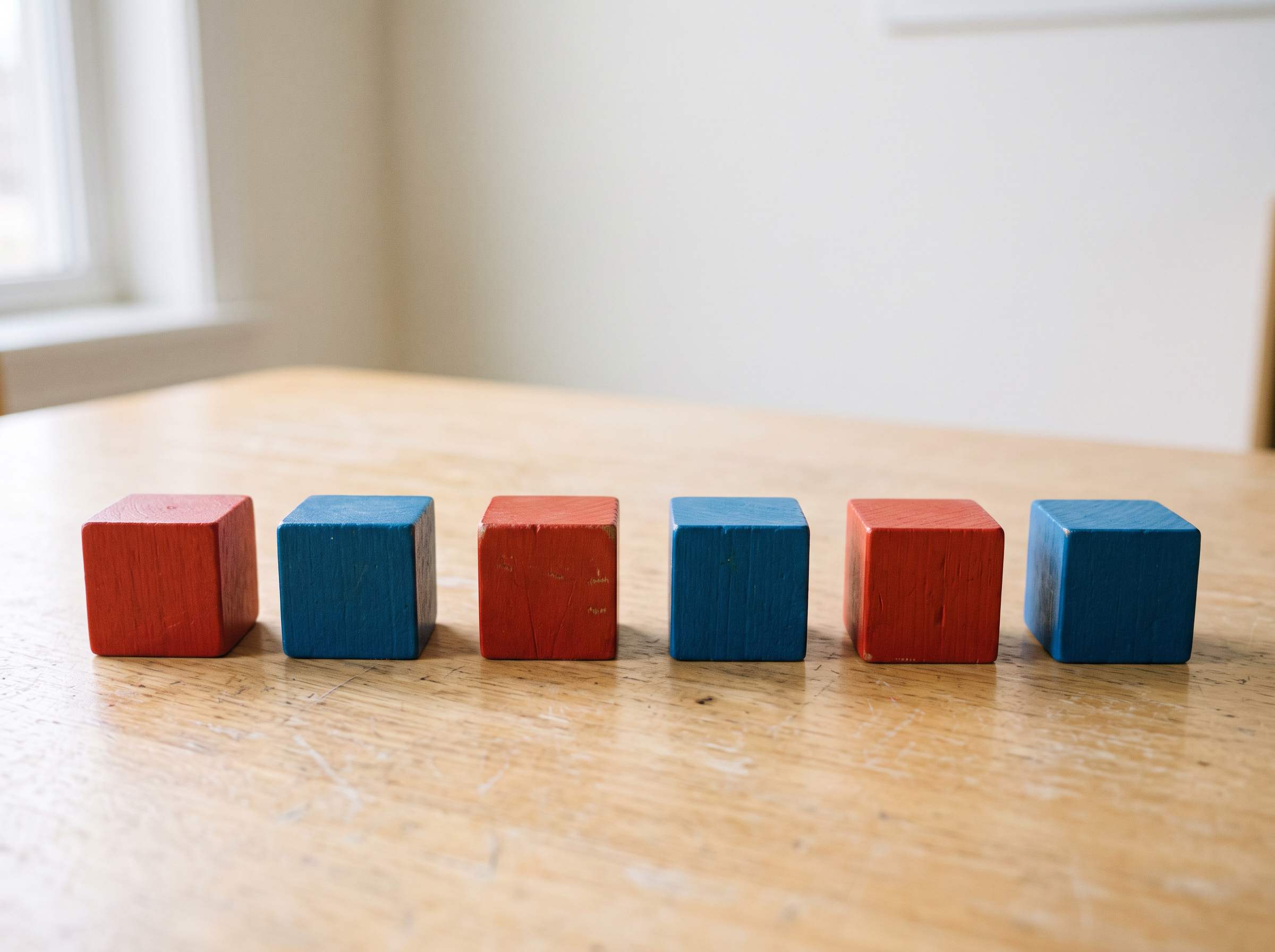
Make a row with a red block, a blue block, another red block, another blue block, and then one more red–blue pair. Keep the blocks evenly spaced at first so children can explore where the repeating groups begin and end.
Keep the example visible while children work, and leave spare blocks within reach.
Stanford DREME describes the pattern unit as the core part of a sequence that repeats. It also distinguishes copying, extending, and recognizing equivalent patterns—useful differences to notice during these activities. Read Patterns at a Glance.
Find the Repeating Group and Add More
Invite the child to look along the block row. Ask:
“Which little group keeps repeating?”
Give the child time to point, describe, or move the blocks. In this row, the smallest repeating group is one red block followed by one blue block.
Once the child has suggested a group, place those two blocks on a small tray. Move the tray beside the beginning of the row and compare its contents with the first two blocks. Then compare it with the next two.
Ask:
“Can you make another group like this and add it to the end?”
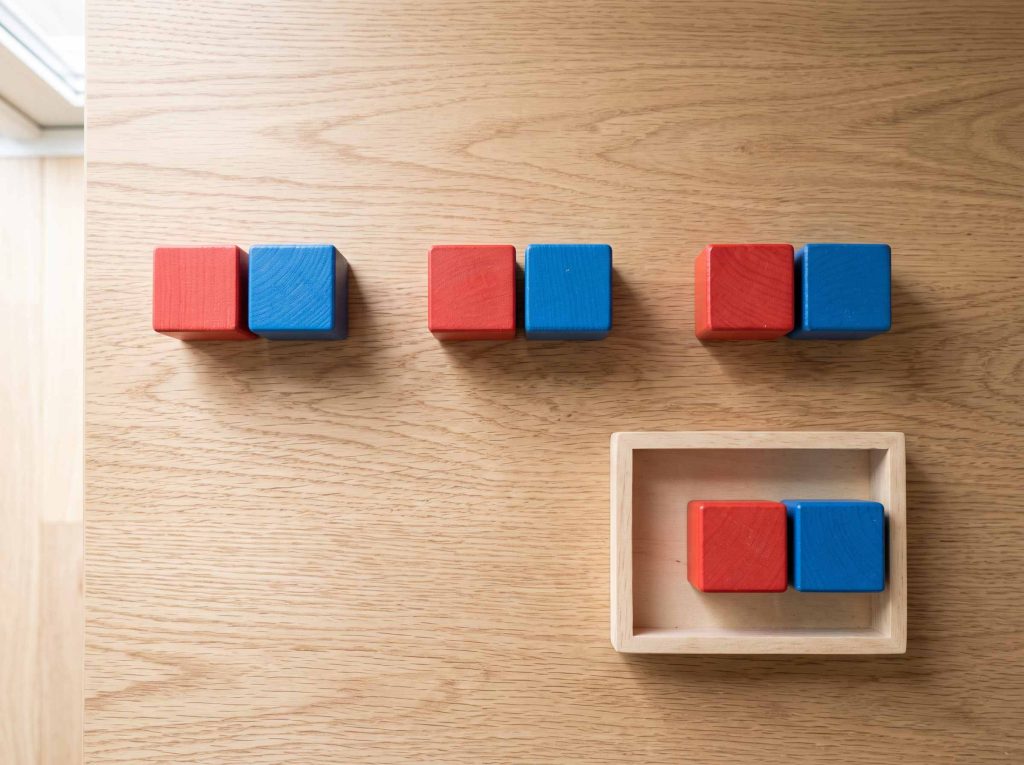
After the child adds the blocks, invite them to check:
“How does your new group match the others?”
If the child needs support, build a red–blue pair together. Leave it on the tray as a reference while they make another pair.
If the child chooses a longer group, try repeating it together. Then explore whether a shorter group can also build the row.
What to observe: Does the child select both blocks together, add them individually, compare positions, or change the rule?
Adding blocks one at a time does not, by itself, show misunderstanding. Ask the child to show which blocks belong together or explain what should come next. NRICH highlights the value of distinguishing item-by-item copying from recognizing the unit of repeat. Read Sue Gifford’s guidance on pattern awareness.
Check the Row and Repair a Mismatch
Make a fresh row using these blocks in order:
| Position | Block |
|---|---|
| First | Red |
| Second | Blue |
| Third | Red |
| Fourth | Red |
| Fifth | Red |
| Sixth | Blue |

Remind the child of the intended rule:
“We’re making a red–blue pattern. Can we check this row together?”
Invite the child to touch or name each block from the beginning. Ask:
“Which block could we change so every group follows our rule?”
Replacing the fourth block with a blue block restores the red–blue arrangement.
After the change, check the whole row together. Compare each pair with the red–blue pair on the tray.
If the child notices a problem but cannot locate it, model one comparison:
“Our tray has red, then blue. Let’s see whether these two blocks match.”
Then invite the child to check the next pair.
What to observe: Does the child notice the mismatch, locate it, try several changes, or explain how the repair restores the rule?
A child may suggest a different arrangement. Ask them to build enough of it to show what repeats, then compare their idea with the original red–blue rule.
NCETM includes deliberate-error activities in its early-years guidance. It also notes that a local correction can move a problem elsewhere, which makes checking the complete row useful. Explore NCETM’s pattern resource.
Make the Same Kind of Pattern with Toys
Keep a correct red–blue block row visible. Offer several matching toy cars and several matching toy buses.
Ask:
“Can you make the same kind of pattern with these vehicles?”
If the child needs a starting point, suggest:
“Let’s put a car wherever there is a red block and a bus wherever there is a blue block.”
Build the first car–bus pair together, then invite the child to continue. Place the vehicle row below the blocks so the positions line up.

Compare the rows:
| Repeating group in the block row | Repeating group in the vehicle row |
|---|---|
| One red block, then one blue block | One car, then one bus |
Ask:
“What changed?”
“What stayed the same?”
The objects changed, while the alternating relationship stayed the same. Teachers often call this an AB pattern: A represents one element and B represents a different element.
Children do not need to use letter labels to show understanding. They might point to matching positions, move a car–bus pair beside a red–blue pair, or describe the rows in their own words.
What to observe: Does the child preserve the relationship when the materials change? Record whether they do this independently or after a demonstration.
For another version, try an action pattern: clap once, pat your knees once, and repeat. Invite the child to join in, continue it, or lead a pattern of their own.
Try a Group with Two Matching Objects
When children are comfortable with the red–blue arrangement, introduce a different repeating group:
One red block followed by two blue blocks.
Build that group three times. Leave the row visible and ask:
“Which group keeps repeating now?”
Invite the child to collect the blocks needed for one more complete group. Compare their selection with each group already in the row.
Next, try the same structure with toys: one car followed by two buses, repeated several times.
Teachers may describe this as an ABB pattern. The important question for the child is what repeats, rather than whether they can name the letter structure.
Including this example shows that two matching objects can sit next to each other within a repeating pattern. NRICH cautions that focusing too heavily on alternating examples can lead some children to think adjacent matching elements cannot belong in a pattern.
Check quantities before starting. Four red–blue groups need four blocks of each color. Four red–blue–blue groups need four red blocks and eight blue blocks.
Keep a Simple Teacher Prompt Card
Use these questions to guide conversation and choose a useful next step.
| Ask | Observe | Try next |
|---|---|---|
| “Which little group repeats?” | How the child identifies a group within the row | Rebuild the row using that group |
| “What do we need for one more group?” | Whether the child maintains the rule | Compare the new group with earlier ones |
| “Does every group follow our rule?” | How the child checks the sequence | Test a proposed repair across the whole row |
| “Can toys make the same kind of pattern?” | Whether the relationship stays the same | Line up the rows and compare positions |
| “Can you make your own repeating pattern?” | How the child chooses and repeats a group | Invite them to show someone else how it works |
Record the example, the child’s action, and any support provided. For example:
“Given three red–blue pairs, added another red–blue pair independently and pointed to each pair when asked what repeats.”
If you demonstrated the pair first, include that detail. These notes support teaching decisions; they are not a formal assessment.
Choose the Next Step from What Children Show You
A child who needs help finding the repeating group may benefit from moving complete pairs together. A child who extends a row confidently might try vehicles, actions, or a group containing one red block and two blue blocks. Another child may enjoy inventing a pattern for a friend to continue.
Keep sorting and patterning distinct. Putting all the red blocks in one basket and all the blue blocks in another explores a different relationship from arranging them in a repeating row.
Return to familiar examples across sessions, changing materials deliberately. Bring the previous observation and choose one question to explore next. Leave enough time and spare objects for children to test their ideas and show how their rule works.