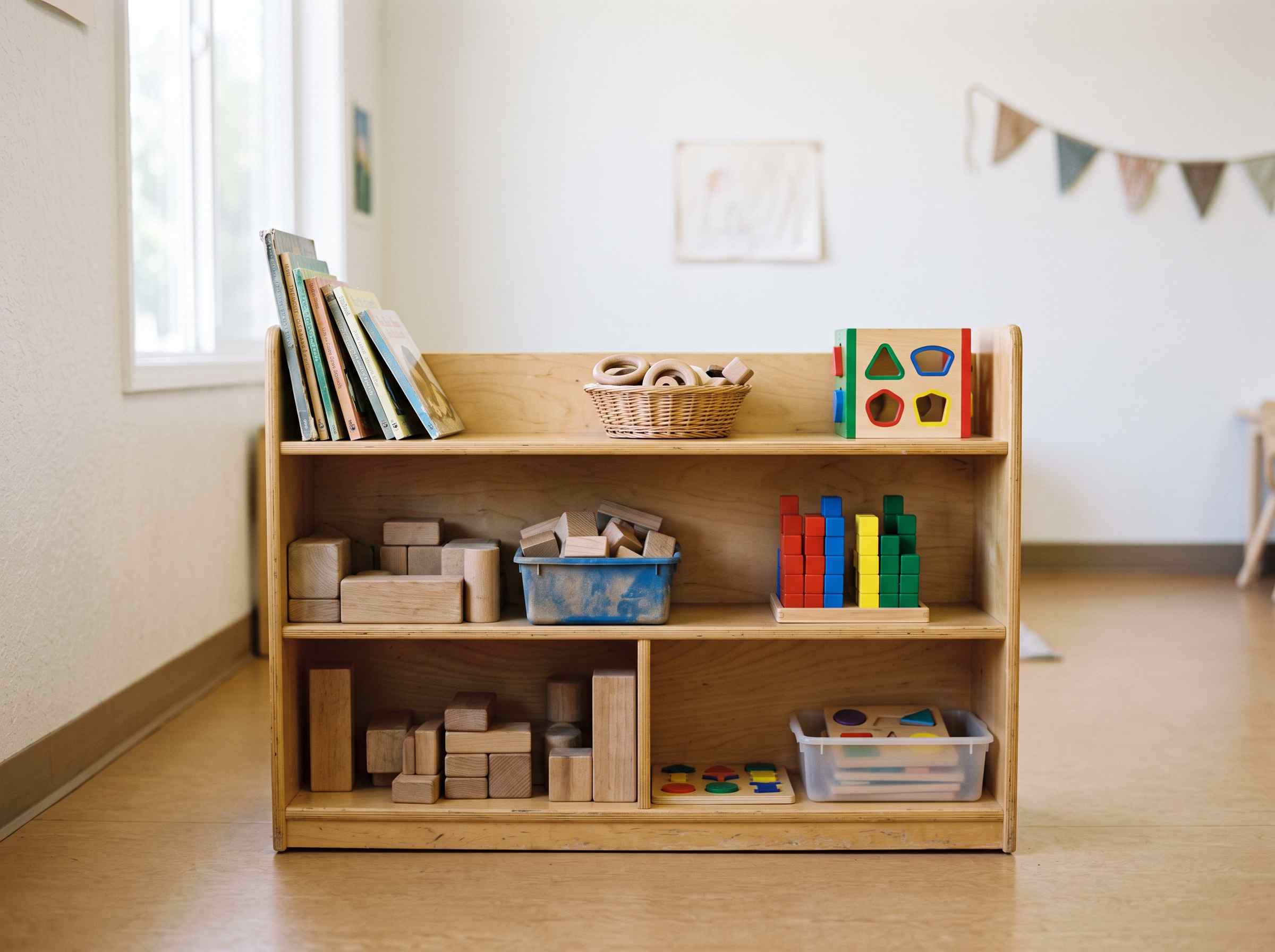
A preschool classroom can look well stocked and still fail to give children the learning opportunities they need. Writing tools may be out of reach, construction materials may be insufficient for group play, or classroom books and dramatic play props may not reflect the languages and experiences of the children who use them.
The real question is not how many materials a classroom contains. It is whether children can access, explore, combine, and revisit those materials during an ordinary day.
A preschool classroom materials audit helps teachers and administrators answer that question. By examining access, variety, condition, and actual use, a team can identify barriers, improve the classroom environment, and make more informed purchasing decisions.
The process does not need to begin with a room-wide inventory. A focused review of one learning center, recurring problem, or current learning goal often provides more useful evidence. When observations lead to specific actions and a follow-up review, the audit becomes a practical part of classroom improvement rather than another administrative task.
Why a Preschool Classroom Materials Audit Starts With Use, Not Volume
A full shelf does not necessarily support meaningful play. Materials may be difficult to reach, confusing to return, unsuitable for different ability levels, or disconnected from children’s current interests. Some resources may remain untouched while other popular items create waiting, frustration, or conflict.
A useful audit treats the classroom environment as part of the learning experience, not simply as a place where resources are stored.
The CLI Engage Classroom Environment Checklist (CEC) provides a relevant reference for evaluating and improving classroom environments, setting enhancement goals, and guiding coaching. Its Pre-K version addresses classroom organization, learning centers, meaningful print, literacy materials, and instructional planning.
The CEC can help educators think about the quality of classroom opportunities. However, it does not replace an inventory, a licensing inspection, or a comprehensive assessment of children’s learning outcomes. A materials audit has its own purpose: connecting what educators observe to decisions about classroom setup, resource use, and purchasing priorities.
Define the Decision Before Starting
Begin by identifying the question the team needs to answer.
For example, teachers might investigate why children frequently wait for construction blocks, why writing materials are rarely used during dramatic play, or why certain sensory materials are difficult to access independently.
Next, establish a reasonable observation period. This might cover a four-week learning unit, a center rotation, or several days of observation in an area where recurring problems occur.
A defined time frame keeps the review manageable. It also helps staff gather evidence that relates directly to a classroom decision rather than counting every object without a clear purpose.
The learning objective should be observable. If the goal is to support comparison, teachers can look for opportunities to sort, measure, order, or distribute objects. If the goal is narrative language, they can examine whether children have props, pictures, writing tools, and opportunities to develop and revisit stories.
Separate Environment Quality From Inventory Control
A classroom environment checklist and a materials inventory serve related but different purposes.
An environment review asks whether children can participate independently, explore varied activities, and use materials meaningfully. An inventory records what exists, how much is available, what remains usable, and whether replenishment is necessary.
Keeping these functions distinct prevents two common mistakes.
First, a classroom may have sufficient quantities of materials but still offer poor access because of shelf placement, unclear labels, or unsuitable storage. Second, a stockroom may contain numerous unused resources that do not address any current classroom need.
The two records can share basic information, but their conclusions should remain different. The environment review identifies barriers to participation; the inventory supports asset management, maintenance, and purchasing.
Assess Each Material Through Four Lenses
A practical preschool classroom materials checklist can be organized around four questions: Can children access the material? Does it offer meaningful variety? Is it in suitable condition? How do children actually use it?
These four lenses help teachers distinguish problems that can be resolved through better organization from gaps that may require repair, replacement, or additional resources.
1. Access and Independence
Start from a child’s perspective rather than an adult standing at the shelf.
Check whether shelves, containers, labels, and tools are accessible to children with different physical abilities, language needs, and levels of independence. A material that is stored in the classroom but cannot be reached independently is not fully accessible in practice.
The return process matters as much as retrieval. Children may be able to remove pieces but struggle to identify where they belong. This can make cleanup dependent on constant adult direction and reduce time available for learning.
Before purchasing new storage or specialized equipment, test simple adjustments such as picture labels, clearly defined containers, stable shelving, and designated spaces for unfinished projects.
These changes may resolve an access problem without increasing the number of materials in the room.
2. Variety and Representation
Variety means more than offering multiple colors or buying several products from the same category.
A balanced collection may include open-ended and structured materials, different levels of challenge, tools for individual and group activities, and resources that encourage language, movement, experimentation, construction, and creative expression.
Representation deserves separate attention. Books, figures, dramatic play props, classroom labels, and visual examples should reflect children’s languages, abilities, and family experiences in respectful ways. Cultural representation should feel like a natural part of the learning environment rather than a themed display used only occasionally.
During the review, record which experiences are available and which are missing. This gives teachers a clearer basis for deciding whether to rotate existing materials, adapt an activity, or introduce something new.
3. Condition and Suitability
Condition involves more than visible damage.
Check for missing pieces, sharp edges, loose components, worn surfaces, difficult-to-clean textures, and other concerns relevant to the material. Consider the intended age group, number of children using the resource, supervision requirements, and classroom cleaning procedures.
A material can be in good physical condition but still be unsuitable for a particular activity.
For example, a small construction set might work well for one child but create long waits during group play. A delicate resource might be appropriate for a supervised project but unsuitable for unrestricted access.
Record the context instead of giving the item a simple good-or-bad label. This distinction helps the team decide whether the answer is a replacement, a different setup, additional quantities, or a change in how the material is used.
4. Actual Use and Engagement
The final lens is what children do with the materials in everyday classroom conditions.
Observe whether children choose resources without prompting, return to them over time, combine them with items from other centers, or abandon an activity after a brief attempt.
A block set might become roads instead of buildings. Magnifiers might attract considerable interest, but children may lack tools to record what they observe. Neither situation automatically means a resource should be removed.
Instead, the observation may reveal an opportunity to add complementary materials, introduce an open-ended question, provide a place to preserve unfinished work, or adjust the activity.
Compare planned learning goals with observed play, but avoid assuming every useful experience must produce an immediate academic result. Persistence, negotiation, planning, and experimentation can all provide meaningful evidence of engagement.
Observe Each Learning Center in Everyday Conditions

A shelf inspection offers useful information about storage and condition, but it cannot show the full value of classroom materials.
Observe the center during ordinary play, and repeat brief observations across several days when possible. A material that receives little attention during one free-choice period may become useful when a teacher introduces a question or a project changes direction.
Repeated observation helps separate a consistent pattern from a temporary interruption.
Record Choice, Return, and Combination
Pay attention to three behaviors:
- Choice: Which materials do children select independently?
- Return: Do they revisit a material, continue a project, or abandon it quickly?
- Combination: Do they use the resource with materials from another learning center?
These observations reveal opportunities and barriers that product descriptions cannot capture.
For instance, children may repeatedly combine loose parts with blocks to create elaborate structures. In that case, separating the resources into different areas may limit an activity that children have already developed themselves.
Alternatively, children may repeatedly abandon a sorting activity because the pieces are difficult to handle or the instructions are unclear. The next step might be an adapted tray, visual prompts, or an alternative way to participate rather than an entirely new product.
Compare Planned Use With Actual Use
Place the current learning goals beside the observation notes.
If the goal involves mathematical comparison, check whether children can sort, count, measure, order, and distribute objects. For narrative development, examine whether story props, images, and writing tools allow children to create, share, and revisit ideas.
Keep the comparison descriptive rather than judgmental. A material may support several learning purposes beyond the one originally planned, and open-ended resources often reveal their value through the ways children adapt and extend an activity.
Include Teacher Prompts and Peer Participation
Material use is influenced by the social environment as well as physical setup.
Record whether teacher prompts extend thinking without taking control, whether peers can join an activity, and whether the available quantity creates unnecessary waiting.
The NAEYC article Fostering Engagement Within Inclusive Settings discusses how adjustments to physical, social, and temporal environments can support engagement in early childhood settings.
This perspective is useful during an audit. A participation barrier may be resolved by moving a shelf, changing group arrangements, introducing a peer role, or adjusting the length of an activity rather than purchasing a different toy.
When a change is tested, record what was adjusted and what happened afterward.
Turn Observations Into a Practical Preschool Materials Checklist
The audit should produce a record that another teacher, room leader, or buyer can understand without needing a lengthy explanation.
Keep the documentation short enough to complete during a planning period. Each entry should connect the observed situation to a specific next action.
What to Include in Each Audit Record
A useful preschool classroom materials checklist can contain the following fields:
| Field | What to Record |
|---|---|
| Material or center | Name the resource or learning area |
| Learning purpose | Identify the activity or experience it supports |
| Location and access | Record placement, labels, retrieval, and return conditions |
| Observed use | Describe how children select and use the material |
| Variety and participation | Note different ways to join and any recurring barriers |
| Condition and suitability | Record completeness, safety concerns, cleaning needs, and fit for the intended activity |
| Main gap | State the issue supported by the observation |
| Next action | Identify a setup change, repair, rotation, or purchasing question |
| Owner and review date | Assign responsibility and a time to check the result |
A photograph or brief observation note can provide useful context when a problem is difficult to explain in a few words. Documentation should avoid identifiable child information unless the program has an appropriate consent and privacy policy.
For a more complete record of quantity, storage location, and replenishment needs, pair the checklist with an existing inventory such as A Preschool Classroom Toy Inventory That Guides Better Reorders.
The inventory records what the classroom owns. The audit explains how the materials function in the learning environment and why an adjustment may be needed.
Example: A Completed Materials Audit Record
The following example illustrates how an observation can lead to an actionable decision. It is a sample scenario, not a report of an actual classroom observation.
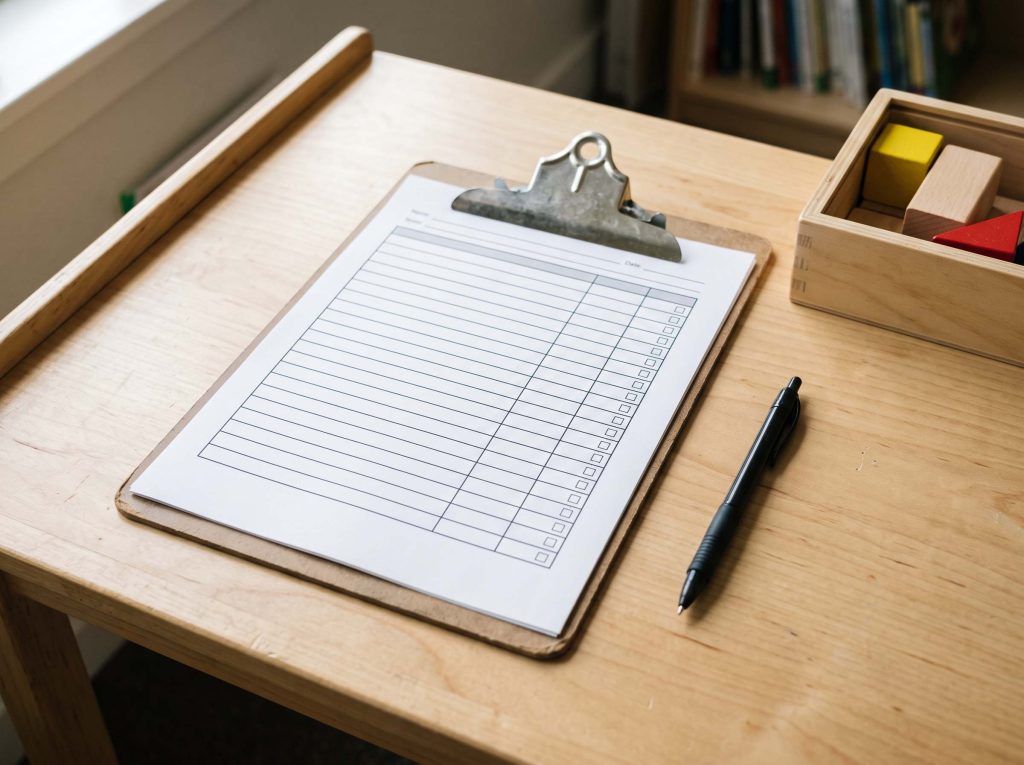
| Audit field | Example entry |
|---|---|
| Material or center | Construction blocks |
| Learning purpose | Building, balance, and collaborative problem-solving |
| Access | Blocks are within reach, but picture labels are difficult to interpret |
| Observed use | Several children want to build at the same time, and some wait for available pieces |
| Condition | Pieces are complete and usable |
| Main gap | Unclear storage labels and possible limits on simultaneous use |
| First action | Test clearer picture labels and observe whether waiting continues |
| Purchasing decision | Review quantities only if repeated observations show that the existing collection remains insufficient |
| Owner and review date | Room lead; reassess after the agreed trial period |
The important feature of this record is the sequence. It does not assume that every difficulty requires a purchase. Staff first test a manageable adjustment, then use the follow-up observation to determine whether a larger change is justified.
Use Clear Status Labels Instead of False Precision
For most classroom teams, a small set of descriptive statuses is sufficient:
- Aligned: The material supports the intended experience and is reasonably accessible and suitable.
- Partly aligned: The material is useful, but an identifiable barrier limits participation or use.
- Gap identified: A missing capability or persistent shortage prevents the intended activity from working as planned.
- Needs review: More observation or discussion is required before deciding what to change.
Each status should include one sentence of evidence. For example, “Pieces are reachable, but children who cannot yet read the labels need adult help returning them” is more actionable than a score of two out of five.
If the program uses numerical ratings, staff should agree on definitions and test them against a small sample first. Otherwise, different observers may rate the same shelf differently because they interpret accessibility or variety in different ways.
Assign an Owner to Every Action
Every action needs a responsible person and a review date.
A teacher may reorganize the shelf, a room leader may test visual labels, and a buyer may compare suitable replacement materials. The review should also identify what evidence will determine whether the change worked.
Without clear ownership and follow-up, an audit describes the classroom without changing it.
Review Materials Across the Whole Preschool Classroom
A whole-room review should not make every learning center identical. Its purpose is to check whether the overall environment offers varied opportunities for exploration, communication, movement, and participation.
Literacy, Math, Science, and Construction
In literacy areas, look beyond the number of books on the shelf. Check whether books are reachable, topics are varied, and writing tools, story props, and meaningful print are available where children can use them.
A class recipe book, a basket of puppets, or writing materials placed near dramatic play may encourage children to create stories, exchange ideas, and experiment with emergent writing.
Math, science, and construction areas should give children practical ways to compare, count, measure, test, build, and record. Review whether the quantity of materials fits the way children use the center, whether several children can work alongside one another, and whether ongoing projects can remain in place when appropriate.
For open-ended construction materials, how to set up loose parts play in a preschool classroom offers a related perspective on material categories, storage, safety, and quantity.
The right number of materials depends on factors such as group size, the activity, how resources are shared, and the supervision plan. A universal quantity rule is unlikely to fit every classroom.
Dramatic Play, Art, and Sensory Areas
Dramatic play benefits from props that allow children to represent familiar routines without prescribing a single script. Review whether children can choose roles, negotiate ideas, and extend play without relying entirely on adult direction.
Art areas need usable consumable supplies, tools with different grips, and work surfaces that support both standing and seated activities.
Sensory areas require clear procedures for hygiene, allergy considerations, cleaning, and small-component storage where relevant. These operational requirements should be considered alongside variety and engagement.
The related guide how to set up a dramatic play center that actually gets used explores themes, roles, and observation. During the audit, focus on whether current props help children initiate and develop play rather than simply filling the area.
Language, Representation, and Physical Access
Review shelf labels, visual instructions, books, family images, and examples of children’s work. Consider whether the environment supports the languages children understand and represents varied cultures, family structures, and abilities respectfully.
Then follow the route from a child’s position to the material. Look for narrow pathways, heavy lids, glare, noise, or surfaces that make manipulation difficult.
A tray, picture sequence, adapted grip, or alternative participation role may remove a barrier without requiring a separate specialized kit for every child.
These adjustments should respond to observed needs rather than assumptions about what a particular child can or cannot do.
Turn Audit Findings Into Better Classroom and Purchasing Decisions

Once the audit identifies a genuine gap, the next step is to decide whether it can be resolved by changing the environment or whether new resources are necessary.
A useful purchasing decision begins with evidence of a recurring barrier, a missing capability, or insufficient materials for the intended activity. It does not begin with a product category or a supplier catalog.
Fix the Environment Before Adding Inventory
Start with changes that make existing resources easier to use.
Move frequently used materials within reach, clarify labels, pair tools that children repeatedly seek together, and separate activities where noise or congestion creates a barrier. Remove unnecessary duplicates when they contribute to clutter rather than meaningful choice.
Test the change for a defined period and observe whether access, participation, cleanup, or sustained engagement improves.
Damaged or unsuitable items should be repaired, restricted, or removed according to the program’s safety procedures. An item should not remain available simply because it was expensive or familiar.
Prioritize Purchases With Evidence
When a purchase is necessary, use the audit findings to define the requirements.
Consider:
- Purpose and suitability: What activity or missing capability must the resource support, and is it appropriate for the intended age group?
- Quantity and shared use: How many children need to use it at the same time, and can the existing collection meet that need?
- Maintenance and lifespan: Can it be cleaned, stored, repaired, and replenished appropriately?
- Accessibility: Does its design allow children with different needs to participate?
- Procurement requirements: What product specifications, safety documentation, replacement-part options, and sample approvals are applicable to the intended market and use?
A small adaptation that removes a barrier for many children may deserve attention before a new center theme. For more costly purchases, a sample or limited trial may help the team confirm that the resource fits the classroom before committing to a larger order.
Ask Suppliers Questions That Match the Audit
The audit can also make supplier discussions more precise.
For mixed-material or institutional orders, buyers can ask suppliers to identify the exact SKUs covered by product documents, provide relevant material specifications, explain sample approval procedures, describe replacement-part availability, and confirm the expected timeline from approved sample to production.
These questions help connect classroom observations to purchasing records. They also reduce the risk of comparing products based on appearance or broad catalog descriptions alone.
Vindstier’s public materials describe OEM and ODM support, an ISO 9001 quality system, SKU-level CPC and CE documentation, and a typical sample delivery period of seven to fourteen days. These are supplier-provided claims and should be verified against the applicable documents, exact product scope, and destination-market requirements before ordering.
The audit should guide the product requirements; the supplier review should establish whether a proposed product and its supporting documentation meet those requirements.
Common Mistakes to Avoid During a Classroom Materials Audit
A well-designed checklist can still produce misleading conclusions if the results are interpreted carelessly.
Treating the audit as a teacher ranking. The purpose is to improve classroom conditions, not to judge staff performance from a single observation. Findings should lead to practical adjustments and constructive discussion.
Buying before identifying the barrier. A product may appear to solve a problem that could be addressed through placement, clearer labels, pairing, repair, or a change in adult support. Test feasible alternatives first.
Removing a material after one quiet observation. Children may need more time, a complementary resource, or a different introduction before a material becomes useful. Repeat observations before making decisions when circumstances allow.
Equating quantity with variety. A shelf full of similar items may offer fewer meaningful choices than a smaller collection that supports multiple types of exploration.
Treating an environment checklist as a compliance certificate. The CLI Engage CEC is a classroom improvement and goal-setting resource. It does not establish a universal number of toys, replace a complete safety assessment, or serve as a purchasing standard.
An audit is most useful when staff acknowledge uncertainty, record the evidence behind their conclusions, and remain open to changing their initial interpretation.
Build a Continuous Cycle of Classroom Improvement
A preschool classroom materials audit is a snapshot of conditions during a defined period. It cannot capture every child’s experience, and the usefulness of a material may change as interests, learning goals, group composition, and classroom routines evolve.
Usage counts alone also cannot explain whether an activity is meaningful or connected to a learning goal. Teacher judgment, child input, and family perspectives remain important when interpreting observations.
For these reasons, the review should end with a follow-up rather than a permanent label.
Return to the same center after the agreed adjustment period. Compare the new observations with the original question. Did children gain independent access? Did waiting or conflict decrease? Did the revised setup support longer exploration? Did the adjustment create a different barrier?
Record what changed and decide whether another adjustment, a new resource, or no further action is necessary.
A preschool classroom materials audit earns its value when it improves the experiences children can access and makes purchasing decisions more defensible. Instead of focusing on how much sits on a shelf, educators can focus on what children can reach, combine, represent, and revisit.
That shift helps teachers design more responsive learning environments and helps administrators direct resources toward materials that serve real classroom needs.