Every parent of a 3-year-old knows the moment well: the iPad goes dark, the meltdown begins, and you find yourself wondering if there’s anything — anything at all — that can hold a child’s attention for more than four minutes without a screen.
Cause-and-effect thinking is one of the earliest and most critical cognitive leaps a child makes. Before a child can understand that pushing a tower makes it fall, or that pulling the wrong stick collapses the whole structure, they are rehearsing the very mental framework that later becomes scientific reasoning, math logic, and emotional self-regulation. The question isn’t whether you should encourage this development — it’s whether the toy in your child’s hands is actually doing the job.
This article takes a close look at what cause-and-effect learning really means for children aged 3 to 8, what the research says about hands-on play, and how one specific wooden falling ball game manages to pack three distinct learning games into a single tower that fits on your coffee table.
What Cause-and-Effect Thinking Actually Looks Like at Age 3–5
Child development researchers at the University of California, Berkeley have documented that children as young as 24 months begin forming rudimentary causal chains — but the leap from passive observation to active experimentation typically happens between ages 3 and 5. This is the window when children stop watching things happen and start deliberately making them happen.
Dr. Alison Gopnik, developmental psychologist and author of The Gardener and the Carpenter, describes this phase as the “causal learning explosion” — a period when children are, neurologically speaking, running constant experiments on the physical world around them.
The problem is that most toys only offer one variable. A shape sorter teaches categorization. A stacking ring teaches size sequencing. A pull-back car teaches motion. Each is valuable in isolation, but none of them require a child to hold multiple variables in mind simultaneously — which is precisely what cause-and-effect reasoning demands.
Why Single-Mechanic Toys Have a Ceiling
Research published in the journal Child Development found that children aged 3–5 showed significantly longer sustained attention — averaging 4.2 minutes longer per play session — when engaging with toys that offered variable outcomes based on their own choices, compared to toys with fixed, predictable results.
In plain terms: when a child knows exactly what will happen, they stop paying attention. When the outcome depends on how carefully they pull, how accurately they roll, or what color they choose, they stay in the game.
This is the developmental gap that a well-designed wooden falling ball game can fill — but only if the mechanics are specific enough to force genuine decision-making at each step.
Three Games, One Tower — How the Wooden Falling Ball Game Creates Three Distinct Learning Loops
Most parents who pick up this wooden falling ball game expect a simple tumbling tower variant. What they get is structurally different from anything in the Jenga-style wooden game category.
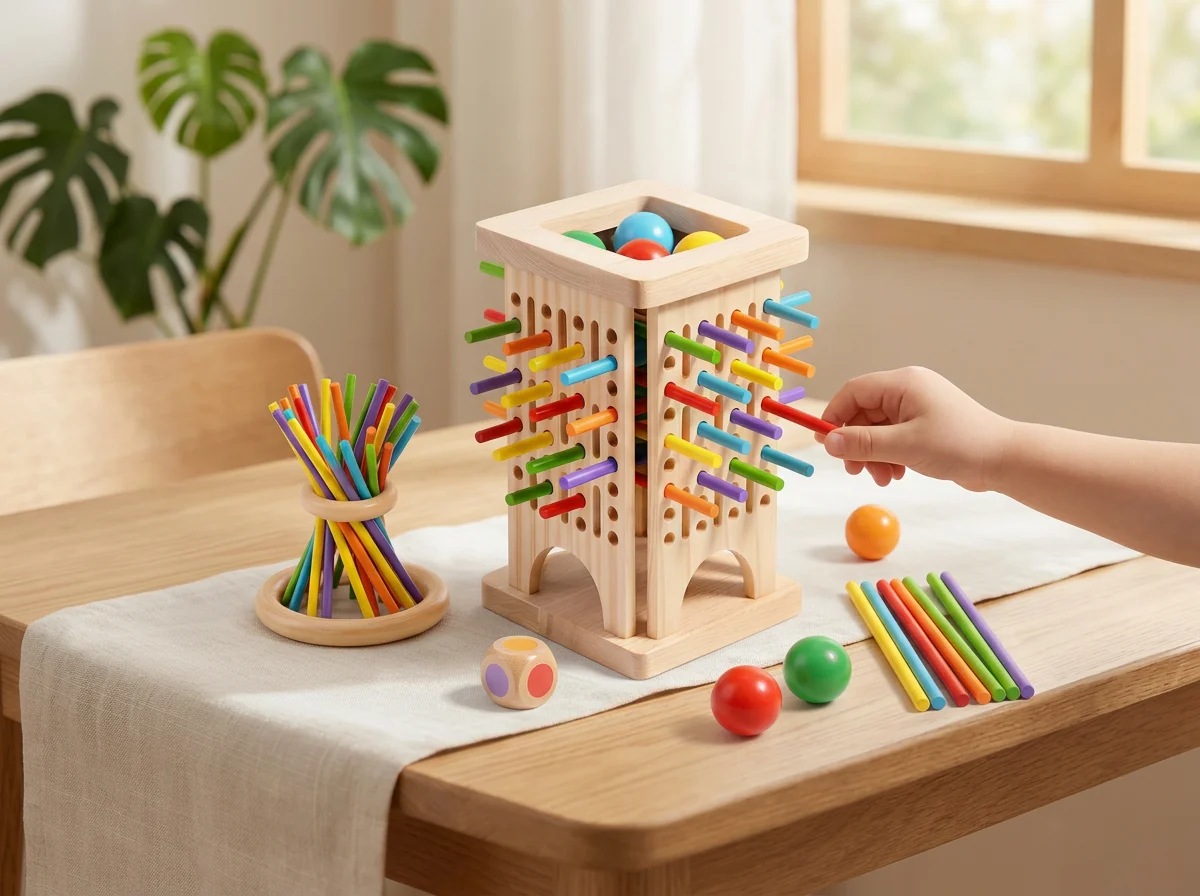
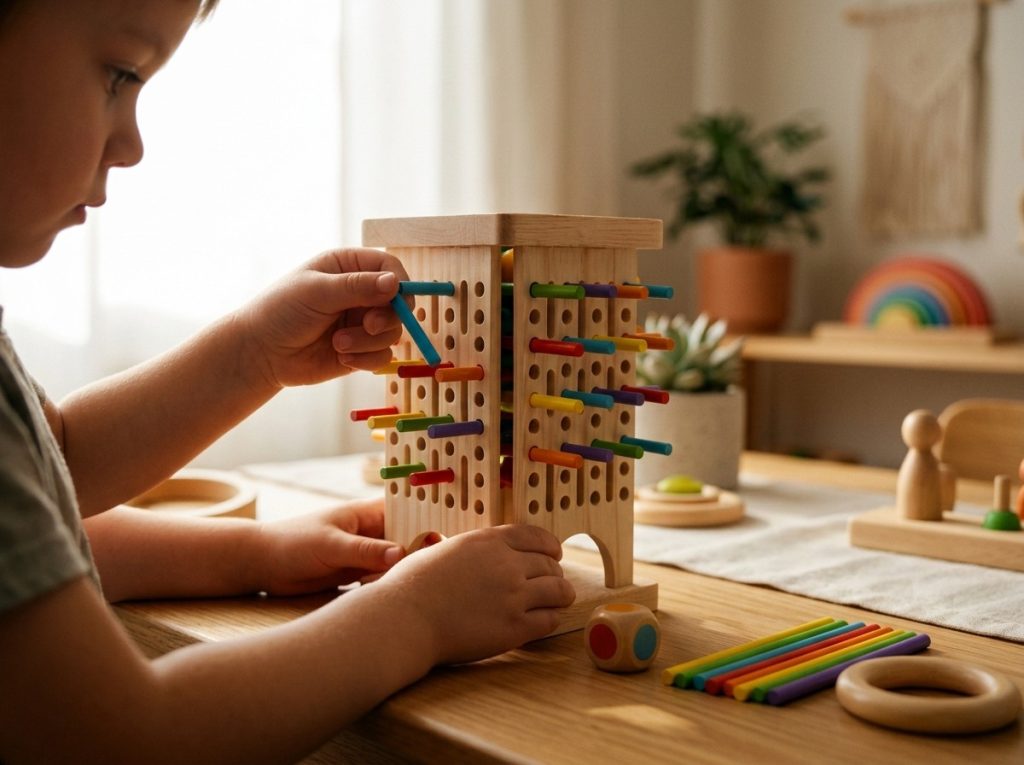
The set contains 30 colored sticks, 4 balls, 1 ring, and a die — all stored inside the main tower itself when not in play. That storage detail matters more than it sounds, but we’ll come back to it. First, the three game modes:
- Game 1 — The Classic Ball Drop (Cause-and-Effect Core Mechanic): Players take turns pulling colored sticks from the tower. When a stick is removed, the balls resting above shift. Pull the wrong one, and a ball drops through — a direct, immediate, physical consequence of a specific choice. For a 3-year-old, this is not just a game; it is a controlled experiment. The child is asking with every pull: “If I do this, what happens?” And the tower answers honestly every single time.
- Game 2 — The Balance Ring Challenge: The ring introduces a second variable: spatial awareness. Children must place or balance the ring on the tower structure without disturbing the balls above. This shifts the cognitive demand from “which stick is safe to pull” to “how do I interact with the structure without triggering a chain reaction?” Research on spatial reasoning from the journal Developmental Science links early balance and spatial tasks to stronger geometry performance at ages 7–9.
- Game 3 — Color Recognition and Sorting: The die determines which color stick a player must interact with next. A child who rolls and sees “red” must locate and assess all red sticks before deciding which is safest to move. This layered decision — color identification, then strategic evaluation — is precisely the kind of multi-step cognitive task that Montessori-aligned learning frameworks are built around.
| Game Mode | Primary Skill Developed | Age Sweet Spot |
| Ball Drop Tower | Cause-and-effect reasoning, impulse control | 3–6 years |
| Balance Ring Challenge | Spatial awareness, fine motor precision | 4–7 years |
| Color Die Sorting | Color recognition, strategic thinking | 3–5 years |
What makes this wooden falling ball game different from a standard wood block tower game or a tumbling tower alternative is that the three modes are not interchangeable novelties — they each target a distinct developmental stage within the same age range.
The Material Decision That Changes How Children Grip, Pull, and Learn
There is a reason Montessori educators have used natural wood toys for over a century that has nothing to do with aesthetics.
Wood has natural weight variance. A 10cm wooden stick carries a different tactile signal than a plastic replica of the same size. Children’s proprioceptive systems — the sensory network that processes body position and force — respond differently to the density and surface texture of natural materials.
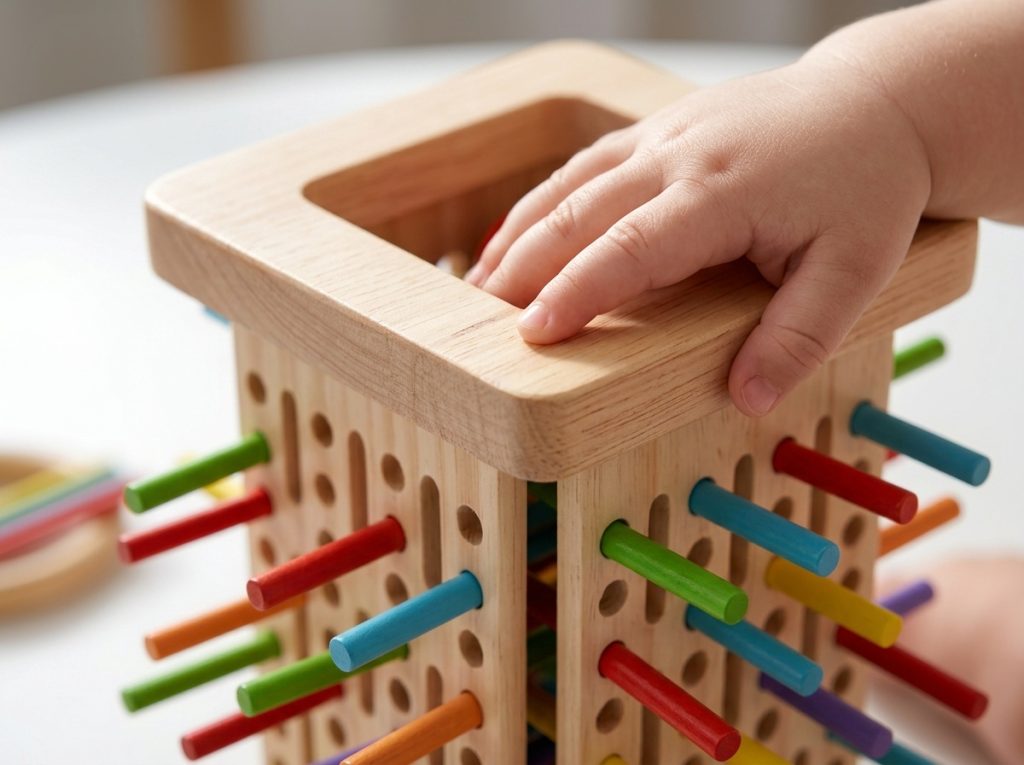
The sticks in this wooden falling ball game are crafted from solid natural wood, sanded to a finish that removes all surface irregularities. This matters specifically for the 3–5 age group because children at this stage are still calibrating grip strength. A rough edge or a splinter doesn’t just cause physical discomfort — it interrupts the cognitive loop. The moment a child flinches, the cause-and-effect experiment is over.
Water-Based Paint and the Sensory Safety Question
Each of the 30 colored sticks is coated in water-based, non-toxic paint. The distinction from solvent-based alternatives is not a minor technical footnote — it directly affects what happens when a 3-year-old does what 3-year-olds inevitably do: put things in their mouth.
Water-based coatings do not off-gas volatile organic compounds (VOCs) under normal play conditions. The colors remain stable after repeated handling, which means the color-sorting mechanic stays visually consistent over time. A red stick that fades to orange after two weeks of play is no longer teaching color recognition — it’s teaching confusion.
The die, the ring, and the tower body are finished to the same standard. From a parent’s perspective, the relevant fact is this: every component your child touches, mouths, or grips has been through the same surface treatment process.
This observation, made over a century ago, is now supported by substantial neuroscientific evidence: fine motor activities activate the prefrontal cortex, the region responsible for planning, decision-making, and impulse control.
The Wooden Falling Ball Game as a STEM Learning Tool — What the Research Actually Supports
The term “STEM toy” has been applied so broadly that it has nearly lost meaning. A toy that simply has numbers printed on it gets labeled a STEM toy. A wooden falling ball game earns the designation differently.
A meta-analysis published in Early Childhood Education Journal reviewed 43 studies on hands-on manipulative play in children aged 3–7. The findings showed that children who regularly engaged with physical cause-and-effect toys demonstrated:
- 34% higher scores on spatial reasoning assessments by age 6
- Measurably improved impulse control, with longer average delay-of-gratification in standard tests
- Stronger performance on early mathematical reasoning tasks, specifically those involving sequencing and prediction
The wooden falling ball game maps directly onto three of the tested variables in that meta-analysis: physical cause-and-effect mechanics, fine motor demand, and multi-step decision sequencing.
Where the Dice Mechanic Does Unexpected Work
The die is often treated as the least important component of this game. That is worth reconsidering.
When a child rolls the die and gets “blue,” they must then scan the tower, identify all blue sticks, and evaluate which blue stick is in the safest structural position. This is a three-step executive function sequence: identify, assess, decide. Neurologically, this is the same sequence used in reading comprehension, mathematical problem-solving, and social conflict resolution.
The die doesn’t just add randomness. It forces the child to accept an externally imposed constraint — a variable they cannot control — and work creatively within it. That is a skill most adults still find challenging.
Built-In Storage That Solves a Problem Most Wooden Game Sets Ignore
Ask any parent of a young child where the pieces of their last wooden game set are. The answer is rarely “all in the box.”
The wooden falling ball game addresses this with a storage design that is structurally integrated rather than added as an afterthought. The tower is the container. When play ends, the 30 colored sticks, 4 balls, the ring, and the die go back inside the tower body. The base locks, and the entire game occupies roughly the footprint of a large coffee mug.
For families who travel frequently, this is practically significant. The game fits in a carry-on bag, a car door pocket, or a daycare bag. There are no separate ziplock bags required. No inventory check before departure. The tower either has everything inside it or it doesn’t — and a 5-year-old can verify that in under 30 seconds.
This is not a minor convenience feature. Incomplete game sets are one of the top reasons parents report abandoning otherwise good toys. When components are lost, the educational mechanic breaks down. A ball-drop tower without balls is not a cause-and-effect toy — it’s a frustration device.
The Wooden Falling Ball Game as a Screen-Free Gift That Actually Gets Used After Day One
The gift-giving calculus for parents of 3–8 year olds has shifted significantly. Recent data from the Toy Association highlights that over 71% of parents actively prioritize screen-free toys when purchasing gifts for children under 8 — a massive jump from just 54% a few years ago. The shift is not driven by nostalgia. It is driven by the growing body of research linking extended screen time in children under 5 to delayed language development and reduced attention spans.
The challenge is that screen-free toys often fail the re-playability test. They are engaging for a day, then forgotten.
The wooden falling ball game’s three-mode structure directly addresses this. Because each game mode targets a different skill and creates a different type of tension, children naturally cycle between modes as their mood changes. A child who wants a quick, low-stakes round plays color sorting. A child who is feeling competitive and wants a high-stakes outcome plays the ball drop. A child working on focused, careful movement plays the balance ring.
Practical gift-use scenarios where this game performs well:
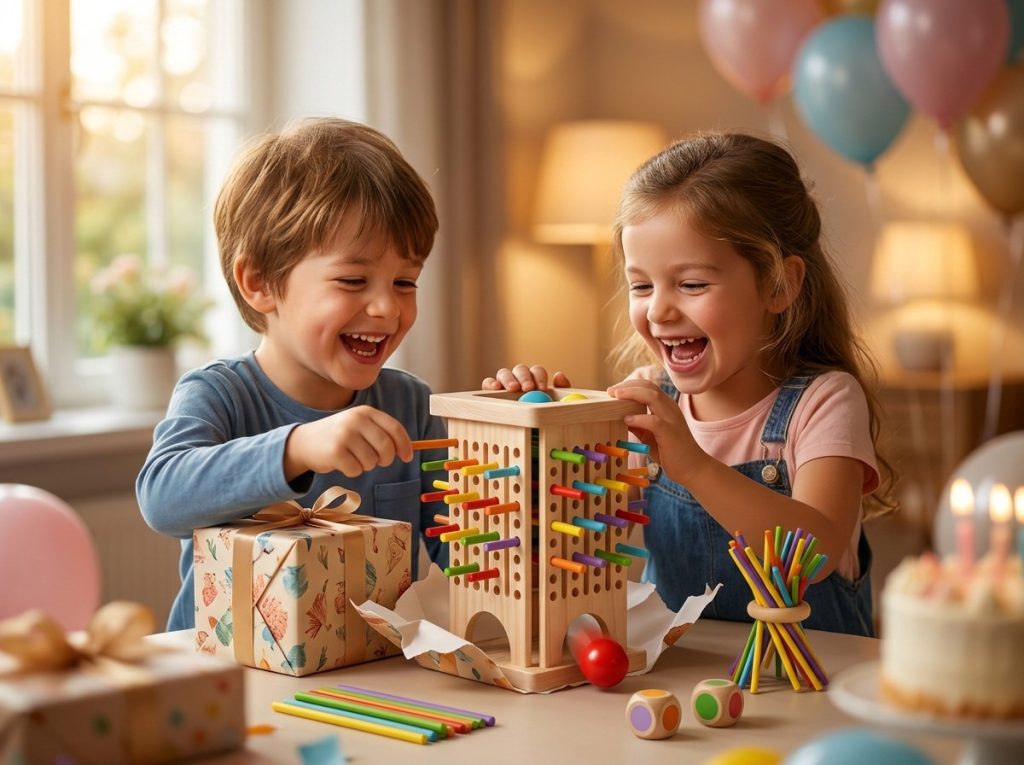
- Birthday parties for 3–5 year olds: The visual design is immediately attractive; no explanation required to start playing.
- Classroom learning tools for preschool and kindergarten settings: The self-contained storage means a teacher can deploy and pack up without counting pieces.
- Easter baskets and holiday gift sets: The compact tower format photographs well and requires no additional packaging to look gift-ready.
- Road trip and travel activity: Fits in a standard tote bag; no screen required; works perfectly on a tray table.
What the Wooden Falling Ball Game Is Not — And Why That Matters for Buyers
This is a game specifically optimized for children aged 3 to 8. Below age 3, the multi-step decision sequence is developmentally premature — not because the game is structurally unsafe, but because the cognitive payoff requires a child who can hold a rule in working memory while executing a physical action. Most children under 3 are not yet at that stage.
Above age 8, the game remains enjoyable as a family activity but loses its primary developmental function. The cause-and-effect loops become too predictable for a child whose executive function is already well-developed.
When evaluating this toy against standard options, the 3–8 age range and the three-game structure are what truly set it apart in the wooden game category. While comparable products in the wood block tower segment typically offer only one mechanic, this multi-mode approach keeps the toy relevant for years. Furthermore, the integrated storage directly addresses the biggest frustration parents have with traditional sets—lost pieces.
The game is not a replacement for outdoor play, social play, or open-ended creative play. It is a specific tool for a specific developmental window, and it works best when it is one part of a broader, active play environment.
Conclusion
Cause-and-effect thinking is not an abstract developmental goal. It is the specific cognitive muscle that a child exercises every time they pull a colored stick from a wooden tower and watch — with complete, undivided attention — what happens next.
The wooden falling ball game earns a place in a child’s play environment not because it carries the right labels, but because its three-game structure creates three distinct learning loops, its natural wood construction delivers consistent tactile feedback that plastic cannot replicate, and its integrated storage design means the game is actually complete and ready to play six months after purchase.
Research consistently shows that children learn cause-and-effect reasoning faster and more durably through physical, variable-outcome play than through screen-based alternatives. The question for a parent standing in front of a shelf of wooden game options is simply: does this toy give my child a real problem to solve, with real consequences for each decision?
For children aged 3 to 8, this one does.