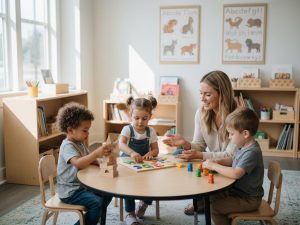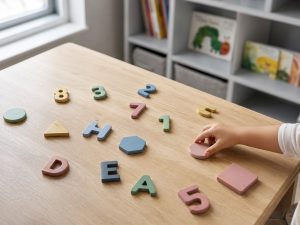
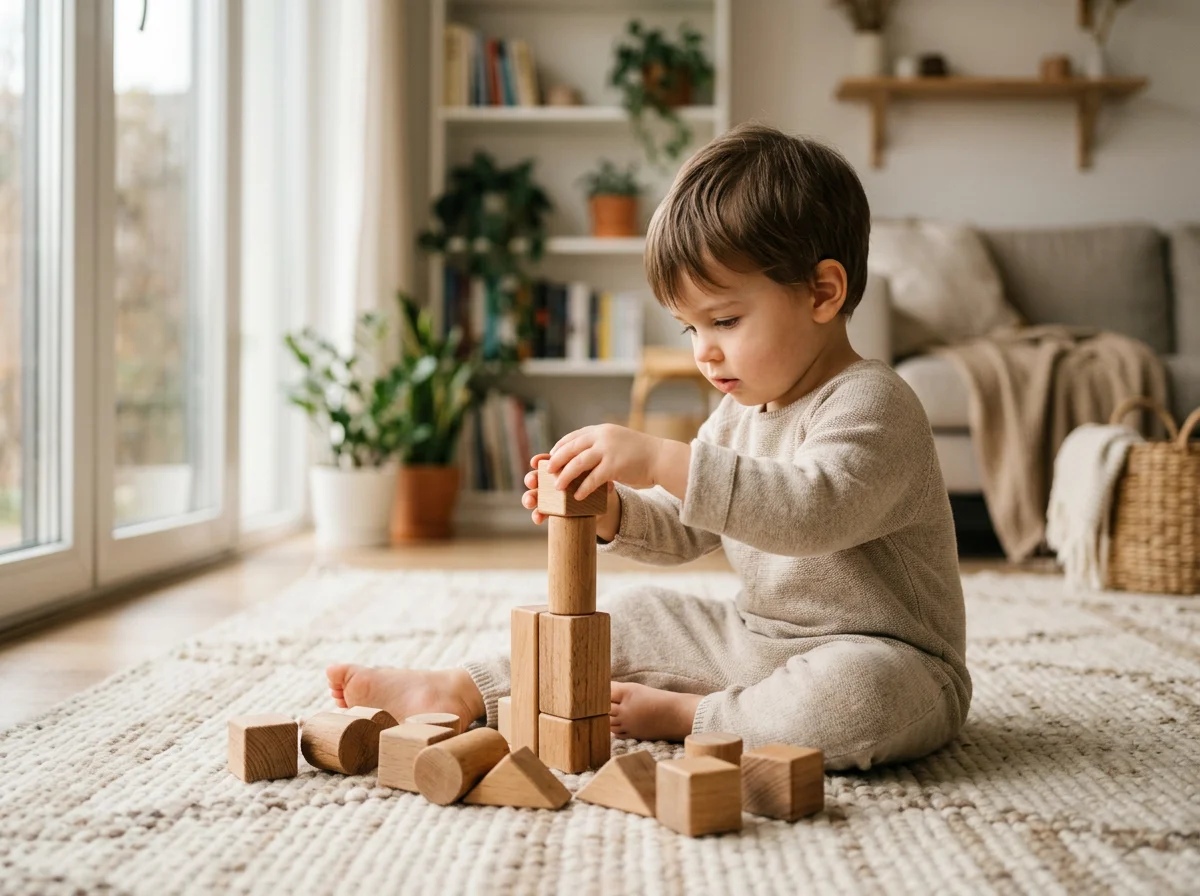
The average toddler in a screen-heavy household gets exposed to nearly 3 hours of screen time per day — more than double what the American Academy of Pediatrics recommends for children under 5. What does that mean for their developing attention spans, and what actually fills the gap when the tablet goes away?
Screen-free toys for toddlers have become a serious topic in early childhood research, not just a parenting trend. The evidence points to something most parents already sense intuitively: when a child plays without a screen, something different happens in their brain. This article breaks down what that difference looks like, why wooden toys specifically tend to produce stronger learning outcomes, and how to match the right toy to what your child is actually ready to learn.
What Happens to a Toddler’s Brain Without a Screen
Research published in JAMA Pediatrics found that higher screen time at age 2 was associated with lower scores in communication, fine motor skills, and problem-solving at ages 3 and 5. The mechanism isn’t complicated: screens deliver stimulation passively. A toddler watching a tablet receives visual and audio input without needing to produce anything in return.
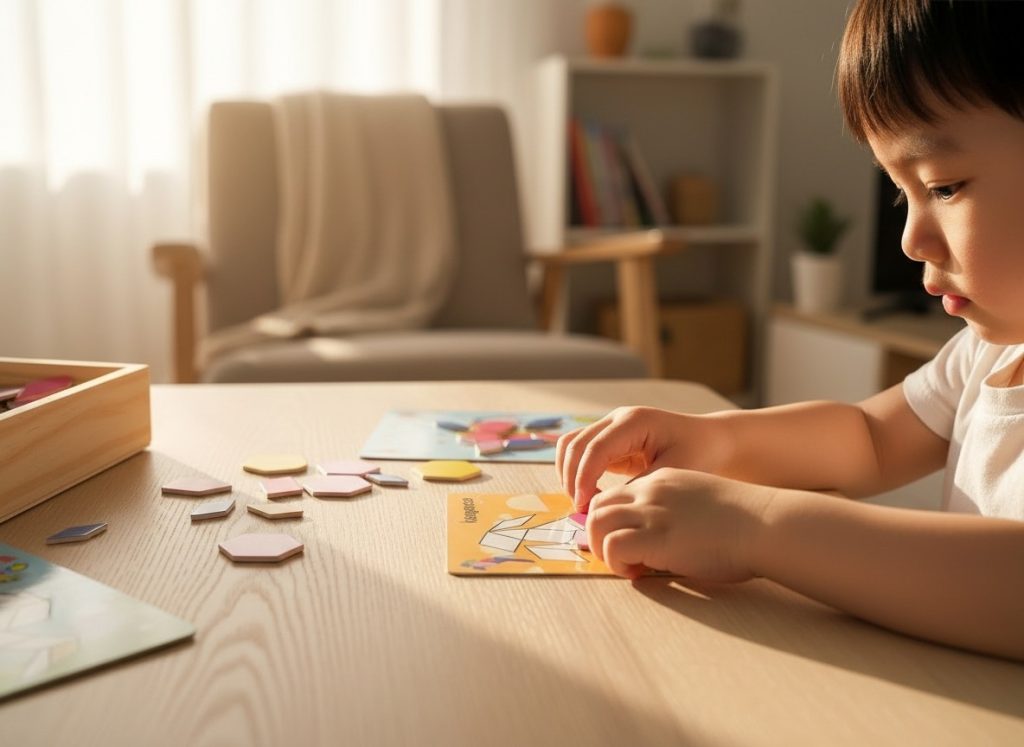
Hands-on play works the opposite way. When a child manipulates a physical object — stacking a block, fitting a shape into a slot, pushing a ball through a wooden track — the brain activates motor planning, spatial reasoning, and cause-and-effect processing simultaneously.
The Attention Gap Between Passive and Active Play
A 2019 study from the University of Virginia tracked toddlers during screen-based play versus object-based play and found that:
| Play Type | Average Sustained Attention (minutes) | Self-Directed Problem Attempts |
| Screen-based | 3.2 | Low |
| Object-based (wooden/tactile) | 7.8 | High |
The difference isn’t about discipline or willpower. It’s about what the activity demands from the child. Screen-free toys for toddlers require the child to be the engine — and that’s exactly what builds focus over time.
Why Wood Works — The Material Actually Matters
Not all screen-free toys produce the same results. Material matters more than most parents realize.
Wooden toys have a natural weight, texture variation, and resistance that plastic and foam simply don’t replicate. When a toddler picks up a wooden block, they’re receiving haptic feedback — the brain is processing grip pressure, surface texture, and object weight at the same time as visual information. That multi-sensory load is what makes the experience cognitively richer.
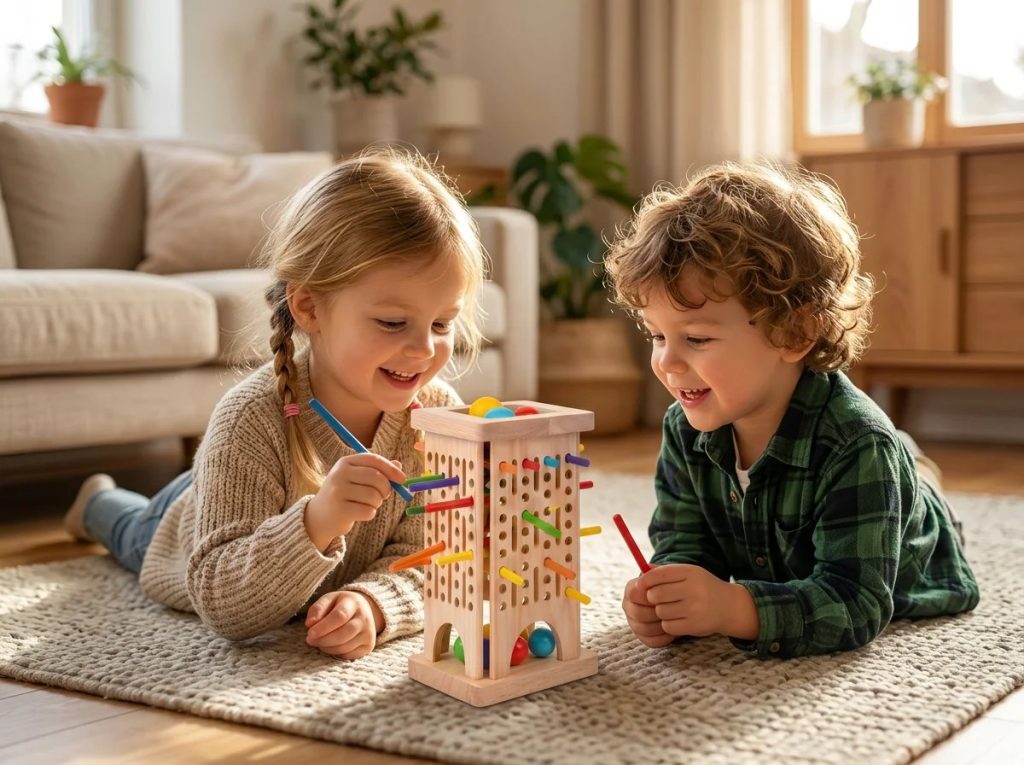
Vindstier’s Wooden Falling Ball Game, for example, weighs more in the hand than comparable plastic versions. That physical density isn’t accidental — it slows the interaction down just enough that children have to engage deliberately rather than swipe and move on.
CE and CPC Certification — What It Actually Means for Wooden Toys
Parents often see certification labels without understanding what was tested. CE certification requires compliance with EN 71, the European toy safety standard that covers mechanical safety, flammability, and chemical composition limits for paints and finishes. CPC (Children’s Product Certificate) goes further, requiring third-party lab testing specifically for the US market under CPSC regulations.
Vindstier wooden toys carry both — which means every unit has been independently tested for lead content in paint finishes, sharp edge thresholds, and small-part detachment under force testing applicable to children aged 3 and up.
That’s not a checkbox. For a wooden toy that’s going in a 3-year-old’s hands every day, it’s the difference between safe and unverified.
Screen-Free Toys for Toddlers That Directly Build Focus
The following Vindstier products were designed around specific cognitive milestones for children ages 3 and up. Each addresses a different aspect of early learning — which is why pairing them produces better results than using any single toy repeatedly.
Magnetic Fraction Teaching Aids Introduces part-whole relationships visually and physically. Children see a circle divided into halves, thirds, and quarters — then physically separate and recombine the pieces. Research on early fraction exposure shows children introduced to part-whole concepts before age 6 demonstrate stronger rational number understanding in primary school.
Magnetic Parking Game Combines letter recognition with spatial reasoning. Each parking space is labeled; each car is assigned a letter. The child must match, sequence, and park — which sounds simple until you watch a 3-year-old work through the logic. It’s a self-correcting activity: the wrong car in the wrong space doesn’t fit.
Fun Dinosaur Maze Maze navigation is one of the earliest measurable tests of planning behavior in children. The child has to look ahead, anticipate dead ends, and backtrack — all core components of executive function. The magnetic wand format removes the frustration of stuck pieces, keeping the focus on the problem-solving rather than the mechanics.
Wooden Number Blocks Functions as three things at once: a counting tool, a stacking challenge, and a balance activity. Because the blocks are numbered 1 through 10 with increasing size, children absorb the concept that larger numbers represent greater quantity — not through instruction, but through the physical experience of how the blocks balance.
How Screen-Free Wooden Toys Support Learning by Age Stage
Not every toy suits every developmental window. Here’s a practical breakdown:
| Age Range | Key Developmental Focus | Recommended Toy Type | Vindstier Example |
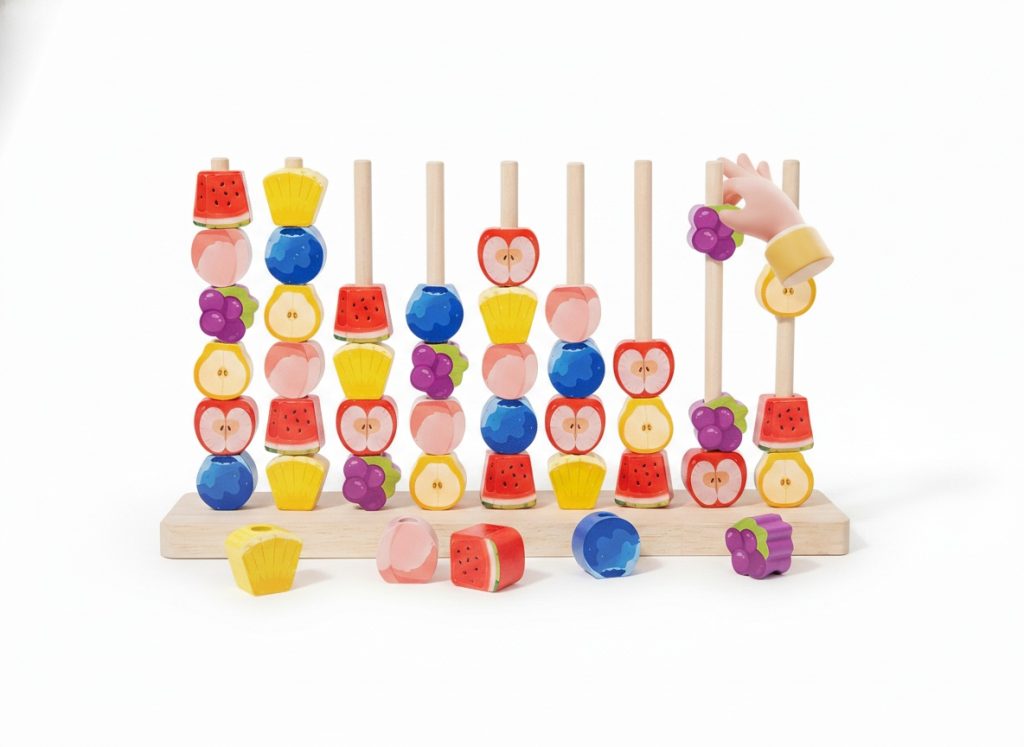
| 3–4 years | Fine motor control, color/shape recognition | Sorting, stacking | Fruit Sorting Stacking Toy |
| 3–5 years | Spatial reasoning, cause and effect | Maze, ball tracks | Fun Dinosaur Maze, Wooden Falling Ball Game |
| 4–6 years | Early numeracy, sequencing | Number-based tools | Wooden Number Blocks, Number Flip Dice Box |
| 4–6 years | Pattern recognition, early geometry | Magnetic building | Magnetic Pattern Blocks Set |
| 4–7 years | Fraction concepts, logical matching | Structured STEM tools | Magnetic Fraction Teaching Aids, Magnetic Parking Game |
When to Introduce Multiple Toys Together
Single-toy play builds depth. Multi-toy play builds flexibility. Once a child is comfortable with one tool — say, the Wooden Number Blocks — introducing the Magnetic Fraction Teaching Aids alongside creates a natural bridge between counting and division concepts.
This is why montessori classrooms organize materials in progressions rather than isolated stations. The toys don’t compete for attention; they build on each other.
Making the Shift — Practical Steps for Reducing Screen Time at Home
Screen-free play doesn’t require a dramatic lifestyle overhaul. Data from Common Sense Media shows that incremental replacement — swapping 30 minutes of screen time for structured hands-on play per day — produces measurable improvements in sleep quality and attention span within 4 weeks.
A few approaches that consistently work:
- Anchor play to routine: Introduce screen-free toys at the same time each day (after lunch, before bed). Predictability reduces resistance.
- Stay nearby but don’t direct: Research on child-led play shows that parental hovering reduces problem-solving attempts. Proximity without intervention is the sweet spot.
- Rotate toys weekly: Novelty drives engagement. Keeping 3–4 toys in rotation rather than 15 available at once reduces choice paralysis and increases time-on-task per toy.
- Match complexity to mood: Save the Magnetic Fraction Teaching Aids for high-energy, focused mornings. The Fruit Sorting Stacking Toy works better as a wind-down activity.
The goal isn’t to eliminate screens entirely — it’s to make sure screen-free toys for toddlers occupy the developmental hours that matter most.
Conclusion
The research doesn’t frame this as a battle between screens and toys. What it consistently points to is the gap between passive input and active engagement — and for toddlers in a critical developmental window, that gap shows up in measurable ways: attention span, problem-solving ability, and early academic readiness.
Wooden toys have stood the test of time not because of nostalgia, but because of what they actually ask of a child: to feel the weight of something real, to trace cause and effect with their own hands, to sit with a problem that doesn’t skip to the next level on its own. That process — unhurried, self-directed, and sometimes frustrating — is precisely how focus gets built.
No single toy solves everything, and no single approach works for every child. But one finding holds up consistently across the research: give a toddler something that requires them to think, then step back. That simple shift tends to produce more than any structured lesson plan.
The real value of screen-free play isn’t what it removes from a child’s day. It’s what it makes room for — the chance to wonder, to attempt, and to figure things out on their own terms.