Every parent searching for maze toys for kids eventually hits the same wall: the toy looks great in photos, but three days after unwrapping it, the pieces are scattered under the couch and the child has moved on. Small beads get lost. Cards warp. The “educational” promise quietly disappears.
This guide cuts through the noise. We tested and evaluated what actually makes a maze toy worth buying in 2026, and one product kept rising to the top of every category that matters to parents of 3 to 6-year-olds: the Vindstier Fun Dinosaur Maze.
Here’s an honest breakdown of why.
What Parents Are Actually Looking for in a Maze Toy for Kids
Before diving into any single product, it’s worth understanding what the research says about how children learn through play, because not all maze toys deliver equal developmental value.
The Fine Motor Development Window
A 2022 study published in Early Childhood Education Journal found that children between ages 3 and 5 are in a critical window for fine motor skill development, with object manipulation activities showing the strongest measurable gains. The study specifically noted that guided bead-tracking tasks, where a child must move an object to a specific target, outperformed open-ended drawing activities in developing precision grip and hand-eye coordination within this age range.
This matters because most dinosaur maze games on the market are purely visual, offering a printed paper maze that a child traces with a finger or crayon. That format misses the tactile, kinesthetic layer that makes the activity stick.
Why “Educational Toy” Claims Need Scrutiny
The Global Toy Industry Report (2023) flagged that 68% of toys marketed as “educational” for ages 3 to 5 do not include structured progression, meaning a child can complete the activity in the same way on day one as on day 100. There is no growth curve. There is no next challenge.
Parents searching for educational toys for 3 year olds or Montessori toys 3+ years are often specifically trying to avoid this plateau.
The “Lost Pieces” Problem
A survey by Parenting Magazine (2023) found that 74% of parents cited “losing small parts” as the number one reason they stopped using a toy before it was outgrown. For any maze toy involving beads, cards, or movable components, this is not a minor inconvenience. It is the reason the toy ends up in a donation box.
How the Fun Dinosaur Maze Solves the Problems Other Maze Toys Don’t
This is where the Vindstier Fun Dinosaur Maze separates itself, not through marketing language, but through specific design decisions that address each of the pain points above directly.
A Dual-Learning System Built Into a Single Board
Most dinosaur maze toys for kids ask a child to do one thing: guide something from point A to point B. The Vindstier Fun Dinosaur Maze asks a child to do two things simultaneously, and scales those things as the child grows.
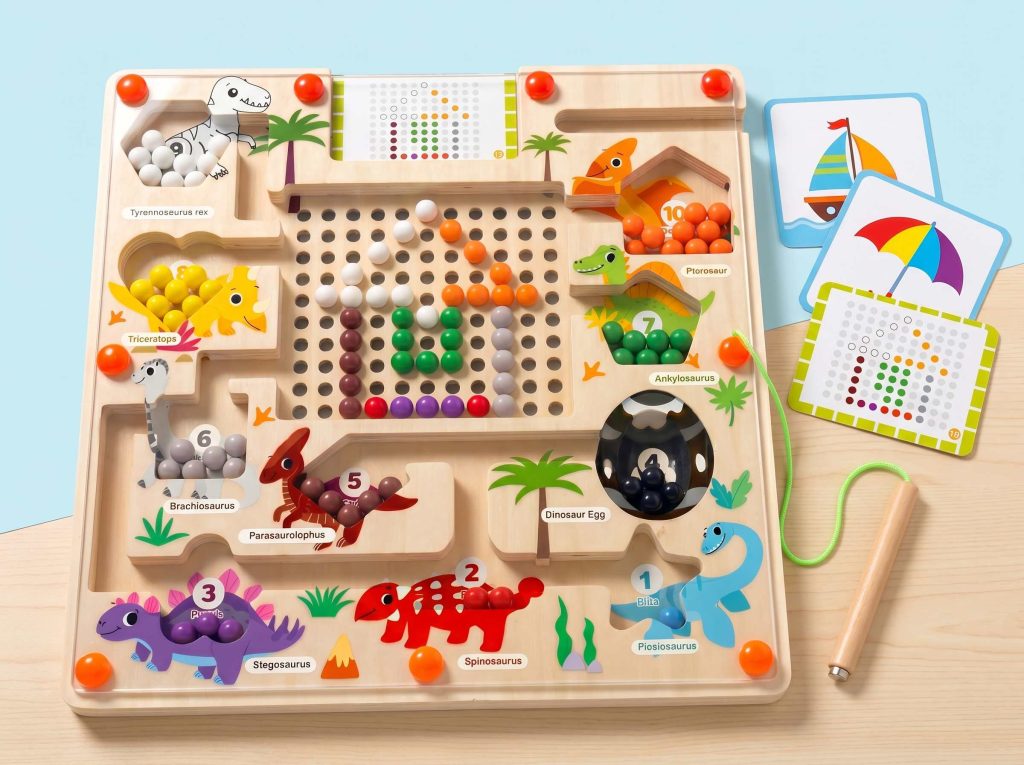
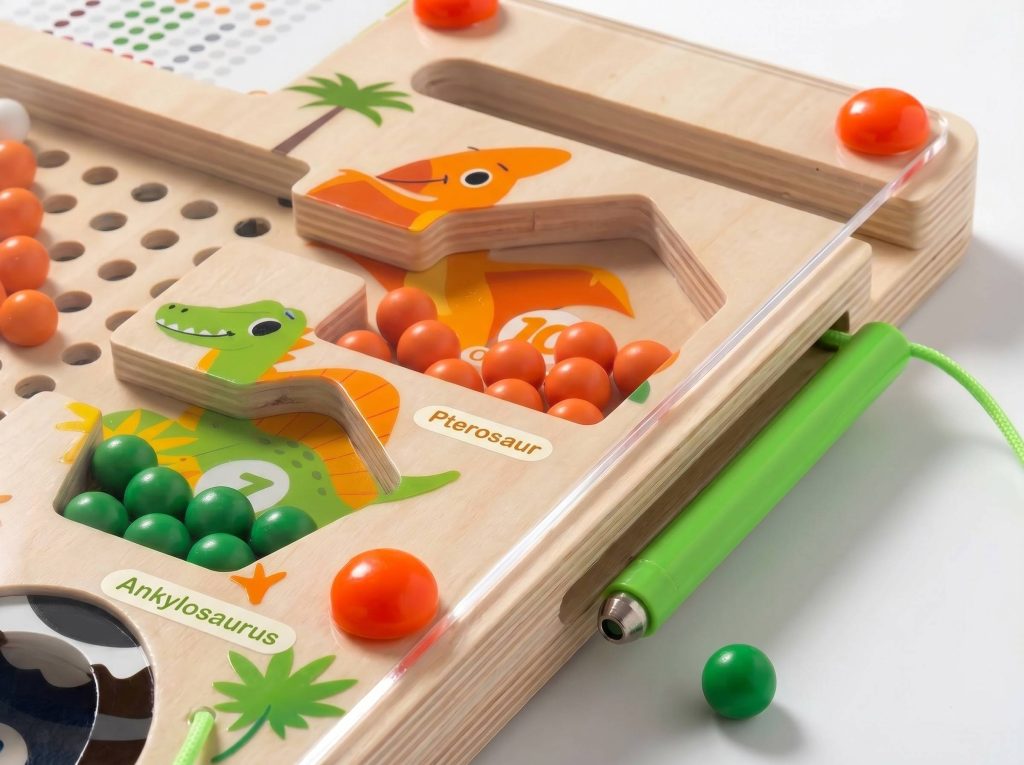
The board comes with 10 double-sided cards, giving 20 distinct pattern challenges. The early cards focus on number recognition and bead counting within the 1 to 10 range, each number linked to a specific dinosaur nest on the board. A child moves magnetic beads into the correct nest for the number shown. Later cards introduce pattern-building challenges using the same bead system, requiring the child to recreate or extend a visual sequence using the 10 color-coded bead types.
This is not a superficial difficulty switch. It is a genuinely different cognitive task. Counting to 5 and building a repeating AB color pattern are skills that develop at different ages, yet the same physical toy supports both. The 20-challenge card system means a child who receives this as a stocking stuffer at age 3 is still engaged with new challenges at age 5.
The Magnetic Pen That Changes Everything
The interaction mechanic of this easy dinosaur maze is the detail most parents notice immediately after opening the box.
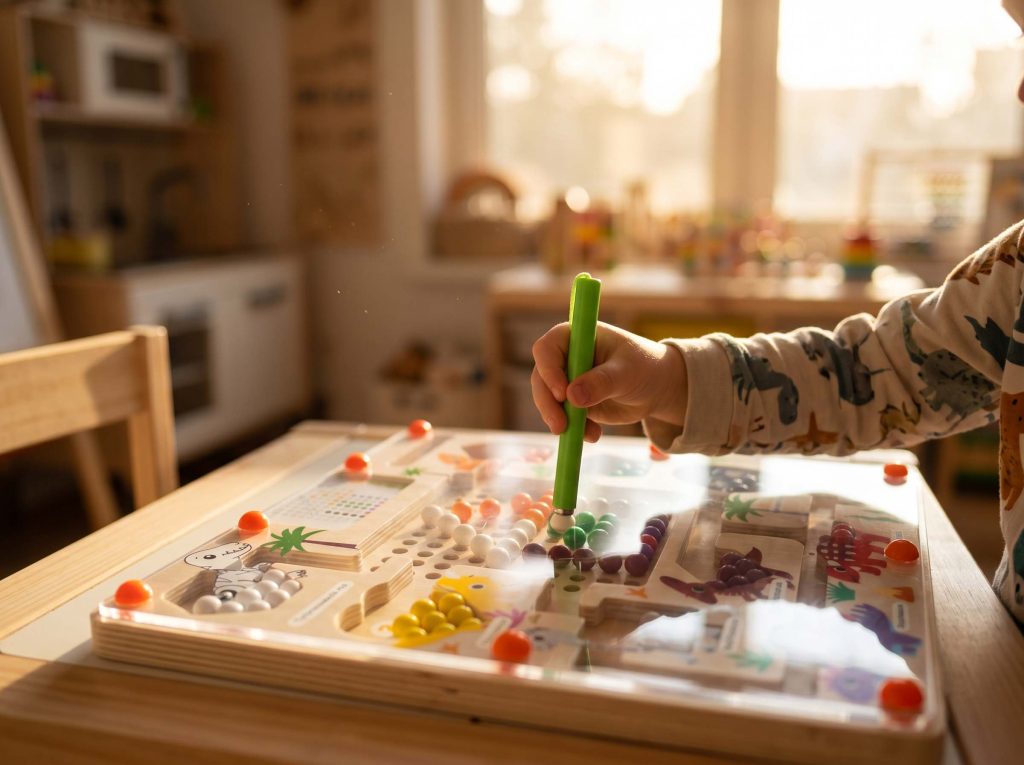
Instead of the child picking up beads with their fingers and placing them (which triggers the small-parts anxiety every parent knows), the child uses a magnetic pen to attract and guide each bead across the board surface. The bead never leaves the board. It never rolls under a chair.
More importantly from a developmental standpoint, this is exactly the kind of pincer-and-guide movement that occupational therapists recommend for fine motor development in the 36-month-plus window. The child cannot rush. The magnetic pull is strong enough to hold the bead but requires steady hand control to guide it accurately to a target nest. Across 20 card challenges, that is hundreds of repetitions of controlled fine motor movement embedded inside a game the child chose to play.
The Bead Containment Design Is Not an Afterthought
The most distinctive feature of this fun dinosaur maze is the one that takes five seconds to understand but solves a problem that frustrates families for years.
The beads are permanently sealed inside the magnetic pen. They do not come out. Ever.
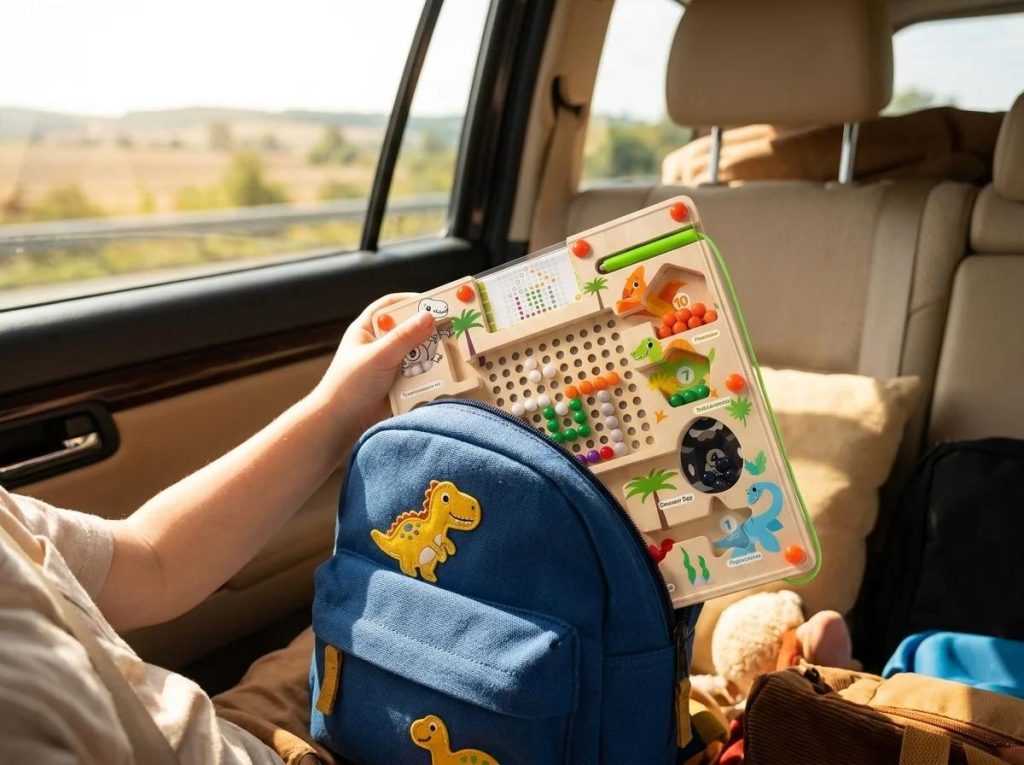
The pen body includes a built-in storage slot on the board frame, so after play the pen has a designated home. The 8.6-inch square board fits inside a standard daypack side pocket. The entire play system, board, pen, and 10 double-sided cards, packs flat and travels without generating a single loose component.
For families who use travel toys on flights or road trips, this is a genuinely different category of product from any dinosaur maze adventure toy that involves separate bead packs or detachable pieces.
| Feature | Typical Maze Toy | Fun Dinosaur Maze |
| Bead containment | Loose, losable | Permanently sealed in pen |
| Challenge progression | Single difficulty level | 20 challenges across 10 double-sided cards |
| Fine motor engagement | Passive tracing | Active magnetic bead guidance |
| Travel readiness | Requires piece management | 8.6-inch flat pack, zero loose parts |
| Color learning | Incidental | 10 specific colors mapped to bead types |
| Number range covered | Often limited to 1-5 | 1 to 10, each mapped to a dinosaur nest |
The Material Reality: What “Safe” Actually Means on This Board
Safety language in toy marketing has become so diluted that most parents scroll past it. For this product, the specifics are worth reading.
Surface and Structure
The board is constructed from natural wood with a sanded, splinter-free finish. The top panel is a thick, high-transparency acrylic sheet rated for scratch resistance, designed to remain clear after repeated bead passes. The acrylic is not adhesive-mounted. It is bolt-secured at the corners, which means the panel does not separate under lateral pressure from a child pressing down during play.
These are not general quality claims. They are specific construction decisions that determine whether the toy survives 18 months of daily use by a 3-year-old who presses hard.
Paint and Finish
The color coding on this fun dinosaur maze, 10 distinct colors across the dinosaur nests and bead types, is achieved using non-toxic paint formulations. The color accuracy matters because the card challenges require the child to match bead color to nest color precisely. A paint that yellows or chips within the first few months of use would degrade the learning mechanic, not just the appearance.
The natural wood base is finished without added sealants that contain volatile compounds, which is relevant for the age group, since 3 to 4-year-olds frequently mouth objects and touch surfaces then touch their faces.
Age Suitability: 36 Months Is a Specific Threshold
The 36-month minimum recommendation on this dinosaur maze for kids corresponds to a specific developmental marker: the emergence of controlled pincer grip and basic number symbol recognition. Below 36 months, neither the magnetic pen mechanics nor the numbered nest system maps onto typical developmental capabilities.
Above 36 months, the 20-challenge card system provides a meaningful skill ladder. The toy is not “suitable from 3 years” as a liability qualifier. It is designed around what a 36-month-old can do and what a 5-year-old still finds genuinely challenging.
Research from the American Academy of Pediatrics (2023) notes that open-ended play toys which support skill progression, rather than single-outcome activities, show significantly higher engagement rates across the 3 to 6 age range, with children returning to the same toy an average of 4.3 times more often over a six-month period.
Fun Dinosaur Maze in the Context of STEM and Montessori Play
Parents researching stem toys for preschoolers and Montessori toys 3+ years are often navigating a crowded and contradictory space. Both frameworks value self-directed learning, hands-on materials, and skill scaffolding. They differ in emphasis, with STEM prioritizing structured problem-solving and Montessori prioritizing child-led exploration.
Where This Dinosaur Maze Adventure Sits
The Vindstier Fun Dinosaur Maze occupies an interesting position. The card-guided challenges are structured, which aligns with STEM’s problem-solving orientation. The magnetic pen mechanic is self-correcting, meaning a child who misplaces a bead simply tries again without adult intervention, which aligns with Montessori’s emphasis on materials that give feedback through use rather than through correction.
The 20-card progression adds a layer that pure Montessori materials often lack: a visible challenge ladder that a child can see and self-assess against. For families who want Montessori sensory exploration with the motivational structure of a game, this combination is not common in the wooden toys for toddlers category.
Open-Ended Extensions Beyond the Cards
While the 10 double-sided cards provide 20 defined challenges, the bead and nest system also supports open-ended play toys usage. A child who has mastered all 20 card patterns can use the board as a free-play surface, creating their own bead arrangements, testing which colors fill which nests fastest, or building patterns that are not on any card.
This extends the useful play life of the toy well beyond the structured card progression and is particularly relevant for families seeking eco-friendly wooden play sets that justify their price point through longevity rather than single-use novelty.
STEM Skill Mapping
The specific skills this toy builds map directly onto early STEM competency frameworks:
- Number recognition and one-to-one correspondence (1 to 10) — foundational mathematics
- Color classification (10 distinct colors) — early data sorting
- Pattern recognition and replication (card challenges) — pre-algebraic thinking
- Fine motor control via magnetic pen guidance — engineering process skills (design, test, adjust)
A child working through the card progression is practicing classification, sequencing, and precision control within the same 15-minute play session.
Gift Packaging and Real-World Gifting Scenarios
The practical question parents face when choosing stocking stuffers for 3+ years or birthday gifts is rarely about the toy in isolation. It is about the moment of giving and the weeks that follow.
The Packaging Experience
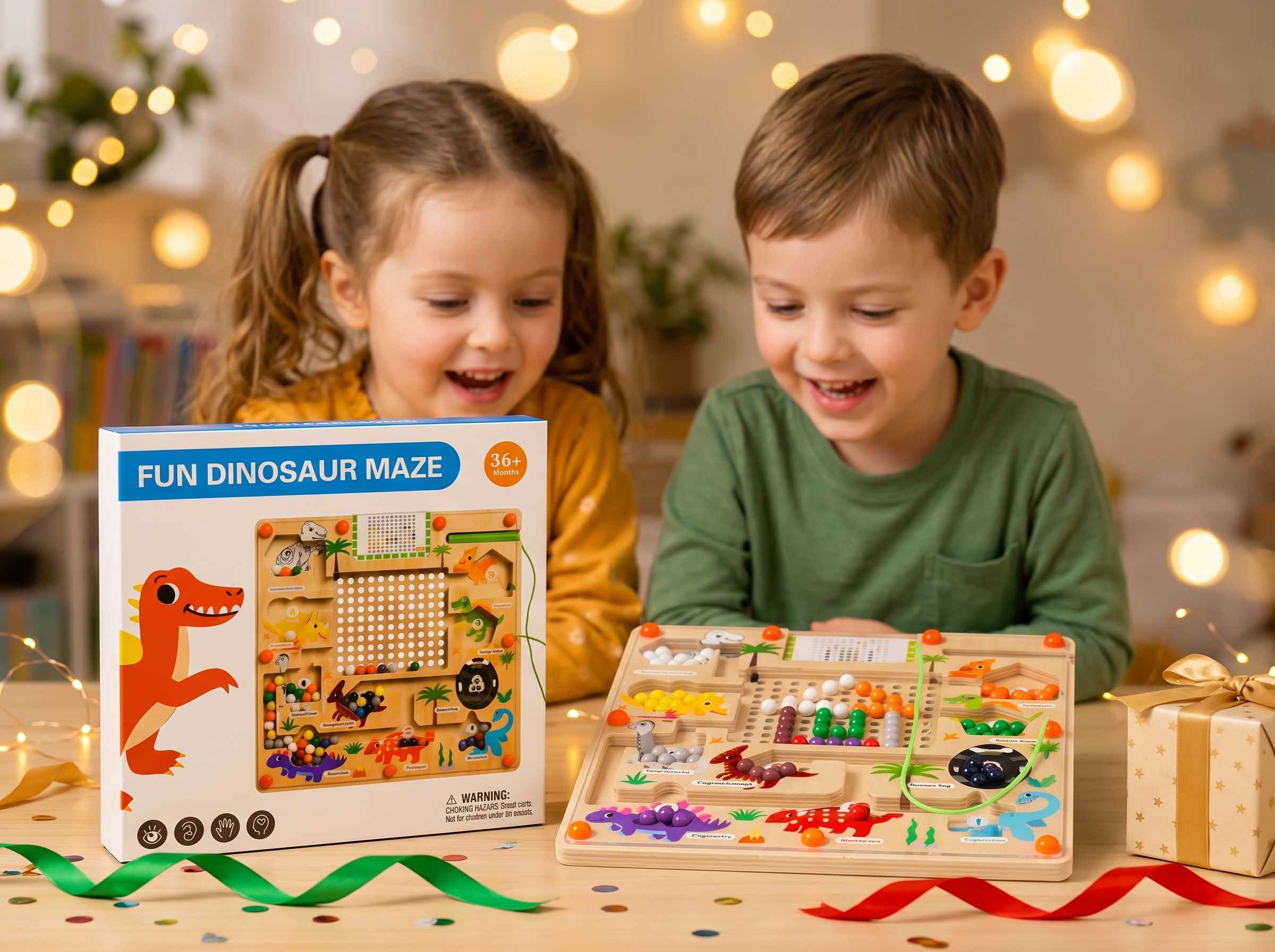
The Vindstier Fun Dinosaur Maze ships in a color-printed gift box with the dinosaur theme carried through from board design to outer packaging. There is no secondary wrapping required. The box itself functions as presentation packaging, which removes a logistical step for parents who are gift-wrapping at the last minute.
Longevity Past the Occasion
A toy given as a Christmas or birthday gift earns its place by lasting. The dual-card system means the challenge is not exhausted by New Year’s Day. A child who receives this at a birthday party in March will still encounter new card challenges in September, and the open-ended play layer means it remains on the shelf past the point where all cards have been completed.
For a gift category, stocking stuffers for 3+ years, that is frequently associated with items that entertain for a week and then disappear, the extended engagement curve of this toy is a meaningful differentiator.
Gender-Neutral Design Without Compromise
The dinosaur theme tests well across gender lines in the 3 to 6 range, a period during which many children regardless of gender show strong interest in prehistoric animals. The color coding uses the full 10-color spectrum rather than a palette that reads as gender-specific. For parents buying group gifts for preschool classes or sibling sets, this removes a common selection anxiety.
Comparing the Fun Dinosaur Maze Against the 2026 Maze Toy Market
The maze toy category has grown significantly, driven by parent demand for screen-free play toys that deliver measurable developmental value. Most products in the category have improved on one dimension: visual quality. Boards are better printed, themes are more appealing, and packaging has become more gift-ready.
What has not improved at scale is the structural play design. The majority of maze toys for kids in 2026 still offer a single-mode activity. A bead runs a track, or a marble finds an exit, or a finger traces a printed path. These are all valid activities. None of them scale with the child.
Data from the Toy Association’s 2024 Developmental Toy Report found that toys with built-in difficulty progression retained active use among children 3 to 5 years old for an average of 14 months, compared to 4 months for single-mode toys in the same price bracket.
The Vindstier Fun Dinosaur Maze’s 20-challenge card system places it directly in the progression category. The retention implication is straightforward: parents who buy it are buying 14 months of engagement, not 4.
Conclusion
Maze toys for kids fill a real developmental need, but most of them ask the child to do one thing, one time, and then stop. The Vindstier Fun Dinosaur Maze is built around a different assumption: that a 3-year-old and a 5-year-old should both be challenged by the same toy, just at different card levels.
The magnetic pen bead system eliminates the small-parts problem that ends most bead-based toys early. The 10 double-sided cards give 20 structured challenges that span number recognition, color classification, and pattern building. The bolt-secured acrylic panel and splinter-free natural wood construction are built for the reality of daily use by children who press hard and drop things. The 8.6-inch flat-pack design travels without generating loose components.
None of these features are incidental. Each one addresses a specific, documented frustration that parents experience with the current maze toy market.
If you are looking for a fun dinosaur maze that earns its shelf space for more than a season, the evidence points clearly in one direction.