Most parents searching for STEM activities aren’t looking for another Pinterest project that requires a supply run and 30 minutes of prep. They want something already on the shelf, ready to go, and capable of holding a child’s attention past the first five minutes.
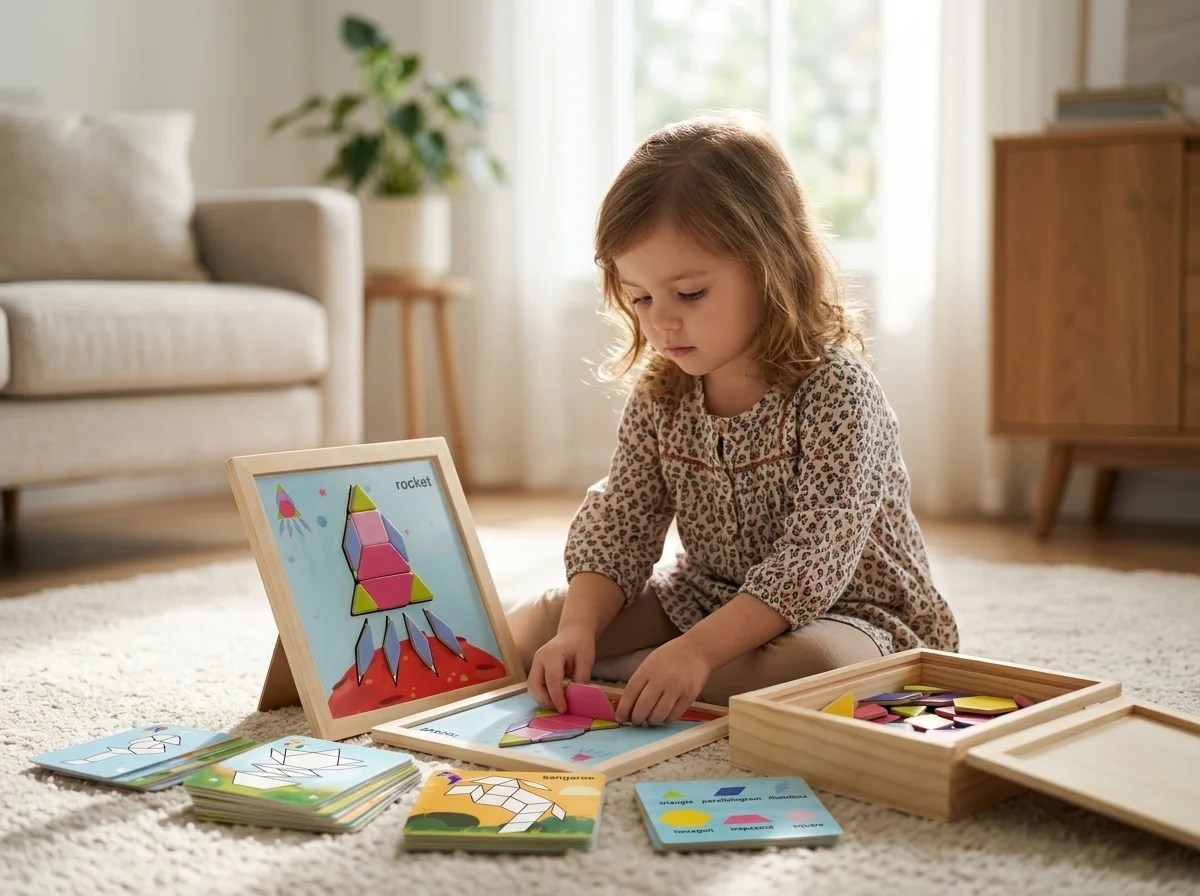
If you’ve got the Vindstier Magnetic Pattern Blocks Set in your playroom, you already have more than you think. This isn’t a one-trick toy. The 30 double-sided activity cards, EVA magnetic pieces, and 7×7 solid wood board were built with enough variation to run structured STEM sessions repeatedly — without repetition, without extra supplies, and without you needing to guide every step.
Here are five specific activities built around what this Magnetic Pattern Blocks Set actually contains.
What’s Inside the Magnetic Pattern Blocks Set Before You Start
Every activity below is tied directly to the physical design of this set. No modifications, no extras needed.
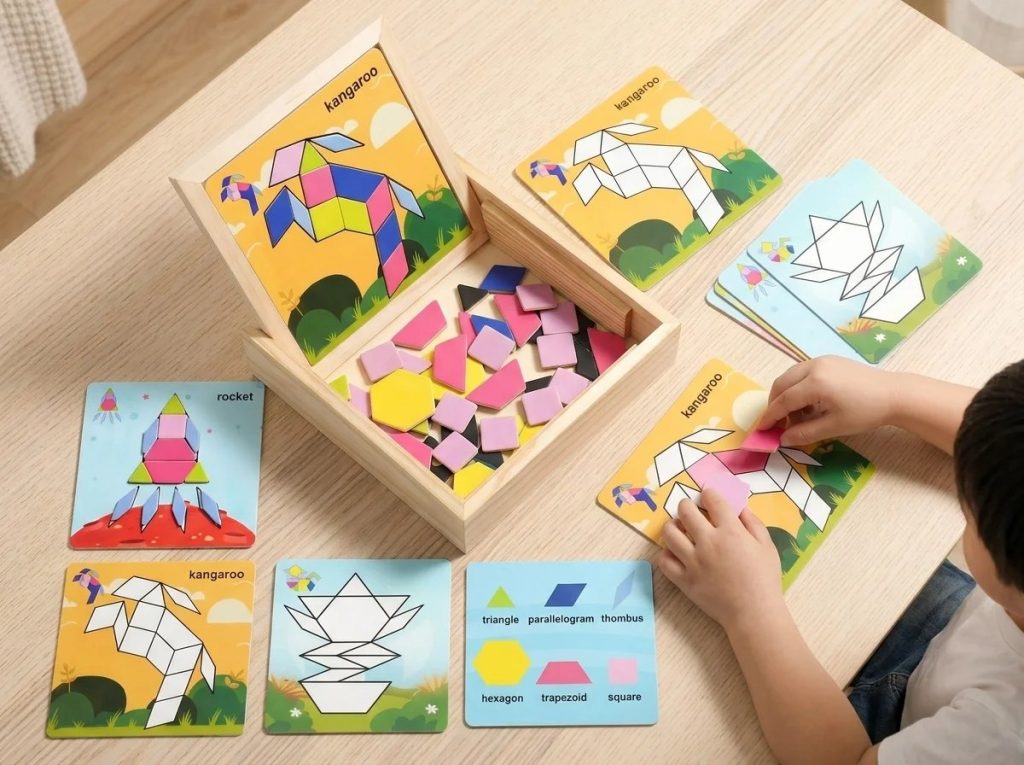
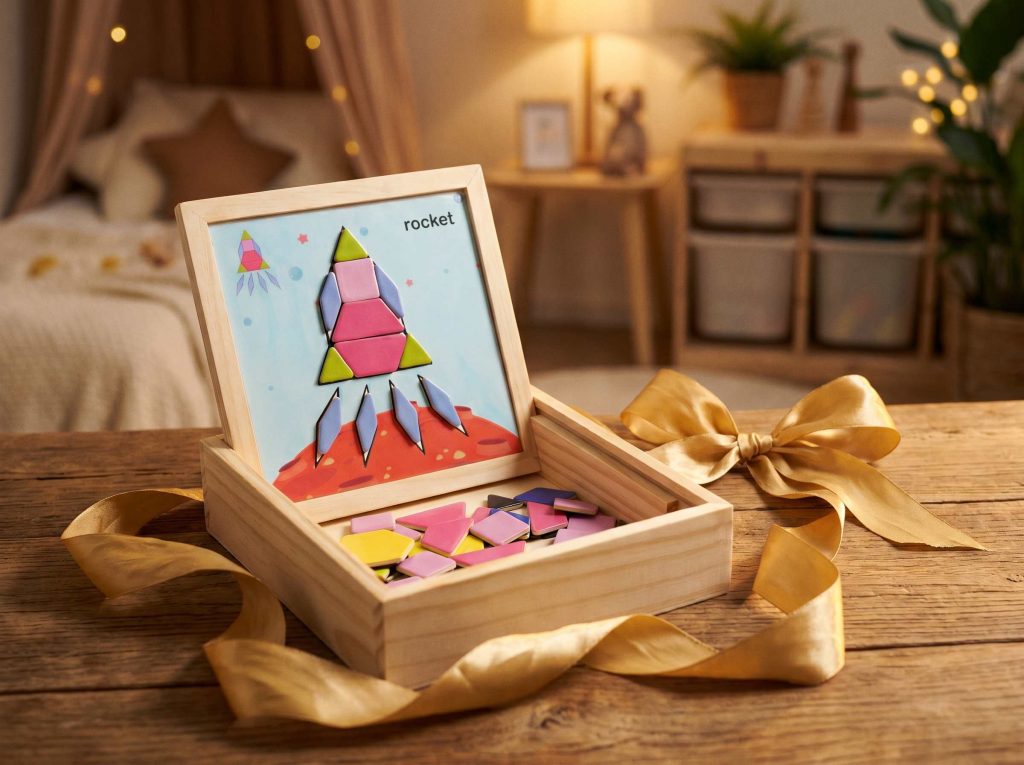
The Magnetic Pattern Blocks Set includes 30 double-sided activity cards — 60 guided configurations total — arranged from simple two-piece placements up to complex multi-shape compositions. The pieces are made from EVA soft-magnetic material, which means they adhere firmly to the included 7×7 inch solid wood board, and equally well to a refrigerator door, magnetic whiteboard, or any ferrous surface at home. The wood box serves double duty: puzzle platform during play, storage case when done.
That last detail matters more than it sounds. The reason many Montessori toys and open ended play toys fall out of rotation isn’t that children lose interest — it’s that pieces scatter, sessions end in frustration, and setup the next time feels like more effort than it’s worth. A self-contained box that doubles as the play surface removes that friction entirely.
Activity 1: Progressive Card Challenges — Working Through All 60 Configurations
Start with Card 1 and work forward. The child replicates each configuration on the wood board using the Magnetic Pattern Blocks Set pieces, then flips to the card’s reverse side for the next challenge.
The 60-configuration sequence is what separates this from a basic shape-matching activity. Early cards involve placing two or three pieces to form a recognizable outline. Later cards require the child to mentally rotate shapes, anticipate how a rhombus fits against a trapezoid, and self-correct when the arrangement doesn’t match. That progression — not the individual cards — is where the spatial reasoning development actually happens.
For parents keeping track: spatial reasoning at ages 3–8 is one of the strongest early predictors of mathematical ability. The card sequence in this Magnetic Pattern Blocks Set is calibrated to the shape recognition sensitive period, which peaks roughly between ages 3 and 6. A 4-year-old working through Card 10 is doing something developmentally meaningful, not just playing with developmental toys for children in the abstract sense.
Practical tip: don’t push through cards in a single session. Ten to fifteen minutes, a few cards, then stop. A simple tally sheet — 60 boxes, one per configuration — gives children a visible goal and turns this into a multi-week project that sustains itself.
Activity 2: Vertical Magnetic Play — Moving the Magnetic Pattern Blocks Set Off the Board
Place the pieces directly on the refrigerator door at the child’s eye level. Leave a partial configuration in the morning — five pieces arranged into an incomplete star, for instance — and let the child complete it before school.
This works specifically because the EVA soft-magnetic material in the Magnetic Pattern Blocks Set holds firmly on vertical ferrous surfaces without sliding. Many magnetic toy sets use weaker magnets that work fine flat but shift and drop when placed vertically. The adhesion strength here makes refrigerator-door play genuinely functional, not just theoretically possible.
The change in surface also changes the physical engagement. A child standing at the fridge is reaching, stepping back to assess, adjusting at arm’s length. The motor demands differ from tabletop play, and for children who struggle to sit still, the standing format naturally extends the session.
For classrooms: a magnetic whiteboard turns the Magnetic Pattern Blocks Set into a group configuration activity. One child places pieces while others call out adjustments. The EVA hold is firm enough that pieces stay put during the discussion — something flimsy magnetic sets simply can’t deliver.
Activity 3: Shape Vocabulary Sessions — Connecting Configurations to Language
Run each card challenge in two rounds.
Round one: the child completes the configuration on the wooden board, focusing entirely on spatial matching. No verbal component.
Round two: point to each piece in the finished arrangement and ask the child to name it. Hexagon, trapezoid, rhombus, equilateral triangle. If they don’t know, name it together, use it in a sentence, and move on.
The 30 activity cards in the Magnetic Pattern Blocks Set were designed to support this exact dual function — the configuration guides spatial reasoning, and shape vocabulary emerges naturally from completing the task. Children aren’t memorizing definitions in the abstract; they’re attaching words to objects they’ve just physically arranged.
By the time a child has worked through 20 or 25 cards this way, they’ll be using “rhombus” and “trapezoid” correctly in conversation — not because they drilled flashcards, but because the words came up repeatedly in a context where they were actually needed.
This matters for kindergarten readiness. Geometric vocabulary is assessed earlier than most parents expect, and dedicated practice through educational toys like this is far less common than it should be.
Activity 4: Open-Ended Scene Building — No Cards, No Prompt
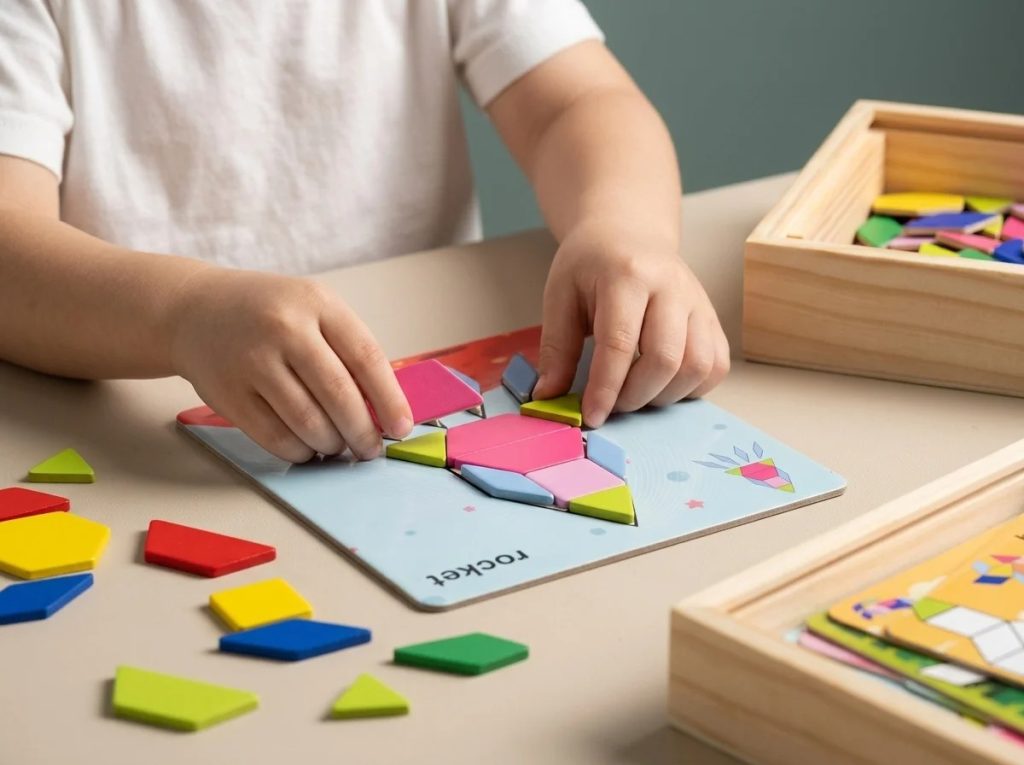
Set the activity cards aside. Place the Magnetic Pattern Blocks Set pieces on the 7×7 wood board and give one instruction: build something you saw today.
The pieces have real physical constraints — they’re flat, they have defined edges, and they either fit together or they don’t. Within those constraints, the child makes every decision. A child who passed a construction site might build something angular and structural. One who spent the afternoon outdoors might arrange shapes into something loosely natural.
What the wooden board does here is frame the composition. There’s a defined space, a physical boundary, and a clear moment of “finished” when the board fills up or the child decides it’s done. That 7×7 boundary — specific to this Magnetic Pattern Blocks Set rather than an open table surface — actually supports creative follow-through. Children are more likely to complete a composition when the space has a visible edge.
This type of bounded open ended play, where materials have real properties and outcomes aren’t predetermined, is where problem-solving habits form in children aged 3–5. The child learns that some configurations work and some don’t, and that adjusting and trying again is a normal part of the process — not a sign that something went wrong. It’s the kind of screen-free, hands-on engagement that sorting and stacking toys and wooden toys for toddlers aim for, but rarely sustain past the first week.
Activity 5: The 60-Configuration Challenge — A Multi-Week STEM Project
Create a tracking sheet: 60 numbered boxes on paper, or a tally on a small whiteboard. Each completed Magnetic Pattern Blocks Set configuration gets one mark. The goal is to fill all 60.
The mechanics are simple. The developmental logic is worth understanding.
Visible progress is one of the most reliable intrinsic motivators for young children. A partially filled tracking sheet gives a child a concrete reason to return without external prompting. The 60-configuration structure means there’s always a next step — never a finished-forever endpoint that kills engagement.
What the progression actually delivers: by configuration 30, the child is working with multi-piece arrangements that require genuine planning before placing the first piece. By configuration 50, they’re navigating spatial relationships that formal early childhood curricula don’t typically introduce until age 6 or 7. The card sequence does the curricular scaffolding; the child just follows the trail.
The 7×7 storage box keeps all Magnetic Pattern Blocks Set pieces and cards together between sessions. When the board is the box and everything lives inside it, the barrier to starting the next session is effectively zero — which is the practical reason multi-week projects actually get completed at home.
Using the Magnetic Pattern Blocks Set in Preschool and Home Classroom Settings
The five activities above are designed to work without adult facilitation after the first introduction. That’s intentional.
For preschool classrooms or home education environments, self-directed materials are the ones that actually get used consistently. A toy requiring teacher setup or ongoing guidance during each session competes with everything else an educator is managing. The card system in the Magnetic Pattern Blocks Set is explicit enough that a 4-year-old can find their last completed card and continue without asking for help.
The set is CPC certified — the Consumer Product Safety Improvement Act certification covering chemical content and physical safety for children’s products sold in U.S. markets, specifically for the labeled age group of 3 and above. In a classroom procurement context, that certification clears the standard approval hurdle. At home, it means the EVA pieces on the refrigerator door at 7 a.m. aren’t something to second-guess.
For home use, keeping the box accessible at the child’s level — rather than stored away — makes the biggest practical difference. Children aged 3–8 with consistent access to the Magnetic Pattern Blocks Set tend to return to it repeatedly across the week, especially when the 60-configuration tracker gives each session a built-in purpose.
Why the Magnetic Pattern Blocks Set Works from Age 3 Through Age 8
Most educational toys for 3 year olds have a realistic engagement window of about 18 months before the child outgrows them. The Magnetic Pattern Blocks Set was designed to span five years of development, and the reason it can is structural.
At age 3, the entry-level cards are accessible to children with normal fine motor development for their age. The EVA pieces are sized and weighted for small hands, and the magnetic hold gives satisfying tactile feedback without requiring force. Simple configurations build confidence quickly.
At age 6 or 7, the advanced configurations are genuinely challenging. The child is no longer matching outlines — they’re constructing arrangements from memory, predicting spatial relationships before placing pieces, and working through the geometric reasoning that appears in second-grade math.
At age 8, open-ended activities become more sophisticated. A child at this age might use the Magnetic Pattern Blocks Set pieces to represent abstract concepts — symmetry, fractions, pattern sequences — rather than concrete objects.
That five-year span is what makes this a different category of purchase from a standard stocking stuffer for 3+ years. A set delivering structured developmental value from preschool through early primary school sits in a different category from single-season toys — even eco-friendly wooden play sets that look similar on the shelf but lack the 60-configuration scaffolding to grow with the child.
Conclusion
The Magnetic Pattern Blocks Set works across five distinct activity formats because its core components — 60 guided configurations, strong EVA magnetic adhesion on any ferrous surface, and a wood board that doubles as a self-contained storage case — were built with enough depth to support repeated use across different play styles and developmental stages.
None of the activities here require additional materials or adult-led instruction after the initial setup. That’s the practical reality most parents and educators are actually looking for: a set of stem toys for preschoolers that holds up, stays organized, and earns its shelf space session after session.
If structured STEM play for the 3–8 window is what you’re after, the Magnetic Pattern Blocks Set is a specific tool designed for exactly that job.