
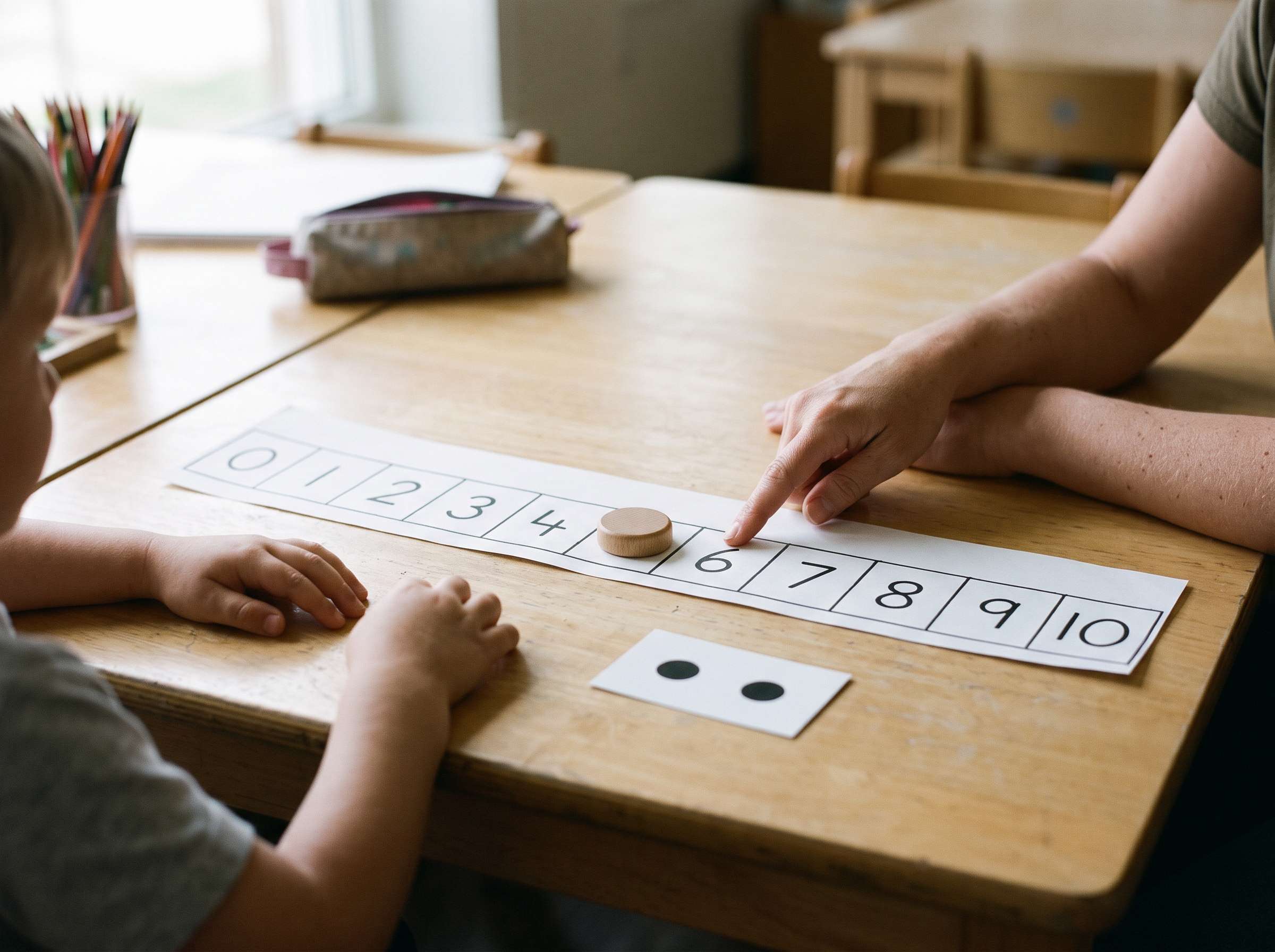
A child’s marker rests on 5. The move card shows two spaces, but the child says “five, six” and stops on 6. Counting on games can help make the distinction clear: the starting box is a position already reached, while each move enters a new box.
The child may be counting the occupied box as the first move. A short demonstration can make the difference visible: “You’re already on five. One move takes you to six. The next takes you to seven.”
Counting on means continuing the number sequence from a number already reached. In a number path game, children practice this by saying the numbers of the new boxes they enter, rather than restarting at one.
The activity below gives teachers a simple way to introduce that movement, observe children’s responses, and choose what to practice next.
Set Up a Simple Number Path
You will need:
- A straight path of equal-sized boxes numbered 0 through 10.
- One marker that fits comfortably inside a box.
- Move cards showing one, two, or three dots.
Keep the numerals readable and the direction of travel clear. The marker should leave enough of the numeral visible for the child to identify its position.
Before playing, check how the child interprets the dot cards. Name the amount when needed; learning to read the card can be a separate task from learning to count on.
NAEYC’s number path games guide presents its counting-on variation for children aged five and older. Use that as a reference alongside the child’s current counting experience and familiarity with moving pieces.

Model One Turn
Place the marker on 5 and show a two-dot card.
- Name the start: “We’re on five.”
- Name the amount: “We’ll move two spaces.”
- Move and count on: Move to 6, then 7, saying “six, seven” as the marker enters each box.
- Describe the result: “We started on five, moved two spaces, and landed on seven.”
Keep the card visible throughout the turn so the child can check the move amount.

Next, place the marker on 3 and show the same card. Ask, “Which box will you move into first?” Allow time for a response before prompting.
If the child indicates 3, point out that the marker is already there. Model leaving the starting box and entering 4. Then invite the child to finish the turn.
Turn the Routine Into a Game
Try a cooperative game called Get the Marker to 10.
Place the shared marker on 3. The teacher and child take turns choosing a face-down move card, moving the marker, and naming the landing number. The shared goal is to reach 10.
Offer cards showing one, two, or three moves. As the marker approaches 10, set out only cards that keep the move within the path. For example, from 8, offer one- and two-move cards.
On an adult turn, model counting on aloud. On the child’s turn, give them time to act before adding help. Invite the child to check the adult’s movement too: “I’m on six and moving two. Watch where I land.”
When the marker reaches 10, let the child choose a new starting position for another round.
Notice What Happens When a Turn Goes Wrong
An incorrect landing number does not tell you, by itself, which part was difficult. Watch the movement, listen to the number words, and note any help you supplied.
| What you notice | What to check next | A useful response |
|---|---|---|
| The child includes the occupied box as a move. | Can they identify the first new box? | Name the start, then model one move out of it. |
| The child says the correct number sequence but skips a box. | Can they coordinate one number word with each move? | Slow the turn down and pause in each new box. |
| The child moves correctly but says “one, two.” | Can they continue the sequence from the starting number? | Acknowledge the two moves, then model the numbers reached. |
| The child continues moving after the required amount. | Can they track how many moves are complete? | Point to one dot on the card for each move. |
| The child needs help naming the starting numeral. | Is numeral recognition adding difficulty? | Supply the starting number and record that support. |

Saying “one, two” can correctly count two moves. When counting on is the goal, connect those moves to the board’s numbers: “Yes, two moves. From five, we reached six, then seven.”
The IES Teaching Math to Young Children Toolkit distinguishes reciting number words from meaningful counting and emphasizes using children’s responses to guide instruction. That distinction makes observation more useful than simply marking a turn right or wrong.
Adjust One Part at a Time
Begin with the same move amount from different starting positions. For example, two moves from 3 reach 5, while two moves from 6 reach 8.
Once that is familiar, keep the start fixed and vary the amount. From 4, try one move, then two, then three.
If coordinating speech and movement is difficult, return to one-move turns. If the marker is hard to handle, try a larger path that the child can point along or step across.
A die can replace the prepared cards later. Reading its dots adds another demand, so introduce it when that fits your teaching goal. NRICH’s early-years dice activity offers related ideas for connecting dot quantities with collections and actions.
Keep a Short, Useful Record
A note such as “got to 7” leaves out how the child reached the answer. A more useful record is:
“Started on 4, moved three boxes, and said 5–6–7 after an adult model.”
For the next session, keep these three prompts nearby:
- First move: Did the child enter the next box?
- Words and movement: Did each spoken number match a newly reached position?
- Support: What did the child do independently, and what help was supplied?
Counting on games provide a focused opportunity to practice continuing from an existing number. Counting from one remains useful, and children still need opportunities to count whole collections.
Return to a familiar move amount and one fresh starting position. Observe the first move closely, then use the child’s response to decide what comes next.